


The train slid out of Okayama Station just after lunch, its windows framing a quick blur of apartment blocks before opening onto low suburbs and flat fields. Fifteen minutes later the local JR line deposited me at Kurashiki Station, a short hop geographically but a world away in atmosphere. I had an afternoon, an evening, and a list of places I wanted to see in the Kurashiki Bikan Historical Quarter: the willow-fringed canal, a traditional river punting tour, Japan’s first Western art museum, brick-red factory buildings swathed in ivy, and narrow streets lined with white-walled merchant houses, denim stores and canvas workshops.
From Okayama to Kurashiki: Arrival and First Impressions
Coming from Okayama, Kurashiki feels deceptively close. Local trains run frequently between Okayama and Kurashiki on the JR Sanyo Line, and the ride usually takes about 15 minutes once you are on board. I left Okayama Station in early afternoon, avoiding both the morning tour groups and the evening commuter rush, which turned out to be a good compromise: enough time to see the main sights before sunset, and a quieter canal district after dark.
Kurashiki Station itself is modern and practical, with a small but useful tourist information office upstairs in the north building and clear signs pointing toward the Bikan Historical Quarter. From the south exit, I followed the covered shopping arcade that runs roughly in the direction of the old town. The walk is around one kilometre and takes about 10 to 15 minutes at a relaxed pace, passing chain stores and cafes before the scenery begins to shift. Convenience stores give way to low, tiled roofs, latticed windows and the first hints of white plaster walls.
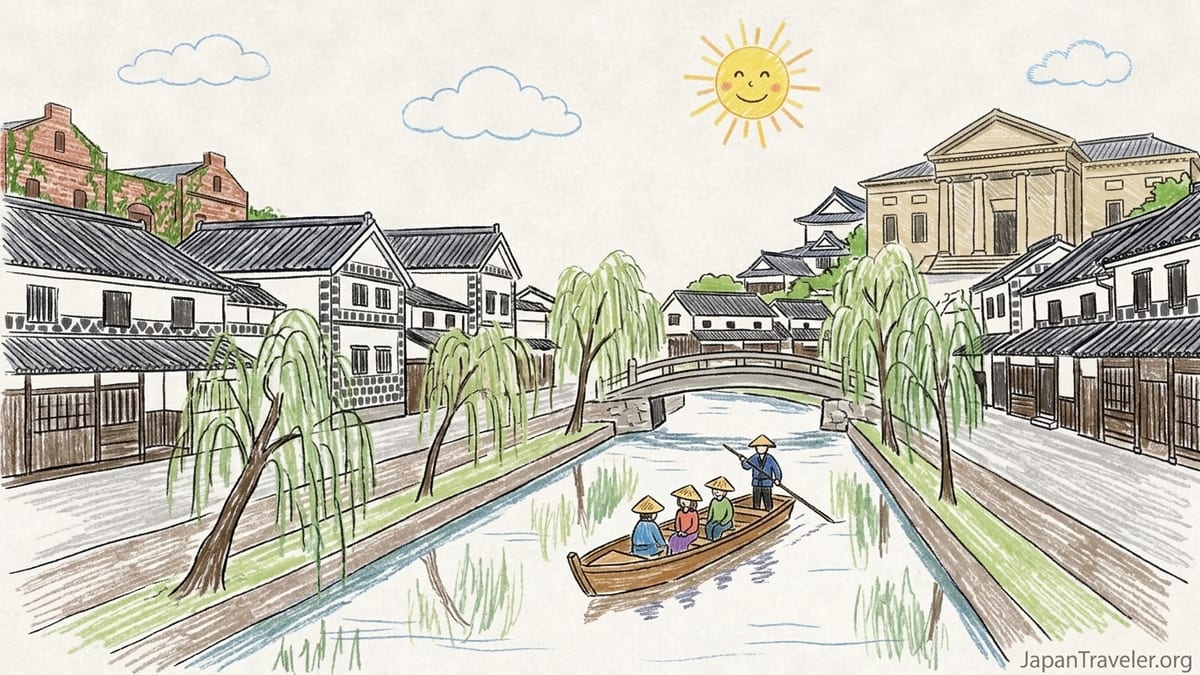
The transition into the Bikan Historical Quarter is gradual but unmistakable. Cars thin out, stone paving appears underfoot, and willows lean over the water of the Kurashiki River. My first proper view of the canal was framed by a stone bridge, with flat-bottomed boats drifting slowly beneath. After the practical bustle of Okayama, this quieter, human-scale streetscape made an immediate impression: merchant storehouses with black-and-white namako walls, tiled roofs, and the soft green curtain of willow branches reflecting in the canal.
By the time I reached the core of the quarter, around the Kurashikikan Tourist Information Center and the main canal bend, the day-trippers from larger tours were starting to thin out. It was still lively, but the mood felt more like a small town on a busy weekend than an overrun attraction. This timing would matter later when I compared the feel of the district in full afternoon light with its atmosphere after sunset.
Walking Route: From Kurashiki Station to Nakabashi Bridge and the Canal
For a first-time visitor, a simple walking route from Kurashiki Station helps turn the station forecourt into a gradual approach to the canal. Exiting the station’s south side, I crossed the plaza and entered the covered arcade known locally as Kurashiki Chuo-dori. This straight, mostly pedestrian-friendly street heads toward the historic area and is lined with everyday shops that remind you Kurashiki is a lived-in city, not an open-air museum.
After about ten minutes, I followed signs toward the Bikan Historical Quarter and soon stepped into a narrower lane with traditional buildings. The soundscape shifted: fewer cars, more bicycle bells and the low chatter of visitors. Another few minutes brought me to the stone-paved canal bank and one of its most photographed points, Nakabashi Bridge, the pale stone span arching gently over the Kurashiki River.
Nakabashi Bridge is both orientation point and viewpoint. From its center, looking one way, I could see willow trees drooping over the water, flat-bottomed boats queuing near the boarding point, and the facade of the Ohara Museum of Art beyond the opposite bank. Looking the other way, the canal narrowed slightly and curved between rows of white-walled kura storehouses and machiya-style townhouses. It was here that the historical and artistic significance of Kurashiki became visible in one frame: Edo-period wealth built on rice and cotton trade, Meiji-era industrialization, and early 20th-century philanthropy that would later produce the Ohara Museum.
From Nakabashi Bridge I turned along the canal walk, passing small cafes, folk craft shops and kimono rental outlets that offered visitors the chance to dress in traditional attire for photographs among the willow trees. Because my goal was to get on the water before crowds built up again, I continued along the canal to the Kurashikikan Tourist Information Center, the main ticket office for the river punting experience.
Booking the Kurashiki River Punting Experience
Kurashiki’s canal boat ride, known locally as the Kurashiki River Boat Tour or Kurashiki Kawabune Nagashi, departs from a small landing near the main canal bend, with tickets sold at the nearby Kurashikikan Tourist Information Center. Official information from the city and regional tourism sites explains that boats usually operate from around 9:30 in the morning to late afternoon, roughly every 30 minutes, with a short break at midday and occasional cancellations in poor weather.
When I visited in October 2026, a small but important change had just come into effect: the standard adult fare, which had long been listed as 700 yen in older English brochures and many pre-2026 guidebooks, had increased to 1,000 yen per adult from 1 October 2026. Children between about five years old and elementary school age were priced at 500 yen. Many online resources had not yet caught up with this adjustment, which meant some visitors in line sounded surprised when they reached the counter. The staff had a clear price board, but it is worth arriving prepared for the updated cost.
Tickets were sold for specific time slots on a first-come, first-served basis. At the Kurashikikan counter I asked for the next available departure for one adult, and the staff member pointed to a schedule board with the next few departures marked. On a clear weekday afternoon, I waited about 25 minutes between purchasing my ticket and boarding, which aligned with the widely quoted 20-minute interval between runs. On busier weekends and holidays, anecdotal reports and local guides suggest waits of an hour or more can occur, especially in mid-afternoon, so arriving by late morning or right after lunch is a good strategy if the boat ride is a priority.
As of autumn 2026, the main system for individual visitors remained same-day, in-person ticket purchase at the Kurashikikan center, though local authorities have announced limited web reservations for some boats from fiscal year 2026 onward. That online access is being introduced gradually and covers only part of the day’s services, so it is safest to plan on buying tickets on site. If boats are sold out for the next couple of hours when you arrive, staff will typically suggest walking the district, visiting a museum such as the Ohara Museum of Art, or exploring Kurashiki Ivy Square before returning in time for your allocated slot.
On the Water: Waiting, Boarding and the 20-Minute Canal Ride
Tickets in hand, I joined a small group at the designated waiting area by the canal. Groups are typically organized by time slot, with staff calling out the departure time and collecting tickets just before boarding. Each boat is a long, narrow wooden craft that holds around six passengers, plus the boatman who stands at the stern wielding a long pole. Life jackets are provided, and you sit low to the waterline on simple plank seats.
Boarding requires a short step down into the boat, so passengers with mobility issues may want to ask staff in advance whether assistance is available or if seats nearer the center feel more stable. Once everyone was seated and the boat balanced, our boatman pushed off from the bank and the quiet of the canal immediately stood out. Even with other boats and tourists around, the motion of the pole in the water and the soft scrape of wood against stone walls created a slower, almost meditative pace.
The ride itself lasts around 20 minutes, confirmed both by official descriptions and by my own watch. For the new adult fare of 1,000 yen, that works out to a short but dense experience. As we glided under the low bridges, including the photogenic Nakabashi, the boatman provided a commentary in Japanese, occasionally pointing out key landmarks: the white storehouses that once held rice and cotton when Kurashiki was a major distribution hub, the facades preserved from the Edo period, and the Western-style stone building of the Ohara Museum, whose founder collected European modern art when few in Japan were doing so.
Even without full comprehension of every detail, the explanations gave a sense of how the city’s economic history shaped its architecture. From the canal, I could see how the backs of many buildings faced the water, with discreet warehouse doors and mooring points revealing that this waterway was once a working canal rather than a purely decorative feature. We passed beneath branches of willow trees that brushed the water, offering natural shade, and the reflection of the white walls in the canal created views that felt distinct from anything visible at street level.
Was it worth the updated 1,000 yen ticket? In my view, yes, provided you are prepared for the short duration. The experience is more than just a photo opportunity; it is a slow, historically grounded circuit through the heart of the district. Seats did not require advance planning on a midweek October day, but in busier seasons such as Golden Week or school holidays, arriving early in the day and building flexibility into your schedule seems wise. If boats are sold out for the near term when you arrive, consider using that time for a museum visit or a coffee break, then returning just before your departure window.
Museums and Brick Walls: Ohara Museum of Art and Kurashiki Ivy Square
After stepping back onto the canal bank, I turned my attention to Kurashiki’s cultural anchor: the Ohara Museum of Art. Located just a short walk from the canal, facing a small plaza, the museum’s main building resembles a neoclassical Western institution with its columned portico and stone steps. Founded in 1930 by local industrialist Ohara Magosaburo, it holds a notable collection of Western art, including works by Monet and other Impressionists, as well as modern Japanese art and craft pieces displayed across several annexes.
Current visitor information indicates that the museum is generally open during standard daytime hours, with specific closing days and special exhibition schedules listed on its official calendar. Adult admission has risen steadily in recent years, and by 2026 the main ticket price for adults is around 2,000 yen, with discounts for students and children. For some visitors, especially those used to free or subsidized public museums, this may feel high relative to the museum’s modest physical size. Yet for travelers interested in art history, particularly the story of how Western modern art was introduced to Japan, the Ohara collection has a unique position: it was the country’s first private museum devoted to Western painting and sculpture and remains an unexpected discovery in a mid-sized regional city.
After an hour browsing the main galleries and the craft-focused annex, I walked west toward Kurashiki Ivy Square, another key stop that reflects the city’s industrial heritage. Ivy Square occupies the brick buildings of a former spinning mill, now converted into a complex that includes a hotel, restaurants, event spaces and small shops. Climbers cover many of the red-brick walls, softening their industrial lines and creating a more romantic backdrop.
In and around Ivy Square, I found several shops selling Kurashiki’s signature textiles. One, Kurashiki Hampu, specializes in sturdy canvas bags, pouches and accessories produced from canvas woven in local factories that have been operating since the Taisho period. Another shop focused on Japanese denim, a regional specialty with links to nearby Kojima, often considered one of the birthplaces of Japanese jeans production. Browsing these stores offered a clear, tangible connection between the city’s merchant past and its current creative identity; canvas and denim feel like contemporary expressions of the cotton trade that once made Kurashiki wealthy.
Old Merchant Streets, Crafts, Denim and Sweets
Between the canal and Ivy Square lies a network of streets such as Honmachi and Higashimachi, where the townscape of white-walled storehouses, narrow facades and tiled roofs is particularly well preserved. Walking these streets in mid-afternoon, I encountered a mix of visitors: small photography groups staging shots under the eaves, couples in rental kimono pausing by old doorways, and tour leaders pointing out architectural details like latticework and namako tile patterns. At times, especially near the central canal bend, the concentration of tripods and posed photos did make the area feel more like a backdrop than a living neighborhood.
However, stepping a block or two away from the main canal quickly changed the atmosphere. In quieter side streets, I wandered past local homes and smaller craft workshops with little signage in English. One canvas shop displayed bolts of heavy Kurashiki canvas and bags in muted earth tones, while another tiny gallery sold ceramics and Bizen-style pottery from the broader Okayama region. Inside one store, I bought a small, olive-green canvas shoulder bag, priced around 6,000 yen, which felt like a practical souvenir directly tied to the area’s textile heritage.
For Japanese denim, several shops along the main approach to Ivy Square and in back streets toward Honmachi carried jeans, jackets and smaller items such as coin cases and tote bags. Many highlighted their links to Kojima and Okayama denim, emphasizing selvedge fabrics, natural indigo and small-batch production. While premium jeans can easily exceed 20,000 yen per pair, there were also more modestly priced items like denim pouches or caps that made sense for travelers with limited luggage space.
Kurashiki’s sweet offerings added another local layer. Traditional confectionery shops close to the canal sold mamegashi (sugar-coated beans), yokan, and delicate monaka wafers filled with sweet bean paste. In one family-run shop, I purchased a small box of bite-sized sweets for about 800 yen and enjoyed a couple on a bench by the canal. Unlike some souvenir districts where shops converge on the same handful of mass-produced trinkets, Kurashiki’s focus on regionally rooted crafts and foods gave many stores a distinctive feel, even if a few did fall into the familiar pattern of generic key chains and printed towels.
Crowds, Atmosphere and Kimono Experiences
Because Kurashiki has become a staple side trip from Okayama and Hiroshima, it is reasonable to expect crowds during peak travel seasons, especially on weekends and holidays. On my October weekday visit, the busiest time was between about 2 pm and 4 pm, when several photography groups appeared near Nakabashi Bridge and queues formed outside the most popular dessert cafes. Tripods and coordinated outfits were common sights, particularly around the willows and canal where reflection shots are popular on social media.
Kimono rental studios have also become part of the local scene, offering packages that include dressing, hairstyling and a few hours of walking the quarter in traditional attire. Prices typically range from the low to mid-thousands of yen depending on the quality of the garments and extras. Watching couples in kimono strolling down the canal did enhance the historical ambience to some extent, although a few staged photoshoots verged on performance rather than quiet appreciation. For visitors interested in experiencing kimono respectfully, booking a rental earlier in the day and avoiding the narrowest peak hours may allow for more relaxed wandering and better photos.
Despite these modern trimmings, Kurashiki’s core character remained intact. The scale of the buildings, the low canal walls and the older shopfronts all help limit the visual intrusion of contemporary signage. Unlike some heavily commercialized old towns, the majority of storefronts here still relate to crafts, cafes or small galleries instead of large chain souvenir outlets. The effect is of a working heritage district that hosts tourism rather than a stage set built solely for it.
For those particularly sensitive to crowds, planning the main canal and boat activities for early morning or just after lunch, then shifting to side streets and museums in mid-afternoon, can keep the experience pleasant. As I would discover later, the district’s character also changes markedly once the day-trippers head back to their trains and buses.
Kurashiki After Dark: Canal Walks and Seasonal Night Boat Rides
By early evening, shortly after 6 pm on my autumn visit, the Bikan Historical Quarter had begun to exhale. Groups clustered around tour buses near the edges of the district, but within the core canal area, the number of people dropped significantly. Many museums and smaller shops had closed, yet a handful of cafes, restaurants and bars remained open, casting warm light onto the streets.
Walking the same route I had followed hours earlier, from Nakabashi Bridge past the boat landing and along the canal, I noticed how different the architecture felt under low lighting. Lantern-style street lamps picked out the white walls and tiled roofs, while the willows became silhouettes against the reflections in the water. Without the daytime chatter and camera shutter sounds, the quarter felt closer to the historical atmosphere its buildings suggest. A couple of photographers with tripods were still about, but they worked quietly, aiming to capture the reflections on the dark canal.
In October and November, Kurashiki sometimes runs limited nighttime versions of the canal boat ride on selected Saturdays, branded as an evening or night riverboat event. Local tourism authorities clearly describe these as seasonal, special operations rather than a year-round service, with specific dates and departure times announced in advance. During my visit, the night rides were scheduled only on a few weekends and were not operating on the weekday evening I stayed. These special departures use softly lit boats and create a more atmospheric glide along the canal, but they should be treated as a bonus opportunity if your timing aligns, not something to depend on when planning an itinerary.
Even without boarding a boat after dark, simply walking the canal in the evening was one of the highlights of my day in Kurashiki. The absence of large tour groups and school excursions changed the rhythm of the streets; locals walking dogs or heading home from work appeared, and the acoustic footprint shrank to footsteps on stone and the occasional clink of plates from a restaurant. For travelers debating whether to stay the night, this quieter, more intimate version of the Bikan Historical Quarter is a strong argument in favor.
Favorite Spots, What I Would Skip, and Day Trip vs Overnight
After a full afternoon and evening in Kurashiki, a few places stood out enough that I would structure a return visit around them. The short canal circuit near Nakabashi Bridge remains the heart of the experience, especially when seen from the boat and then again on foot at dusk. Among the streets, Honmachi was my personal favorite: a gently curving road lined with well-preserved merchant houses, small galleries and craft shops, where foot traffic was lighter than directly along the canal yet the historical character remained strong.
In terms of paid attractions, the canal boat ride justified both its time and its updated 1,000 yen fare. The 20 minutes on the water offered a concentrated view of Kurashiki’s architectural layers and a sense of how the canal originally functioned in the city’s life. The Ohara Museum of Art was also worthwhile, though travelers less interested in Western art history might prefer to allocate that budget to additional local crafts or a more elaborate meal. Ivy Square, while visually appealing and historically interesting as a former spinning mill, can feel more like a pleasant backdrop and shopping area than an essential stop; if your time is limited to just a few hours, focusing on the canal, boat ride and old streets would still deliver a rewarding visit.
What would I skip next time? I would spend less time in the busiest souvenir corridors closest to the main canal bend, where some shops lean toward generic sweets and trinkets that could be found in many Japanese tourist towns. Instead, I would head more quickly to smaller workshops and stores that specialize in Kurashiki canvas, Japanese denim, stationery or ceramics, where the products reflect local skills and materials. I would also allow more structured time for a café stop in a converted kura, which I only managed spontaneously on this visit.
As for the question of whether Kurashiki is best as a day trip from Okayama or deserves an overnight stay, the answer depends on your priorities. Logistically, it is very easy to visit on a half-day or full-day trip: frequent 15-minute train connections, manageable walking distances, and a compact historic core make it simple to leave Okayama after breakfast and be back by evening. However, what I valued most about Kurashiki emerged after 6 pm, when the quarter quieted and the canal-side lights reflected softly in the water. If your broader itinerary can spare the time and budget, staying one night in a small hotel or ryokan within walking distance of the Bikan Historical Quarter allows you to see both the lively daytime and the calmer night-time faces of the district, and to enjoy an unhurried morning wander before new visitors arrive.
FAQ
Q1. How do I get from Okayama to the Kurashiki Bikan Historical Quarter?
From Okayama Station, take a JR Sanyo Line local train to Kurashiki Station, which usually takes about 15 minutes. From Kurashiki Station’s south exit, walk roughly 10 to 15 minutes through the shopping arcade and follow signs toward the Bikan Historical Quarter until you reach the canal and Nakabashi Bridge.
Q2. Where do I buy tickets for the Kurashiki canal boat ride and how much does it cost now?
Tickets for the Kurashiki River Boat Tour are sold at the Kurashikikan Tourist Information Center near the main canal bend. As of 1 October 2026, the standard adult fare is 1,000 yen and children from about five years old to elementary school age pay 500 yen. Older guidebooks that still list 700 yen for adults are out of date.
Q3. Do I need a reservation for the Kurashiki canal boat and what happens if it is sold out?
Most individual travelers buy same-day tickets in person at the Kurashikikan counter, and boats usually depart every 30 minutes. Some limited online reservations are being introduced for certain time slots, but the system is still partial. If boats are sold out when you arrive, staff will offer tickets for a later departure; you can use the waiting time to visit nearby sights such as the Ohara Museum of Art or Kurashiki Ivy Square.
Q4. How long does the canal boat ride last, and is it worth the updated price?
The boat ride lasts around 20 minutes and follows a loop through the central part of the canal, passing under bridges and along historic storehouses. Even at the updated 1,000 yen adult fare, many visitors find it worthwhile because it offers a distinct perspective on the district’s architecture and history that you do not get from the banks alone.
Q5. What are the must-see sights in the Kurashiki Bikan Historical Quarter?
Key highlights include the willow-lined canal and Nakabashi Bridge, the Kurashiki River Boat Tour, the Ohara Museum of Art with its collection of Western and Japanese works, the converted factory complex of Kurashiki Ivy Square, and the old merchant streets such as Honmachi and Higashimachi, where traditional buildings and craft shops are concentrated.
Q6. Where can I buy local products like Kurashiki canvas, denim and sweets?
Look for Kurashiki canvas shops in and around Ivy Square and the old streets, where you will find sturdy bags and accessories made from locally woven canvas. Several boutiques in the quarter sell Japanese denim linked to nearby Kojima, and traditional confectionery shops near the canal offer regional sweets such as mamegashi, yokan and monaka that work well as edible souvenirs.
Q7. How crowded does the historic area get, and when is the best time to visit?
The Bikan Historical Quarter can become busy between early afternoon and late afternoon, especially on weekends, holidays and during school trips, when photography groups and tour parties cluster near the canal. Visiting early in the morning, just after lunch, or staying into the evening helps you experience the streets with fewer crowds and a calmer atmosphere.
Q8. Are there nighttime canal boat rides in Kurashiki?
Kurashiki sometimes offers special nighttime canal boat rides on selected Saturdays in October and November, but these are limited, seasonal events rather than a permanent service. Schedules and availability change each year, so they should be seen as a bonus if your travel dates coincide rather than a guaranteed part of the visit.
Q9. Does Kurashiki work better as a day trip from Okayama or an overnight stay?
Kurashiki is very workable as a day trip due to the short train ride and compact historical area; many travelers comfortably see the main sights in a long afternoon. Staying overnight, however, lets you enjoy the canal and old streets after most visitors have left and allows for a quieter morning stroll, which can significantly change the feel of the place.
Q10. What should I prioritize if I only have a half day in Kurashiki?
With limited time, focus on walking from Kurashiki Station to the canal, crossing Nakabashi Bridge, taking the canal boat ride if tickets are available, and exploring the streets immediately around the canal and Honmachi. If time and budget permit, add either the Ohara Museum of Art for culture or a quick visit to Ivy Square for its brick architecture and textile-related shops.