


Naoshima has grown from a quiet island in the Seto Inland Sea into one of the world’s best known contemporary art destinations. In 2026, the opening of the Naoshima New Museum of Art, updated exhibitions and evolving ticket systems mean that many older guides are now out of date. This practical, up to date guide explains how to see Naoshima’s headline museums, outdoor installations and architecture efficiently, what to book in advance, how to move around the island and how much an art focused visit really costs.
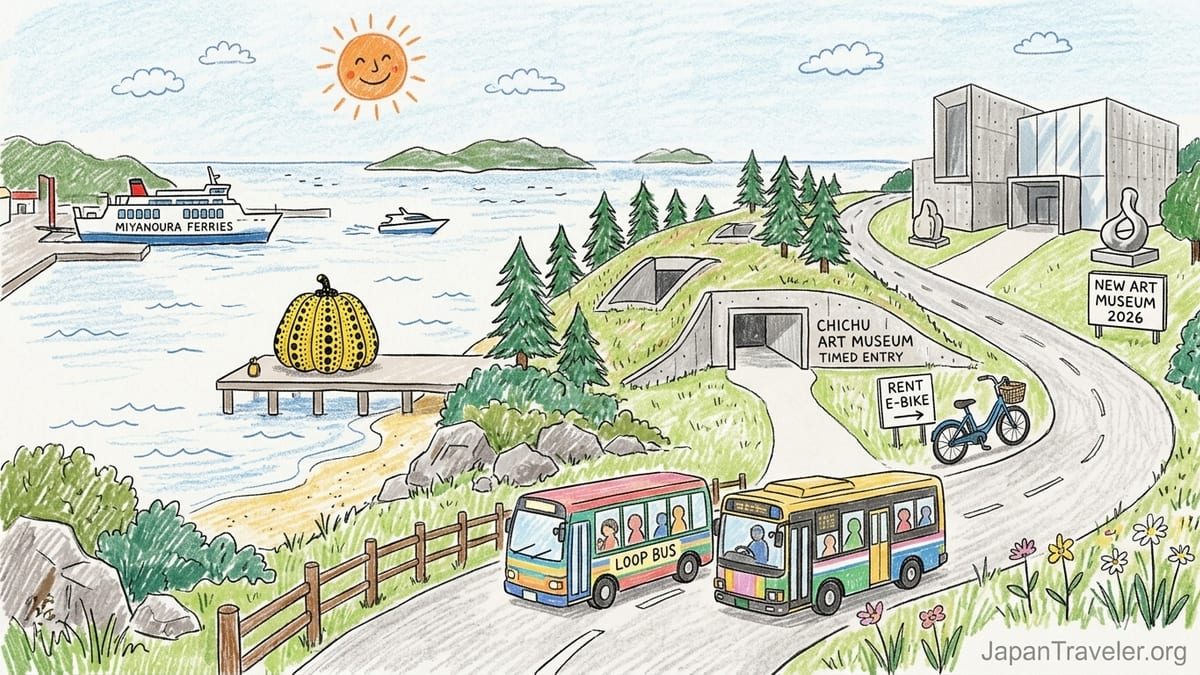
Naoshima in 2026: What Has Changed and Why It Matters
Naoshima’s reputation has long rested on a handful of iconic names: Chichu Art Museum, Benesse House, Yayoi Kusama’s pumpkins and Tadao Ando’s concrete architecture integrated with the island’s landscape. In 2026, the picture has become more complex. The Naoshima New Museum of Art has added a major new indoor venue, Chichu has refined its timed entry system and Benesse House and Lee Ufan Museum remain central, while the Art House Project, ANDO MUSEUM and Hiroshi Sugimoto Gallery deepen the experience in Honmura village. For travelers, this means more to see, but also more planning.
Most museums are clustered in two areas. Around the Benesse House zone in the island’s south you will find Chichu Art Museum, Benesse House Museum, Lee Ufan Museum, the Naoshima New Museum of Art and outdoor works including Kusama’s famous pumpkins. Around Honmura on the east side are the Art House Project installations, ANDO MUSEUM and Hiroshi Sugimoto Gallery. Ferries arrive at either Miyanoura Port on the west side or Honmura Port on the east, and a simple loop bus connects the ports with the museum areas, but departures thin out in the late afternoon.
The new museum and stricter timed ticketing mean that a spontaneous, unplanned Naoshima day is now much harder, especially between March and November and on Japanese holiday weekends. You can still enjoy outdoor works and some village installations for free, but the most sought after spaces tend to sell out in advance. Older itineraries that treated Chichu tickets as optional or assumed you could wander between indoor venues in any order no longer match reality.
At the same time, the island remains small and manageable. Travel writers and recent visitors still report that a well planned one day trip from Okayama or Takamatsu is possible, but a one night stay allows you to see more calmly, especially if you want to include sunset at Chichu, a late evening stroll among outdoor works near Benesse House or a second morning in Honmura.
Reserved Museums vs Outdoor Art: Tickets, Light and Photography
Naoshima’s art experiences fall into two broad categories. The first are reserved entry museums such as Chichu Art Museum and, increasingly, the Naoshima New Museum of Art, where visitor numbers are controlled and timed tickets are required or strongly recommended. The second are general access outdoor artworks and some village installations, which can be visited freely without advance booking and often at any hour of daylight.
Chichu Art Museum is the clearest example of the reserved model. Built largely underground by Tadao Ando, it houses works by Claude Monet, James Turrell and Walter De Maria. Entry is sold in timed slots, and in 2026 the standard online price is 2,500 yen on weekdays and 2,700 yen on weekends and holidays. Same day tickets on site cost a little more, and popular days often sell out in advance, especially in October and November when international tourism is strong. Visitors are asked to arrive during their chosen 30 minute window, and queues can form at peak times, so a punctual approach is important.
Reserved entry also comes with tighter photography rules. Inside Chichu, photography is prohibited in most spaces, including the Monet room and Turrell installations, to preserve the calm, contemplative atmosphere and protect delicate works. In some outdoor courtyards and entrance areas, photos may be permitted, but you should always follow staff instructions. By contrast, outdoor works near Benesse House, including Kusama’s Yellow Pumpkin on the pier and many sculptures around the lawns and shoreline, are free to view and generally open to photography, provided you respect barriers and do not climb on works.
Natural light is central to several of Naoshima’s most famous installations. At Chichu, the Monet room uses filtered natural daylight from overhead, which changes subtly with time of day and weather. James Turrell’s Open Sky work, accessible during museum opening hours, is particularly dramatic near sunset when the shifting sky color contrasts with the architectural frame. Similarly, in the Art House Project, works such as Minamidera’s light installation rely on complete darkness and choreographed illumination. This interplay of art and natural conditions is a key reason to plan specific time slots rather than simply “dropping by” each museum in random order.
Key Museums: What Distinguishes Each Space
Chichu Art Museum is often the single reason travelers make the journey to Naoshima. Its buried concrete structure, minimal signage and carefully controlled visitor flow create a contemplative atmosphere closer to a pilgrimage site than a conventional museum. The permanent collection is small but extremely focused. Monet’s Water Lilies series is displayed in a custom designed room where visitors remove their shoes, while Turrell’s light pieces and De Maria’s large spherical installation depend on precise architectural framing and natural light. Expect to spend around 60 to 90 minutes inside, longer if you linger at the café terrace overlooking the Seto Inland Sea.
Benesse House Museum combines a contemporary art museum with a hotel. The museum portion includes changing exhibitions and permanent works by both Japanese and international artists, installed not only in galleries but also along corridors, staircases and outdoor terraces. Some rooms are open to the public, while additional works are accessible only to overnight guests. As of 2026, online museum admission is commonly listed around 1,300 yen with a slightly higher on site price, and is free for hotel guests and children 15 and under. The atmosphere is more informal than Chichu, with visitors roaming between indoor galleries and seaside lawns where sculptures by artists such as Niki de Saint Phalle and George Rickey stand against sea views.
Lee Ufan Museum, a collaboration between the Korean artist and Tadao Ando, is smaller and quieter. It focuses on sparse, meditative works that combine stone, steel and blank space, extending the Mono-ha tradition. The building uses long, low concrete volumes and gardens that encourage slow, reflective walking. Tickets are typically bought separately from Benesse House and Chichu, and the museum keeps similar daytime opening hours. Travelers who enjoy minimalism and conceptual art often rate Lee Ufan as a highlight; others may find it best appreciated after seeing Chichu and Benesse House first.
The Naoshima New Museum of Art, which opened in the mid 2020s, is the newest major addition. In 2026 it charges 1,500 yen for online tickets, with on site prices subject to change. A significant operational detail is its scheduled maintenance closure from 24 November to 12 December 2026, a window that falls during a period when many international travelers visit Japan. The museum expands Naoshima’s capacity for temporary exhibitions and new commissions, which means that older one day itineraries that aimed to see “all the main museums” now need more time or sharper choices. For example, a traveler who once fit Chichu, Benesse House and the Art House Project into a single day now faces an extra major indoor venue that easily absorbs another 60 to 90 minutes.
In Honmura, the ANDO MUSEUM summarizes Tadao Ando’s Naoshima projects inside a traditional wooden house that has been hollowed out and rebuilt with concrete forms. Small in scale but dense with models, photographs and drawings, it helps first time visitors understand how Naoshima’s art sites evolved. Nearby, the Art House Project transforms old village homes and a temple into artworks by different artists. Each house has its own admission rules; in recent years, a combined ticket for several houses such as Minamidera, Haisha and Kadoya has been common, with limited timed slots for spaces that can only hold a few people at once. The Hiroshi Sugimoto Gallery adds another strand, presenting the photographer and architect’s work in a space that complements his minimal, often monochrome aesthetic.
What Is Free and What Requires Paid Admission
Costs on Naoshima add up quickly, so it helps to distinguish between free and ticketed experiences. Outdoor works in the Benesse House area, including many seafront sculptures and Yayoi Kusama’s Yellow Pumpkin, are free to view. You can walk from Tsutsujiso bus stop toward Benesse House and encounter large scale works scattered along the shore and in grassy clearings without passing through a ticket gate. This is particularly appealing for budget travelers or those arriving late in the afternoon after indoor museums have closed.
However, most indoor museums require paid admission, and there is no single all inclusive pass. In 2026, a traveler who books online might expect to pay 2,500 to 2,700 yen for Chichu depending on the day, around 1,300 to 1,500 yen for Benesse House Museum, a similar range for Lee Ufan Museum, 1,500 yen for the Naoshima New Museum of Art, and separate fees for the Art House Project, ANDO MUSEUM and Hiroshi Sugimoto Gallery. Even without souvenirs or café stops, a full set of major venues can easily reach or exceed 8,000 yen per person.
The Art House Project area is partly walkable without tickets. You can wander Honmura’s narrow streets, see the exteriors of houses, visit small local shrines and cafés and enjoy the atmosphere of a lived in village for free. But entry into individual houses such as Minamidera, where visitors experience a timed light piece, requires a paid ticket, sometimes in the form of a multi house pass available from a central ticket office. ANDO MUSEUM and Hiroshi Sugimoto Gallery use separate admission systems, so even a focused Honmura morning can involve three or four small entry fees.
Photography rules also divide free and paid areas. On public streets, at Miyanoura Port and around many outdoor artworks, photography is relaxed, and Kusama’s pumpkins in particular have become popular backdrops for visitors’ portraits. Inside reserved entry museums, restrictions are strict. Chichu bans photography in key galleries. Benesse House and Lee Ufan Museum often allow photos only in limited zones, and staff will remind guests who raise phones or cameras near sensitive works. Travelers should prepare to experience some of Naoshima’s most famous spaces entirely without taking pictures and focus instead on careful looking.
Getting There and Around: Miyanoura vs Honmura, Buses and Bicycles
Most visitors reach Naoshima either by ferry from Uno Port in Okayama Prefecture or from Takamatsu Port in Kagawa Prefecture. Crossings from Uno to Miyanoura typically take around 20 minutes on regular ferries, while boats from Takamatsu to Naoshima can take around 50 minutes on the standard ferry or under half an hour on high speed services when they run. Up to date timetables are published by ferry operators and local tourism offices, and recent visitors report that frequencies are reasonable during the day but thin out in the early evening, especially on weekdays.
Miyanoura Port on the west side is the main gateway, with more frequent ferries and simple bus connections. The Naoshima town loop bus runs from Miyanoura through Honmura to the Tsutsujiso stop near the Benesse House area. Buses are inexpensive, often around 100 yen per ride, but they are relatively small and can be crowded right after a big ferry arrives. Service generally starts in the early morning and winds down in the early evening, which makes it important to check when your last bus back from Tsutsujiso to Miyanoura leaves if you plan to catch a specific return ferry.
Honmura Port, on the east side, is served by some ferries, including services that link Naoshima with Teshima and Takamatsu. Arriving at Honmura can make sense if your first priority is the Art House Project, ANDO MUSEUM or Hiroshi Sugimoto Gallery, since the village is directly inland from the small harbor. Travelers who base themselves in Okayama often prefer Miyanoura via Uno because the ferry terminal there is a short walk from Uno Station, which has frequent trains to Okayama on the Uno Line.
Once on the island, travelers typically combine buses, rental bicycles and walking. Bicycle rental shops operate near Miyanoura and Honmura ports, offering both standard and electric assist bikes. E-bikes are strongly recommended if you plan to pedal from Miyanoura or Honmura up to the museum area, since roads include several steep hills. Walking is feasible within each cluster, such as between Benesse House, Lee Ufan Museum, Chichu and the New Museum, but distances between Miyanoura, Honmura and the museum zone are long enough that many visitors underestimate how much time and energy they require on foot, especially in summer heat.
One Day and Two Day Naoshima Plans for 2026
A realistic one day itinerary in 2026 must account for museum closures, limited buses and the new museum. A common pattern from Okayama is to take an early train to Uno, catch one of the first ferries to Miyanoura, then use the bus to reach the museum area in time for a late morning Chichu slot. For example, you might arrive at Miyanoura around 9:00, rent a bicycle or board the bus, and plan a 10:30 or 11:00 entry at Chichu. After 60 to 90 minutes inside, you could walk or shuttle to Benesse House for a lunchtime visit, including café or restaurant if reservations allow.
In the afternoon, you might continue to Lee Ufan Museum, then decide whether to include the Naoshima New Museum of Art or head toward Honmura. If you are set on seeing the New Museum, it is wise to pre book a mid afternoon entry, perhaps around 14:30. This leaves you time to exit before late afternoon buses thin out. From Tsutsujiso or the museum area, you can ride the bus to Honmura for a brief look at the village and possibly one or two Art House Project sites if their ticket office hours align. However, trying to see Chichu, Benesse House, Lee Ufan, the New Museum, multiple Art Houses and ANDO MUSEUM all in a single day tends to feel rushed.
A two day itinerary opens up more thoughtful pacing. One strategy is to devote the first day to the Benesse area. After arriving via Miyanoura, drop luggage at your accommodation or use a locker at the port, then head to Chichu for a late morning slot followed by lunch and an unhurried wander among Benesse House Museum, Lee Ufan and outdoor artworks. If you stay at Benesse House, you can continue exploring both indoor and outdoor works into the evening, when day trippers have left and the shoreline is quieter. Alternatively, if you stay in a guesthouse in Miyanoura or Honmura, you can return by bus, have dinner in the port area and perhaps visit the Naoshima Bath “I♥Yu” art bathhouse if it is operating during your stay.
On the second day, you can focus on Honmura’s village art. Start with the Art House Project ticket office, securing timed entry for houses with limited capacity such as Minamidera. Allow time for ANDO MUSEUM to better understand how the various Naoshima projects fit together historically, then continue to Hiroshi Sugimoto Gallery. Between art stops, it is easy to duck into small cafés, local bakeries or simple udon shops for lunch. Depending on ferry times, you may fit in a late afternoon stop at the Naoshima New Museum of Art on your way back toward Miyanoura, especially if you are returning to Takamatsu on an early evening boat.
Accommodation: Benesse House vs Local Guesthouses
Where you stay has a big influence on how you experience Naoshima. Benesse House is the island’s most famous accommodation, combining museum access with hotel services. Guests typically enjoy extended museum opening hours, free entry to the Benesse House Museum and easy access to the outdoor sculptures that surround the complex. The hotel is spread across several buildings, from the more traditional Museum and Oval wings to the Beach and Park areas, and room rates reflect the combination of art immersion and limited capacity.
For art focused travelers with flexible budgets, a night at Benesse House can be justified by the convenience of early morning or late evening walks among the sculptures, when light is soft and crowds are minimal. For example, guests can step outside after dinner to see Kusama’s pumpkins or other seafront works without needing to worry about bus timetables or fading daylight. However, some recent visitors note that room prices are high compared with design hotels on the mainland, so the value equation depends heavily on your interest in Naoshima’s art site specifically.
Locally operated guesthouses and small inns in Miyanoura and Honmura offer a different experience. These include simple minshuku in family homes, contemporary guesthouses run by younger islanders and small hostels. They usually provide more modest rooms, shared facilities in some cases and occasional curfews, but at significantly lower prices. Staying near Miyanoura suits those looking for easy ferry connections, access to basic supermarkets and casual dining. Honmura, by contrast, offers a quieter atmosphere among old wooden houses and places you steps away from the Art House Project in the morning.
For travelers on a tighter budget, spending a night in a guesthouse and buying individual museum tickets can make more sense than splurging on Benesse House. A couple might spend far less on a Honmura guesthouse and still enjoy sunset near the Benesse area by timing their afternoon visit, then catch an early evening bus back to the village. Since this article focuses on attractions and logistics, a detailed hotel comparison is best left to a dedicated accommodation guide, but it is worth recognizing that Naoshima now supports a wider range of lodging styles than when early English language articles were written.
How the Naoshima New Museum of Art Changes Older Itineraries
When many classic Naoshima itineraries were first published, the island’s main indoor venues were Chichu Art Museum, Benesse House Museum, Lee Ufan Museum and the Art House Project, with side notes on ANDO MUSEUM and later the Hiroshi Sugimoto Gallery. These guides often suggested a day that started with Chichu, followed by Benesse House, then a bus ride to Honmura for several Art Houses, with some travelers squeezing in Lee Ufan at the end. This was already ambitious but achievable during shoulder seasons.
The arrival of the Naoshima New Museum of Art adds another substantial block of time and a significant extra ticket cost. The museum’s emphasis on new commissions and rotating shows encourages return visits and deepens Naoshima’s role as a living art site rather than a static set of monuments. Practically, however, it means that “seeing everything” is now a two day undertaking for most travelers, unless they are willing to rush through installations that were explicitly designed for slow, attentive viewing.
The New Museum’s scheduled maintenance closure from 24 November to 12 December 2026 is a reminder that Naoshima’s schedule is closely linked to its institutions. Ferry timetables can be adjusted when major museums alter their opening days, and visitors who plan shoulder season trips need to check not only boat times but also which museums are open on specific dates. For example, some travelers deliberately choose days when Chichu is open but the New Museum is closed to reduce the temptation to overpack their day and to keep costs slightly lower.
Older itineraries also tend to underplay how ticketing systems have evolved. Chichu’s variable pricing between weekdays and weekends, along with online timed entry requirements, reflects sustained high demand. The New Museum has adopted online ticketing at a 1,500 yen price point, mirroring how Naoshima is increasingly managed as a carefully calibrated art environment. Travelers who follow guides written before 2024 may be surprised to find that what was once a relaxed walk up experience now turns them away without a reservation, especially during spring and autumn peaks.
The Takeaway: What to Book, Costs and Day Trip vs Overnight
If you remember only a few planning priorities for Naoshima in 2026, they should be about reservations and timing. Chichu Art Museum deserves top priority for advance tickets, especially if you plan to visit in March, April, October or November, on weekends or during national holidays. Choose a time that fits your ferry and bus connections, ideally late morning or mid afternoon to avoid extreme heat in summer and to enjoy the play of natural light. The Naoshima New Museum of Art is the next most important candidate for advance booking, because its 1,500 yen tickets and limited capacity mean it can also sell out on busy days.
Benesse House Museum and Lee Ufan Museum are important but somewhat more flexible. While they can be busy, they have slightly more room to absorb visitors, and same day tickets are usually possible outside the very busiest periods. The Art House Project, ANDO MUSEUM and Hiroshi Sugimoto Gallery often allow on the spot decisions, although individual houses with limited space may issue timed slips or close ticket sales for the day when they reach capacity. Outdoor works and village wandering require no reservations at all.
For a complete art focused day that includes Chichu, Benesse House, Lee Ufan, the Naoshima New Museum of Art and a selection of Art House Project sites, a realistic budget per adult might include around 8,000 yen or a little more in admission fees alone. Add ferry fares from Uno or Takamatsu, bus rides or bicycle rental, and at least one café or restaurant meal, and the total for a long day can climb into the low to mid five figures in yen. Families should note that children often receive free or discounted admission at several venues, especially under age 15, which softens the overall cost.
Whether staying overnight offers better value than visiting from Takamatsu or Okayama depends on your priorities. A day trip from either city is feasible if you focus on a smaller set of highlights, such as Chichu plus Benesse House and a brief look at outdoor works. This approach keeps lodging costs in a mainland city, where hotel options are abundant and often less expensive, and it suits travelers with tight schedules who prefer to change bases less often. However, it compresses the Naoshima experience into rigid ferry and museum slots, leaving little room for weather changes, delays or simply slowing down.
An overnight stay, whether at Benesse House or a local guesthouse, spreads both time and costs. You still pay individual museum tickets, but you can distribute them over two days, which feels gentler on both budget and attention span. You gain early mornings and evenings, when light over the Seto Inland Sea is beautiful and crowds are thinnest. For many art travelers, this balance of immersion and flexibility makes spending at least one night on Naoshima the better overall value, even if the headline figures on paper look higher than a strict day trip from Takamatsu or Okayama.
FAQ
Q1. Do I really need to book Chichu Art Museum tickets in advance?
Yes, advance online reservations are strongly recommended, especially for weekends, holidays and the popular months of March, April, October and November. Same day slots can sell out, and walk up visitors are often turned away.
Q2. Which Naoshima museums require timed entry and which are flexible?
Chichu Art Museum always uses timed entry. The Naoshima New Museum of Art also sells timed online tickets. Benesse House Museum, Lee Ufan Museum, ANDO MUSEUM, the Art House Project and Hiroshi Sugimoto Gallery generally use regular daytime opening hours with last entry times, though some individual Art House sites issue timed slips when crowded.
Q3. How much should I budget for museum tickets on a full day?
A traveler visiting Chichu, Benesse House, Lee Ufan, the Naoshima New Museum of Art and several Art House Project sites can easily spend around 8,000 yen or more on admission alone in 2026, not including transport or food.
Q4. Are Yayoi Kusama’s pumpkin sculptures free to see?
Yes, Kusama’s outdoor pumpkin sculptures near the Benesse House area are free to view. You can walk to them from the Tsutsujiso bus stop or Benesse House grounds without paying a separate ticket, although access may be restricted temporarily during bad weather or maintenance.
Q5. Is it better to arrive at Miyanoura or Honmura?
Miyanoura has more frequent ferry connections and is convenient if you plan to use the loop bus to reach the museum area first. Honmura works well if your priority is the Art House Project and village sites. Many visitors arrive at Miyanoura and then visit Honmura later by bus or bicycle.
Q6. Can I see the main museums on a day trip from Okayama or Takamatsu?
Yes, a focused day trip is possible, especially if you secure a mid morning Chichu slot and one or two other key venues. However, trying to see Chichu, Benesse House, Lee Ufan, the Naoshima New Museum of Art and multiple Art Houses in a single day often feels rushed. An overnight stay allows for a more relaxed pace.
Q7. What happens if it rains during my visit?
Indoor museums such as Chichu, Benesse House, Lee Ufan and the New Museum operate as usual in light to moderate rain, although outdoor works may be less comfortable to visit. Strong winds or severe weather can briefly close some seafront installations and may disrupt ferries, so it is wise to keep an eye on local forecasts.
Q8. Are there luggage storage options on Naoshima?
Yes, coin lockers and simple luggage storage services are typically available around Miyanoura Port, and some accommodations and bicycle rental shops offer storage for guests. This makes it easier to visit museums immediately after arrival or before departure without carrying suitcases.
Q9. Is cycling safe on Naoshima, and do I need an electric bike?
Cycling is popular and generally safe, but roads are narrow in places and include several hills between ports and the museum area. Many visitors choose electric assist bikes to handle climbs, particularly in summer. Helmets are usually available from rental shops, and cyclists should ride cautiously near buses and pedestrians.
Q10. How does the Naoshima New Museum of Art affect my planning in late 2026?
The New Museum adds another major venue and ticket cost, and it will be closed for maintenance from 24 November to 12 December 2026. If you travel during that period, you should adjust your plans and expectations, focusing instead on Chichu, Benesse House, Lee Ufan and Honmura’s art sites.