


Most travelers treat Takamatsu as a place to change from train to ferry before sailing out to Naoshima or the other art islands of the Seto Inland Sea. On my last trip I did the opposite, building an entire morning around Ritsurin Garden and only boarding a boat once I had walked, sipped and floated my way through this vast daimyo garden. What I learned in those few unhurried hours changed how I thought about Japanese gardens, and about Takamatsu itself.
Getting From Central Takamatsu To The Garden Gates
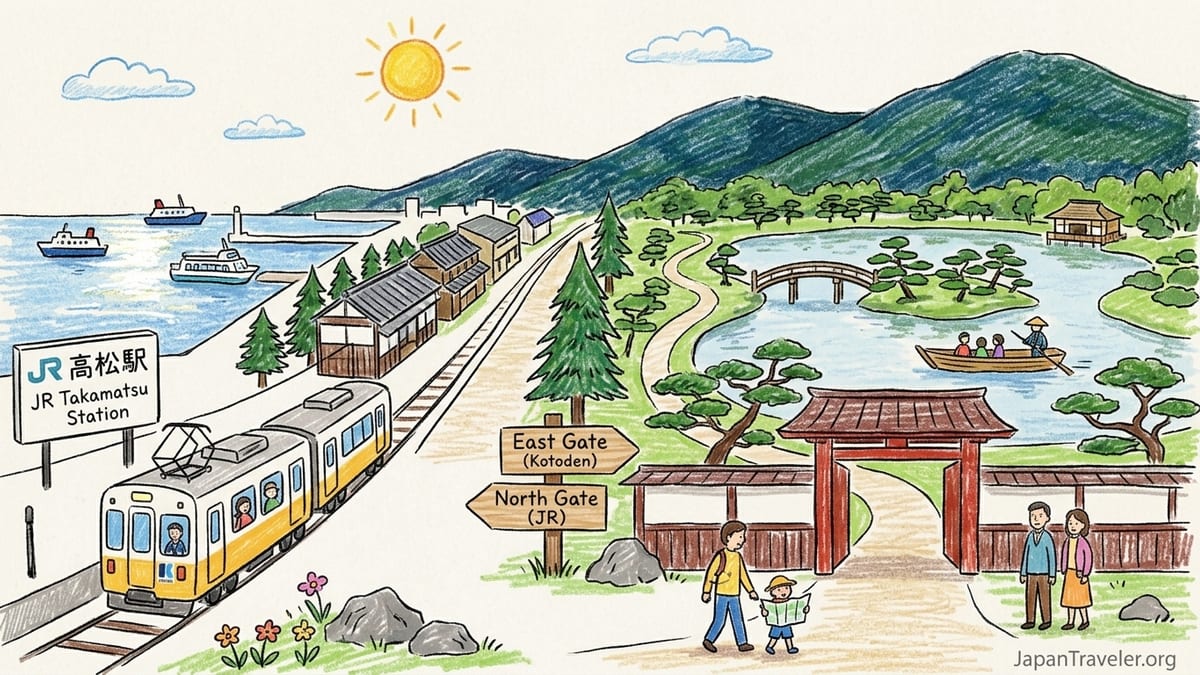
I started the morning at JR Takamatsu Station, coffee in hand, with the ferries to Naoshima and Megijima glinting just across the road. It is tempting to stay by the harbor and wait for a departure, but Ritsurin Garden sits only about two kilometers to the south, and local transport makes it very easy to reach. I chose the Kotoden private railway, partly because the small two-car trains feel like a gentle step down from the Shinkansen rhythm. From Takamatsu-Chikko Station, across from JR Takamatsu, the ride to Ritsurin-Koen Station on the Kotohira Line takes around seven minutes and costs only a few hundred yen. From there, it is a straightforward 7 to 10 minute walk to the East Gate along quiet streets that already feel far removed from the port.
Travelers who prefer JR can ride the Kotoku Line just one stop from Takamatsu to Ritsurin-Koen-Kitaguchi Station, then walk about three minutes to the North Gate. Buses leave from stands 4 and 5 outside JR Takamatsu for the Ritsurin-Koen-mae stop right at the East Gate, so there is no shortage of options. Door to door from the station or port, the journey rarely exceeds 25 to 30 minutes, even including walking time, which makes it easy to fit a dedicated garden visit into a Setouchi itinerary built around ferries.
I arrived just after opening on a clear spring morning, which in Takamatsu usually means soft light and cool air until about 10 a.m. Ritsurin Garden opens from early morning, with hours that shift slightly by season, so it is worth checking locally the day before. Coming this early turned out to be one of the best decisions of the day: for the first hour, the main paths were shared mostly with gardeners and retired locals walking regular circuits, and the South Pond was as calm as a mirror.
Entrance is refreshingly straightforward. The official admission is currently 500 yen for adults and 170 yen for school-age children, paid in cash or by common transport cards at the ticket window. At the East Gate there is more signage in English, a staffed information desk, and the immediate sense of being in the “front door” of a major attraction. At the North Gate near JR, arrival feels quieter and more residential. You step almost directly into the less visited half of the grounds, which is attractive if you prefer to build toward the grand South Garden rather than plunge into it.
Choosing Between East And North Gates
Ritsurin Garden is often described as having a South Garden and a North Garden, loosely corresponding to its more formal, historic core and its later, more open parkland. The East Gate brings you straight into the South Garden’s orbit, near the Ticket Office, main souvenir shop and the path that leads quickly toward South Pond. It is the most efficient entrance for visitors with limited time and for those planning to ride the South Pond boat, since the boathouse is only a few minutes’ walk from here.
Arriving at the North Gate, by contrast, feels like stepping in through a side entrance reserved for neighbors. There is still a ticket window, but fewer tour groups and less bustle. I walked this way later in the morning and saw parents pushing strollers, office workers cutting through on their way downtown and a school group sketching under a row of pines. If you begin here, the first half hour of your visit will likely be spent in hushed, tree-lined lanes and open lawns rather than around the photographic landmarks.
The real difference is psychological as much as physical. Entering from the East Gate situates you immediately in the “sightseeing” version of Ritsurin, where signboards point to South Pond, Engetsukyo Bridge and Kikugetsutei Teahouse. From the North Gate, you wander first through the more relaxed northern grounds and reach the iconic scenes only after you have already walked for twenty or thirty minutes. On a repeat visit, I would start in the north and save the South Pond’s drama for later, but for a first visit focused on a morning before a ferry, entering at the East Gate gives useful orientation and keeps logistics simple.
Either way, you should plan to spend several hours, not squeeze Ritsurin into a one-hour pocket before heading to the art islands. The garden covers more than 70 hectares when you include the flanking Mount Shiun, and even the recommended “short” walking route through the South Garden alone is estimated at around one hour without long stops. With time for tea, a boat ride, pauses at viewpoints and photo stops, a relaxed visit easily fills a full morning.
Walking The South Pond: Learning Ippo Ikkei Step By Step
From the East Gate, I followed the red-dotted “South Garden course” shown on the free English map. Within minutes, the path curved around a low hill and delivered the first breathtaking view of South Pond, also called Nanko. Pine islands rose from the still water like slow-moving clouds, each tree trained and pruned over decades. Here, the design principle of ippo ikkei comes to life. Literally meaning “a different view with every step,” it describes a strolling garden designed to reveal changing compositions as you move, like frames in a film rather than a single postcard shot.
I made a point of slowing down and noticing the shifts. After five steps, a stone lantern that had been hidden behind a branch slid into view, suddenly anchoring the composition. Ten steps later, the same lantern disappeared again, replaced by the arc of Engetsukyo Bridge in the middle distance. From one bend along the shore, the mountains outside the garden dropped behind a ridge and the world seemed entirely contained within the garden’s pine-framed horizon. Two meters on, Shikoku’s hills reappeared, reminding me that this had always been a lord’s garden framed by real, lived-in countryside rather than a closed fantasy.
Close to the water, each tree becomes a character. Some lean out over the pond on gnarled trunks held up by discreet wooden props. Others rise in dense, dark towers, their trunks wrapped in straw in winter to trap pests. Gardeners with ladders and hand shears moved slowly among them, painstakingly maintaining silhouettes that appear effortless from a distance. Watching them work, I began to understand that ippo ikkei is not a slogan but the result of hundreds of small decisions taken every season for centuries.
The paths themselves make it easy to appreciate this layered design. Ritsurin’s main circuit is mostly flat and well maintained, suitable for older visitors who prefer steady ground. Here and there, side trails rise gently onto small hills or cross stone steps over streams. Even within a single section along South Pond, you are invited to choose between a low lakeside route that brushes the reeds and a slightly raised levee path that gives more sweeping views. Choosing different options on the way out and back makes the garden feel larger than the map suggests, and deepens the sense that there really is a different scene with every dozen steps.
Engetsukyo Bridge, Hiraiho Viewpoint And The Quiet Of The North Garden
Engetsukyo Bridge is one of the garden’s most photographed features, an arched wooden span that rises above a narrow point of South Pond. Early in the morning, I had it nearly to myself. The planks creaked softly as I crossed, and from the top I could see carp scattering below like bronze arrows. Looking back toward the shore, the bridge aligns with a small stone island and a background hill in a way that feels almost too perfect. With a small shift to the left, the balance breaks and the view becomes ordinary. It is another lesson in ippo ikkei: the same place contains both masterpiece and everyday angle, depending on where you plant your feet.
From Engetsukyo, the path climbs gently to Hiraiho, a carefully shaped mini-mountain that serves as one of Ritsurin’s classic viewpoints. The ascent is short but includes some uneven stone steps, so visitors with limited mobility may prefer to admire the scene from below. For those able to climb, the reward is a sweeping view across South Pond to pine islands, the dark slope of Mount Shiun behind, and the long sweep of the garden’s southern shore. I stood there long enough to watch a wasen, one of the traditional wooden boats, glide from behind an island and leave a soft V on the water that slowly disappeared. From this height, you sense how deliberately the garden uses borrowed scenery from beyond its walls to make the grounds feel infinite.
After the viewpoints and the concentration of visitors around the teahouse and boat landing, the northern sections of Ritsurin feel like a different park entirely. The paths broaden, the planting opens up, and lawns and groves invite picnics and quiet reading. Sculpted pines still appear, but their arrangement is less formal, and seasonal flower beds and plum groves take a more obvious role. I noticed more local families here, perhaps because several of the wide paths are particularly stroller friendly and there is more open space for children to wander without the worry of ponds.
In these northern walks, the ippo ikkei principle softens into something more relaxed. You still find new views with every turn, but the garden seems to encourage longer strides and casual conversation rather than the hushed, almost reverential pace that comes naturally around South Pond. For older visitors, this area provides many benches and shaded corners for breaks. It is also where the sense of Ritsurin as a neighborhood’s daily green space comes into focus, which balances its image as a heritage site.
Matcha And Sweets At Kikugetsutei Teahouse
No visit to Ritsurin feels complete without stopping at Kikugetsutei, the teahouse that sits on the edge of South Pond with picture-book views framed by sliding doors. Reaching it involves a short walk along the water and a few stepping stones over a narrow inlet, which already feels like a small ceremony. Shoes come off at the entrance, and staff guide you to either tatami rooms with low tables or seats near the veranda, where you can look directly over the pond.
Kikugetsutei offers matcha with a traditional Japanese sweet for an additional fee on top of the garden admission. When I visited, a basic set of whisked matcha and a seasonal wagashi cost the equivalent of several hundred yen. The matcha arrived in a wide, slightly rough-glazed bowl, bright green against the neutral tones of the room, along with a small square of bean paste wrapped in a thin layer of mochi shaped like a chrysanthemum petal. The staff member set it down silently, then quietly explained which side of the sweet to cut first, keeping to the understated service style that suits a place built for contemplation rather than performance.
The taste mirrored the setting. The matcha was pleasantly bitter, with a thick enough foam to leave a ring on the bowl, but not so intense as in a formal tea ceremony. The wagashi was subtly sweet and almost floral, cleansing the palate between sips. Through the open shoji, I watched the surface of South Pond shift with passing breezes and listened to the muffled crunch of footsteps outside on the gravel path. Sitting there for twenty minutes made the rest of the visit feel different, as if I had tuned my attention more finely to small changes in light and sound.
For travelers on a tight schedule, it might be tempting to skip the teahouse and simply admire it from outside. In practice, setting aside half an hour here anchors the whole experience. Prices are moderate compared with tea offerings in Tokyo or Kyoto, and the combination of taste, view and calm makes it feel like genuine value rather than a tourist add-on. It is also an accessible way for first-time visitors to experience a slice of tea culture without the formality or time commitment of a full ceremony.
Seeing The Garden From The Water: South Pond Boat Ride
From near Kikugetsutei, a small sign points toward the boat landing where traditional wooden wasen depart on short excursions around South Pond. The ride currently costs 850 yen per adult, paid at a small kiosk where staff record your name and assign a departure time. Boats are relatively small, usually taking around six passengers plus the boatman, and departures cluster more tightly in the late morning and early afternoon when day trippers from Okayama and the ferries tend to arrive. At opening time, I was able to join the next available boat with almost no wait. Later in the morning, I saw a simple handwritten board showing boats filling one or two departures ahead.
Boarding feels informal but safe. You step down onto a low wooden pier, accept a simple life vest if offered, and sit on flat cushions arranged along the sides of the boat. The boatman stands at the stern, guiding with a long pole rather than an engine, which keeps the ride quiet enough to hear birds and rustling pines. The route traces a slow loop among the islands and under low bridges, giving you a chance to see up close the root systems of pines that, from the shore, appear to float effortlessly on their islets.
The commentary varies by operator and time of day, but many boatmen offer basic explanations in simple English or with a laminated information sheet. Mine pointed out a particularly old pine that had survived several typhoons thanks to its careful training, and a corner of the pond where koi carp often gather when visitors gather on the banks. He also gestured up to Hiraiho viewpoint, now above us, explaining that the garden was designed to be read from both land and water, with the boat ride originally reserved for local lords and their guests. The circuit took around 25 to 30 minutes, which felt sufficient to see the main sections of South Pond without becoming repetitive.
Experiencing Ritsurin from the water changed how I understood its scale. From the shore, islands and peninsulas seem to stack closely. From the boat, the distances between them open up, and you sense just how large the pond is relative to a human figure. Looking back toward Engetsukyo Bridge, I saw other visitors cross it and disappear behind pines, realizing that earlier I had been one of those moving dots. The ride also brings the texture of the garden closer: the grain of the boat’s worn planks, the ripples created by the pole, the play of reflections where real branches and their mirrored doubles meet. For the additional cost, it added enough depth and quiet to feel worthwhile, particularly on a first visit.
Practicalities: Distance, Shade, Seasons And Crowds
One of the surprises of Ritsurin is how physically manageable it feels despite its size. The recommended South Garden loop is listed at around an hour of walking, and including detours to Hiraiho, Kikugetsutei and various side paths, my morning stroll totaled perhaps three to four kilometers. Paths are generally smooth gravel or packed earth, with only occasional short flights of stone steps. There are some steeper climbs to viewpoints, but these are optional. Visitors with limited mobility can still see South Pond, Engetsukyo and several prime vistas from level ground, though certain bridges and hills will be out of reach.
Shade is another consideration, especially in the warmer months. Fortunately, pines and other trees line much of the main route, providing intermittent relief from the sun. Certain exposed stretches around open lawns and along the top of Hiraiho can feel hot at midday, so a hat and water bottle are sensible. Benches and rest houses appear at regular intervals, often near particularly good viewpoints, which makes it easy for older travelers or families with small children to pace the visit.
Seasonal change is one of Ritsurin’s greatest strengths. In early spring, plum and cherry blossoms add pockets of color that contrast with the constant green of the pines. Late spring and early summer bring irises and bright new needles on the trees. Autumn paints certain hillsides and maples in deep reds and golds, which reflect dramatically in South Pond, and winter can be surprisingly beautiful when snow rests briefly on the sculpted pine branches. Every season offers distinct photography opportunities: low morning light on frosty paths in January, or mist lifting off the pond in the rainy season. Tripods are generally discouraged on busy days, but hand-held cameras and phones can easily capture the ippo ikkei effect by simply shooting from different steps along the same path.
Despite its calm reputation, Ritsurin does have busier pockets. The area around the East Gate, main shop, South Pond shoreline and Kikugetsutei can become crowded from mid-morning, especially during autumn foliage and spring blossom periods. Engetsukyo Bridge in particular often has a queue of visitors waiting to take photos around mid-day, and the boat landing sometimes builds a short waiting list. Yet only ten or fifteen minutes’ walk away, especially toward the North Garden, the crowds thin drastically. Even on a popular weekend, I found stretches of path where I walked for five minutes without seeing another visitor.
Comparing Ritsurin With Okayama’s Korakuen
Many Setouchi itineraries include both Ritsurin Garden and Korakuen in Okayama, and having visited each within the same year, I found the comparison illuminating. Korakuen, located beside Okayama Castle, is famous for its large open lawns, borrowed views of the castle keep and expansive, almost park-like feeling. You can stand in the center and see wide horizons of grass crisscrossed by paths, with the pond and tea houses clustered on one side. It is a garden that reveals much of itself at once, inviting long, gentle loops rather than intimate discoveries.
Ritsurin, in contrast, feels more enclosed and layered. The predominance of pines, the irregular coastline of South Pond, and the integration of Mount Shiun as a backdrop create a sense of depth and shifting scenes that aligns closely with the ippo ikkei idea. Where Korakuen’s lawns encourage picnics and play, Ritsurin’s sculpted shorelines and island clusters reward slower, almost cinematic walking. The teahouse experience also differs. Korakuen has several tea spots, but Kikugetsutei’s position right at the edge of South Pond, with boat traffic and islands in front, felt more immersive.
In practical terms, both gardens are relatively flat and accessible, though Korakuen’s lawns make it somewhat easier for visitors who use wheelchairs or have limited mobility to see broad vistas without tackling slopes. Ritsurin compensates with more shaded paths and the option of viewing much of South Pond from comfortable benches. Visiting both in one trip offers a deeper understanding of how daimyo gardens could differ dramatically in mood and structure even within the same broad historical period.
The Takeaway
By the time I exited through the East Gate, nearly three hours had passed since I first stepped off the Kotoden train. I had walked the South Garden, climbed to Hiraiho, crossed Engetsukyo, sipped matcha at Kikugetsutei, drifted around South Pond by boat and wandered the quieter northern sections. What surprised me most was that the experience never felt rushed or repetitive. Ritsurin is large enough to absorb people, yet intricately designed enough that every shift in angle reveals something worth pausing for, whether it is a reflection, a pruned branch or the profile of a distant hill.
For travelers using Takamatsu primarily as a ferry gateway, Ritsurin absolutely deserves a dedicated morning. Logistically, it fits well. An early start from JR Takamatsu or the port gets you into the garden soon after opening, well before the busiest time. Spending three hours there still leaves a comfortable buffer to return to the station, collect stored luggage if needed, and walk or ride back to the ferry terminal for an early afternoon sailing to Naoshima, Teshima or Shodoshima. In practice, I would plan something like an 8:00 or 8:30 arrival at the garden, depart around 11:30, enjoy a quick bowl of Sanuki udon nearby, then head for a 13:00 or later ferry.
Did the boat ride add worthwhile value? For me, yes. The view from the water rounded out the understanding formed from the paths and viewpoints, and the calm of gliding silently between islands offered a different kind of stillness than sitting at the teahouse or resting on a bench. If budget or time are very tight, you can appreciate Ritsurin perfectly well on foot alone, but if you have the means, that 850 yen ticket buys a perspective that lingers in memory long after departure.
Above all, Ritsurin changed how I thought about Japanese gardens as travel experiences. Instead of checking off famous bridges and teahouses on the way to the next ferry, I left Takamatsu feeling that the garden itself had been the day’s main destination and that my island visits were an extension rather than the core. Walking back toward the port under the same morning sun, I realized that the calm and attentiveness I had found among Ritsurin’s pines would shape how I looked at art installations and shorelines across the Seto Inland Sea for the rest of the trip.
FAQ
Q1. How much time should I plan for Ritsurin Garden before a ferry to the art islands?
Most visitors who include matcha at Kikugetsutei and a South Pond boat ride find that three hours inside the garden feels comfortable without being rushed, plus transit time from and back to the port or JR Takamatsu Station.
Q2. Which entrance is better if I am coming from Takamatsu Port?
From the port area it is usually most convenient to ride the Kotoden from Takamatsu-Chikko to Ritsurin-Koen Station and use the East Gate, which places you near South Pond, the teahouse and the boat landing.
Q3. Is Ritsurin Garden suitable for older visitors or those with limited mobility?
Yes. Many of the main paths around South Pond are flat and well maintained, with frequent benches and shaded spots. Certain viewpoints like Hiraiho require climbing stone steps, but these are optional rather than essential to enjoying the garden.
Q4. Do I need to reserve the South Pond boat ride in advance?
The boat ride typically operates on a same-day basis, with tickets sold at the small kiosk by the landing. During peak seasons or busy weekends, it is wise to check the next available departure time soon after you arrive in the garden.
Q5. How much does it cost to visit Ritsurin and take the boat?
The garden admission is currently 500 yen for adults and 170 yen for school-age children. The traditional boat ride on South Pond costs an additional 850 yen per adult, paid separately at the boat landing.
Q6. What is ippo ikkei and how can I experience it in Ritsurin?
Ippo ikkei refers to the idea that each step reveals a different view. In Ritsurin, you can experience this by walking slowly along South Pond and noticing how small changes in position transform the relationship between bridges, islands, trees and mountains.
Q7. When is the best season to visit Ritsurin Garden?
Ritsurin is rewarding year-round, but many travelers favor spring for cherry and plum blossoms or late autumn for colorful foliage reflected in South Pond. Summer offers lush greens and shade, while winter highlights the structure of the pines.
Q8. Is Kikugetsutei Teahouse worth the extra time and cost?
For most visitors, yes. A set of matcha and seasonal wagashi costs only a modest amount and provides both a quiet rest and one of the garden’s best views over South Pond, deepening the overall experience.
Q9. Can I visit both Ritsurin Garden and an art island like Naoshima in the same day?
It is possible with an early start. Many travelers spend the morning in Ritsurin, return to Takamatsu around midday, then board an afternoon ferry. Checking ferry schedules in advance is important to avoid a rushed transfer.
Q10. How does Ritsurin compare to Okayama’s Korakuen for a first-time visitor?
Korakuen offers broad open lawns and castle views, while Ritsurin feels more intimate and layered, with pine-framed ponds and changing vistas at every turn. If your route allows, visiting both gives a richer sense of Japanese garden design.