

The Setouchi art islands are surprisingly sensitive to where you sleep. Your overnight base will determine which ferries you can catch, whether you make that early Chichu Art Museum slot, how much you spend on boats, and how many islands you can realistically see in one trip. This guide compares Takamatsu, Uno, Okayama, Naoshima and Teshima as bases, using real hotel and ferry examples current to late 2026, so you can match your accommodation and transport to the art you most want to see.
How Ferry Routes Shape Your Whole Setouchi Plan
The first surprise for many visitors is that the ferries around Naoshima, Teshima and Inujima do not work like an unlimited hop-on-hop-off pass. Each route is operated by specific companies, tickets are sold per leg, and there is no through-ticket that lets you wander between islands all day. You need to think in point-to-point segments, such as Uno to Naoshima, Naoshima to Teshima, or Takamatsu to Teshima, and pay for each separately.
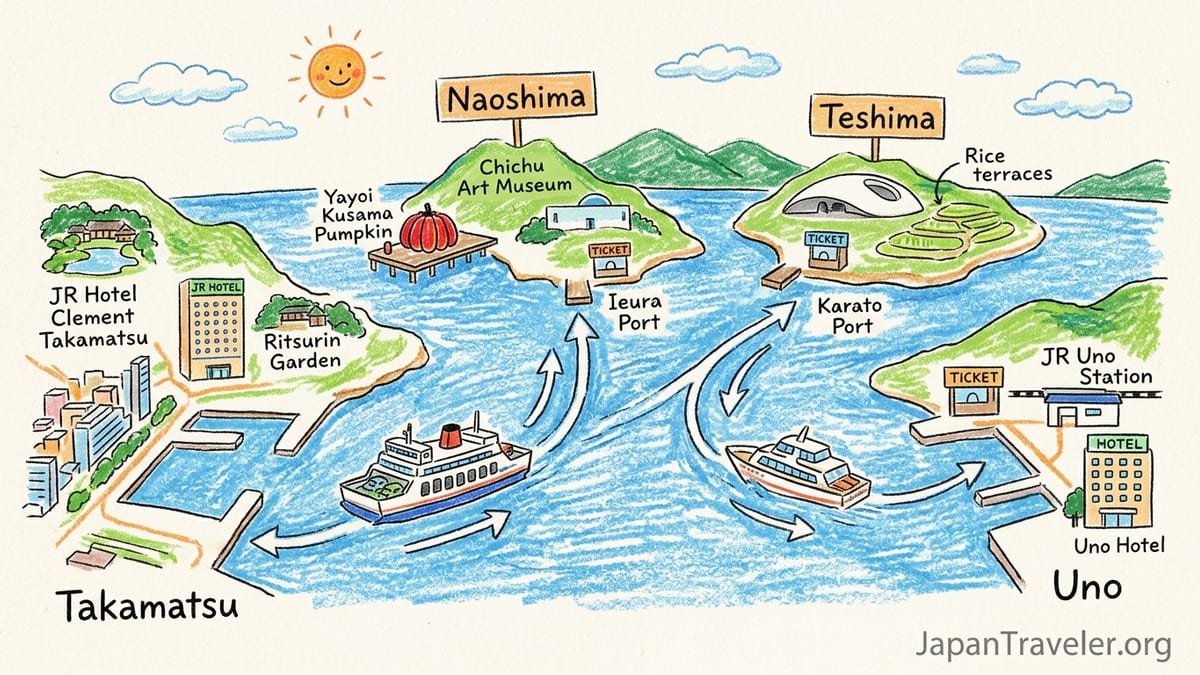
As of late 2026, the basic pattern is that Shikoku Kisen runs the main car ferries between Uno, Naoshima and Takamatsu, while Teshima Ferry and Shodoshima Teshima Ferry cover the links to Teshima and Shodoshima. From Takamatsu, a car ferry to Naoshima’s Miyanoura port takes about 50 minutes and costs around 680 yen one way for an adult, after fare increases in 2025. Fast passenger boats on some routes cost more, roughly in the 1500 yen range for Takamatsu to Naoshima, in exchange for shorter crossing times. From Uno, fares to Naoshima have also risen since early 2026 and sit in a similar band once converted to today’s prices, though exact amounts can change and should always be checked locally before travel.
Connections to Teshima are more fragmented. Ferries and high speed boats run from both Uno and Takamatsu to Teshima’s Ieura port, with some continuing to Karato and on to Tonosho on Shodoshima. Crossing times range from about 25 to 40 minutes from Uno to Ieura, and roughly 35 minutes from Takamatsu to Ieura. Operators clearly state that timetables change seasonally, especially during Setouchi Triennale years, so it is important to download the latest bilingual route map and timetable from Naoshima and Teshima tourism offices shortly before your trip rather than relying on old screenshots.
Capacity and last sailings matter. Car ferries on the Uno to Naoshima route can take several hundred passengers, which makes them relatively forgiving on normal days. By contrast, some fast passenger boats to Teshima have limited capacity with simple ticket counters at the pier, and tickets are often sold as first come first served. If you are visiting during a busy weekend or national holiday, you may find that the boat you planned to take is sold out and you need to wait several hours for the next sailing. Missing the final boat of the day is even more consequential, as there is no late night backup and no bridge to the islands. An unplanned hotel night or an expensive charter boat becomes your only option.
Takamatsu: Best for Variety, City Comfort and Multi-Island Hopping
Takamatsu on Shikoku is the most flexible urban base for the art islands. From Takamatsu Port, you can sail directly to Naoshima’s Miyanoura port, to Teshima’s Ieura port on high speed boats, and to Shodoshima on regular ferries. That makes it ideal if you want to combine Naoshima with Teshima or Shodoshima, or if you are traveling by Shinkansen to Okayama and then transferring across the Seto Ohashi bridge by train. JR Takamatsu Station sits right by the waterfront, so walking from station to port is a straightforward 10 to 20 minutes depending on your hotel.
A flagship option immediately in front of JR Takamatsu Station is JR Hotel Clement Takamatsu. The official access information notes that the airport limousine bus stops right outside the hotel just before its final stop at Takamatsu Station, which means you can arrive from Takamatsu Airport, check in or leave bags, and then walk to the port without needing a taxi. In practice, the walk from the Clement to Takamatsu Port is about 5 to 10 minutes along a flat waterfront. For many visitors, that combination of direct airport bus, mainline rail access and port proximity makes the Clement one of the most efficient bases for a two or three day art island program.
Room rates at JR Hotel Clement Takamatsu fluctuate by season and booking channel, but sample searches for midweek nights outside peak festivals often show standard doubles in the ballpark of 12,000 to 18,000 yen per room, including breakfast in some plans. Breakfast service typically begins around 6:30 or 7:00, which suits early ferry departures to Naoshima or Teshima. Budget travelers can consider nearby business hotels next to Takamatsu Station, which often undercut the Clement by several thousand yen while still keeping walking time to the port under 15 minutes. In all of these hotels, early check out around 10:00 is standard, and front desks generally offer free or inexpensive luggage storage for guests who want to return for their bags after an art island day trip.
On top of transport convenience, Takamatsu adds genuine city attractions. Ritsurin Garden is one of Japan’s celebrated historical strolling gardens and is reachable from the station by local train or bus in around 15 minutes. At night, the restaurant and bar scene near Kataharamachi and the station offers more choice than Uno or the islands, including izakaya, udon shops and casual wine bars. For travelers who want art by day and urban dining by night, or those concerned about rain days when ferries might be disrupted, Takamatsu’s size and amenities make it the safest all round choice.
Uno and Okayama: Fast Mainland Access to Naoshima and Teshima
On the Honshu side of the Seto Inland Sea, Uno in Tamano City is the closest mainland port to Naoshima. Trains run from Okayama Station to Uno in a little under an hour, usually with one easy transfer. For Shinkansen travelers from Tokyo, Osaka, Kyoto or Hiroshima, this means you can step off the bullet train at Okayama, switch to a local line, and reach Uno the same afternoon without complex route finding.
Uno itself is a compact seaside town centered on JR Uno Station and the ferry terminal. UNO HOTEL stands directly on the waterfront in a converted port building, only a few minutes’ walk from both station and embarkation area. Uno Port Inn is another traveler favorite, described by its operators as literally a one minute walk from both JR Uno Station and the ferry terminal. Guests are encouraged to arrive early, drop luggage for free, and head straight to Naoshima or Teshima. This kind of door to port proximity minimizes the risk of missing a morning boat and makes it easy to return between islands and your room during the day if necessary.
In terms of price, both UNO HOTEL and Uno Port Inn position themselves in the mid range by Japanese standards. Example nightly rates for a double room often fall somewhere around 12,000 to 20,000 yen depending on room type and season, with breakfast plans adding a modest surcharge. Breakfast start times usually sit around 7:00 to 7:30. If you want to catch the very first ferry to Naoshima, you may need to either request an early-light breakfast option, rely on convenience store food from around JR Okayama or Uno, or simply eat on the island after arrival. Check out tends to be at 10:00, but these smaller hotels are used to art island guests and usually store luggage without charge until late afternoon boats.
Okayama city itself is not on the water, but it offers the region’s best Shinkansen access and big-city accommodation stock. National business chains and full service hotels cluster around Okayama Station, making it relatively easy to find doubles in the 8,000 to 15,000 yen range outside peak Sakura and Golden Week periods. From Okayama Station to Uno you should allow roughly an hour, including any transfer, so day trips to Naoshima remain feasible but slightly less relaxed than from Uno. Okayama is a smart base if you want to combine Naoshima with the city’s own highlights, such as Korakuen Garden and Okayama Castle, or if you want to keep hotel costs lower by avoiding waterfront properties.
Naoshima Stays: Sleeping Inside the Art Site
Staying on Naoshima itself eliminates the daily question of whether you will make the first ferry. It also changes your museum rhythm. Instead of rushing to catch a return boat, you can book an early Chichu Art Museum slot, visit Benesse House Museum in the evening, or sit by the shore after bus tours have ended. The trade-offs are higher room rates and less varied dining compared with Takamatsu or Okayama.
The most famous property on the island is Benesse House, which combines an art museum and hotel spread across several buildings designed by Tadao Ando. Published information from the operator indicates around 65 guest rooms in total and courtesy buses that meet ferry arrivals at Miyanoura port according to set timetables. These shuttles connect Miyanoura with Benesse House and the Chichu Art Museum area, so guests rarely need a taxi for the main art sites. Breakfast at Benesse House’s restaurants is a high-end affair priced in the six thousand yen range per person, reflecting both quality ingredients and the limited competition on the island.
Benesse House room rates span a wide range depending on building and plan. In recent years, sample prices for two adults can start in the several tens of thousands of yen per night, particularly for sea view rooms in the Museum or Beach sections. That can easily exceed the combined cost of a Takamatsu hotel and multiple ferry trips over several days. However, Benesse House guests benefit from late night museum access in some wings, shorter logistics for early or late entry museum slots, and the intangible pleasure of waking up inside the art site itself. For serious museum enthusiasts, that convenience often justifies the higher outlay.
Beyond Benesse House, Naoshima has a growing collection of guesthouses, small hotels and minshuku. A tourism information PDF lists establishments such as Naoshima Backpackers Guesthouse with indicative dormitory beds from around 3,000 yen, as well as small design guesthouses and family-run inns in both Miyanoura and Honmura. Many of these properties are walking distance from either port and close to island bus stops. Breakfast options range from simple toast and coffee to Japanese set meals. Check in and check out times are usually stricter than in city hotels, and luggage storage may be more informal, occasionally involving leaving bags in common areas.
The practical difference between Naoshima’s two main ports matters. Miyanoura is the island’s main gateway, receiving ferries and passenger boats from both Uno and Takamatsu. It has the bus terminal, convenience store, several restaurants and bicycle rentals. Benesse House’s courtesy bus runs to and from Miyanoura in sync with major ferry times, so most visitors arriving from the mainland will pass through here. Honmura, by contrast, is closer to the Art House Project and has a more residential feel with narrow streets and small cafes. Some passenger boats from Takamatsu call at Honmura, but large car ferries do not. If your priority is Benesse and Chichu, staying near Miyanoura or at Benesse itself means fewer transfers. If you want to explore the Art House installations on foot in the early morning or late evening, Honmura guesthouses have the edge.
Teshima: A Quieter Overnight on a Fragile Transport Network
Teshima feels wilder and more rural than Naoshima, with rice terraces, forested ridges and fewer visitors outside festival periods. Its main contemporary draw is the Teshima Art Museum, an organic concrete shell on a hillside above Karato, along with scattered artworks between the island’s three main districts of Ieura, Karato and Kou. Staying overnight here can be very rewarding, but only if you understand the island’s limited transport infrastructure and reduced lodging choices.
Access to Teshima operates through two ports. Ieura, on the northwest coast, is the principal entry point for ferries and high speed boats from Uno and Takamatsu. Maps from the Teshima tourism office show ticket counters and separate piers for car ferries and passenger boats. Karato, on the northeast side, also receives some ferries along the Uno to Shodoshima line, and sits closer to the Teshima Art Museum and several outdoor works. A small island bus and occasional shuttle services connect Ieura and Karato, running along the spine road in about 15 to 20 minutes. However, these buses are infrequent, so many visitors either rent electric bicycles near Ieura or plan their day so that long walks between sites become part of the experience.
Some boats to and from Teshima have very limited capacity. High speed passenger vessels from Takamatsu to Ieura can fill up quickly on weekends, and even car ferries from Uno that stop at Ieura and Karato are not immune to crowding at peak times. Tickets for these services are often sold in cash at small windows by the pier, and the English signage may be minimal. Travelers have reported needing to arrive significantly before departure during busy periods to secure a place, especially if they are hoping to catch the last boat back to Uno or Naoshima. Because capacity is finite and there are few sailings each day, missing a departure can compress your art schedule or make it impossible to see both Teshima and another island on the same day.
Ferry fares from Uno to Ieura or Karato usually sit a little above the cost of an Uno to Naoshima ticket once updated for recent fuel and fare revisions. From Takamatsu to Ieura, fast boats charge more than the slower ferries but cut crossing time to roughly half an hour. Operators stress that all fares and timetables are subject to change, particularly after 2023 timetable revisions and fare increases in 2025 and 2026, so you should treat any quoted amount as approximate until you confirm it on the official notices at the port or the companies’ Japanese language websites.
Lodging on Teshima is intentionally scarce. A handful of design-focused accommodations and family-run inns operate around Ieura and in rural areas, often with just a few rooms each. Per-night rates commonly match or exceed mid-range mainland hotels, especially when breakfast and dinner are included, since almost all food has to be transported in. Check in can be early in the afternoon and check out by 10:00, largely to match the ferry timetable. Some inns can arrange pick up from Ieura or Karato if you reserve in advance, but taxi availability on the island is limited or nonexistent outside special arrangements. The payoff is that when day trippers leave on the last afternoon boat, the island becomes quiet, the roads empty, and you can experience the Teshima Art Museum, rice fields and coastal views in a calm that is hard to find on Naoshima.
How Much Will You Spend on Ferries vs Rooms?
Choosing where to stay around the Setouchi art islands is partly a question of whether to invest more in a special room on the islands or to accept repeated ferry costs from a cheaper mainland base. Because fares have changed several times in recent years and may change again, the figures below are rounded examples rather than guaranteed prices. The purpose is to show the balance between accommodation and transport over one, two and three art island days.
Imagine a couple visiting in the shoulder season who chooses Takamatsu as a base. They book a mid-range city hotel near JR Takamatsu Station for about 14,000 yen per night including breakfast. On day one, they take the car ferry from Takamatsu to Naoshima’s Miyanoura port and back, paying around 680 yen per person each way, or about 2,720 yen total for two people round trip. Their combined room plus ferry cost for that Naoshima day lands near 16,700 yen. On a second day to Teshima using a high speed boat from Takamatsu to Ieura and back, they might spend in the ballpark of 3,000 yen or more per person in total, pushing that day’s combined room and boat spend closer to 20,000 yen.
By contrast, consider a couple staying directly at Benesse House on Naoshima for one night, structured around a single intense art day. If their chosen room and dining plan adds up to somewhere in the region of 60,000 yen for that night, their additional ferry costs are relatively small. They might travel from Uno to Naoshima and back for roughly 700 to 800 yen per person each way, or something like 2,800 to 3,200 yen total for two people. Their single Naoshima day then costs in the region of 63,000 yen including transport. On a per-day basis this dwarfs the Takamatsu option, but their time inside the museums is maximized, and they avoid the stress of catching an early morning ferry. If they added a second Naoshima day from the same hotel stay, the marginal ferry cost would be almost zero, but the nightly room rate would double.
Over three art island days, a mixed strategy often balances cost and convenience. One example is to spend two nights at a Takamatsu or Uno hotel and one night on Naoshima. The first mainland night can support a Teshima or Shodoshima day trip, the island night centers on Naoshima and Benesse facilities, and the final mainland night after returning from Naoshima allows for a relaxed departure. In such a plan, ferry spending for two travelers might creep toward 10,000 to 15,000 yen total, depending on routes and operators used, while accommodation could span from 40,000 to well over 100,000 yen depending on whether you choose business hotels or art hotels. The key is that a single night on Naoshima or Teshima often gives you the experiential benefit of staying on the islands without committing your entire budget to high nightly rates.
For budget-conscious travelers, basing in Okayama or Takamatsu and accepting daily ferries keeps overall spending more predictable. For those treating the art islands as a once-in-a-lifetime highlight, splurging on at least one night at Benesse House or a Teshima design inn often feels justified. In both cases, the practical discipline is to count legs: every time you move between Uno, Takamatsu, Naoshima, Teshima and Inujima, you are buying another single segment ticket rather than drawing on a day pass.
Practicalities: Tickets, Payment, Luggage and Taxis
Ferry ticketing around the Setouchi art islands remains mostly analog in 2026. While some operators have started to experiment with online information and limited reservation systems, many crossings still require you to purchase physical tickets from small windows near the pier shortly before boarding. Cash remains the most reliable payment method, especially on the smaller routes to Teshima and Inujima. Larger ports such as Takamatsu and Uno do increasingly accept major credit cards or transport IC cards for some services, but those systems are not universal and may not extend to all boats, particularly the high speed passenger launches.
Luggage handling is another reason to choose your base carefully. City hotels in Takamatsu and Okayama almost always store luggage for free on check out day, letting you travel to Naoshima or Teshima with only a daypack. Uno Port Inn explicitly invites guests to drop bags early in the morning before checking in, so they can take a ferry immediately. On Naoshima, some guesthouses will hold bags until an afternoon boat, but storage space can be limited, and formal baggage storage at the ports may not be available outside festival periods. Benesse House alleviates this by ferrying guest luggage together with passengers in its courtesy buses between Miyanoura and the hotel area.
Taxis deserve special mention. In Takamatsu, regular city taxis operate throughout the day and can easily take you from a more distant hotel to the port in 10 minutes if you misjudge walking time. Around Okayama Station and in Uno, taxis are fewer but still present, mainly during train arrival waves. Once you are on Naoshima or Teshima, however, taxis become rare. Naoshima has a small taxi company that may be available for pre-booked transfers or emergencies, but most visitors rely on the island bus and rental cycles. Teshima has even fewer motorized options. If walking hilly roads or cycling is difficult for mobility reasons, you should coordinate with your inn in advance to arrange pickups or consider basing on Naoshima or the mainland instead.
Finally, the consequences of missing the last boat should shape your daily planning. On core routes like Uno to Naoshima or Takamatsu to Naoshima, the last ferries usually depart in the late afternoon or early evening, with approximate final times changing by season. The Uno to Teshima to Shodoshima line also has evening cutoffs. Travellers and local guides frequently emphasize that there is no such thing as a midnight rescue ferry. If you are still at Benesse House or the Teshima Art Museum when the last bus leaves for the port, you could be stuck overnight without a booked room. Always check the day’s last departures on the printed timetable at the port, cross reference them with museum ticket slots, and leave deliberate padding in your schedule.
Who Should Stay Where?
Different traveler types benefit from different bases around the Setouchi art islands. Museum enthusiasts often gain the most from at least one night on Naoshima. Being able to walk or shuttle between Benesse House, Chichu Art Museum and the Art House Project without worrying about ferries lets you book the earliest or latest time slots, when spaces are quietest. If budget permits, a night at Benesse House creates a fully immersive art environment. Those who want to visit Teshima’s museum intensively might consider one night on Teshima as well, but should pay close attention to ferry and inn reservation conditions.
Families with children often prefer Takamatsu or Uno. Both offer easier access to supermarkets, pharmacies and casual restaurants, along with more flexible check in and room layouts. From Takamatsu, families can decide at breakfast whether children are up for a full day trip or whether to switch to Ritsurin Garden or indoor attractions on a rainy day. Uno, with hotels just steps from the port, simplifies stroller logistics and nap returns. For families still wanting an island experience, a single pre-planned night on Naoshima in a guesthouse near Miyanoura allows for sandy beach time and early evening walks without committing the entire trip to island prices.
Solo travelers and budget travelers tend to benefit from the wider range of dorm beds and business hotels in Takamatsu and Okayama. A solo guest can find dormitory accommodation in Naoshima or low-cost guesthouses, but the cheapest nightly options are often on the mainland. From there, buying single ferry tickets each day remains affordable, particularly if you prioritize one island instead of trying to tick every name on the map. Solo visitors who value late night drinking and socializing also find more bar and hostel communities in Takamatsu than on the quieter islands.
Couples seeking atmosphere may be torn between Naoshima and Teshima. Naoshima offers more dining choice, iconic art objects like the Yayoi Kusama pumpkins, and the architectural drama of Benesse and Chichu. Teshima offers more solitude, starrier skies and rural landscapes. A romantic itinerary might involve one night in a design hotel in Takamatsu, one night on Naoshima at Benesse or a stylish guesthouse, and one night on Teshima if budget and ferry schedules align. In every case, booking accommodation and museum tickets as early as possible is essential, especially during spring and autumn weekends.
For visitors arriving from Osaka, Kyoto or Hiroshima, route logic also matters. If you are coming from the east on the Sanyo Shinkansen, getting off at Okayama and transferring to Uno for a Naoshima-first itinerary is efficient. After one or two nights anchored around Uno or Naoshima, you can continue to Takamatsu for Ritsurin Garden and a Teshima day trip before heading back to Osaka by highway bus or limited express. If you are coming from Hiroshima, changing at Okayama still makes sense, but you might prefer to base in Okayama itself for its own sights and day trip flexibility, adding Naoshima as a full day excursion from Uno.
FAQ
Q1. Is it better to base in Takamatsu or Uno for Naoshima?
For most travelers, Takamatsu offers better restaurants, more hotel choice and easier backup plans if ferries are disrupted. Uno is closer to Naoshima and Teshima by sailing time and has hotels just steps from the ferries, which is ideal if your entire focus is the art islands and you do not mind a quieter town.
Q2. What is the main difference between arriving at Miyanoura and Honmura ports on Naoshima?
Miyanoura is the main gateway with most ferries from Uno and Takamatsu, the bus terminal, convenience store and several rental shops. Honmura is smaller and closer to the Art House Project but served mainly by some passenger boats, not the larger car ferries. If you are staying at Benesse House or near the main bus routes, Miyanoura is generally more convenient.
Q3. How do Ieura and Karato ports differ on Teshima?
Ieura is the principal arrival point for ferries and high speed boats from Uno and Takamatsu, with ticket counters and rental services. Karato lies closer to the Teshima Art Museum and some artworks, and is served by fewer ferries along the Uno to Shodoshima route. A small island bus and hilly roads connect the two, but services are infrequent so you must time transfers carefully.
Q4. Can I freely island hop between Naoshima, Teshima and Inujima in one day?
No. Each ferry route is separate, with its own timetable and fare, and there is no unlimited day pass covering all islands. While certain boats connect Naoshima, Teshima and Inujima, limited departures and small capacities mean that trying to visit all three in one day is risky and usually not enjoyable.
Q5. Do I need to book ferries in advance?
For most car ferries from Uno and Takamatsu, foot passengers simply buy tickets on the day at the port. High speed boats to Teshima or smaller services can fill up in busy periods, so arriving early is recommended. Online reservations are still limited and you should always confirm the latest arrangements with the operators shortly before your trip.
Q6. Are credit cards accepted for ferry tickets?
Larger ports such as Takamatsu and Uno are gradually adding card and transport IC payment for some services, but cash remains the most reliable option, especially at small piers and on Teshima or Inujima routes. Carry enough yen to cover all your boat segments and basic food on the islands.
Q7. Does staying on Naoshima or Teshima reduce my overall costs?
Usually not. Rooms on Naoshima and Teshima, especially at Benesse House and design inns, are generally more expensive than mainland hotels. You will save on some ferry costs and time, but most travelers choose island stays for convenience and experience rather than for budget savings.
Q8. How early do museum reservations open, and how do they affect where I stay?
Reservations for Chichu Art Museum and some other Benesse Art Site facilities often open several months ahead and can sell out for popular dates. If you secure a very early morning or late afternoon slot, staying on Naoshima or in Uno makes it much easier to match ferry times than commuting from more distant cities.
Q9. What happens if I miss the last boat from Naoshima or Teshima?
If you miss the final scheduled boat, there is no regular backup service and no bridge. You may need to find last minute accommodation on the island or attempt to charter a private boat, which can be expensive and is not guaranteed. Checking the last departure times at the port before you start your day is essential.
Q10. Is it realistic to visit Naoshima and Teshima in a single day?
It is technically possible using the earliest and latest boats, but it leaves little margin for delays and can feel rushed, especially if you want to enjoy key museums on both islands. Most visitors who care about the art prefer to allocate one full day per island, or stay overnight on at least one of them.