


Travelers who arrive in Japan after Tokyo and Kyoto’s sakura have already scattered often assume they have missed the season. In reality, late April and early May in northern Japan can feel like stepping back in time. As the cherry blossom front slowly moves from Tohoku into Hokkaido, historic castles, samurai streets and riverside parks ignite in fresh pink. This guide explains how to plan a flexible northbound route through Hirosaki, Kakunodate, Kitakami and key spots in Hokkaido, with realistic timing advice, festival information and examples of how weather and bookings play out in practice.
Understanding the Northbound Sakura Season
Cherry blossoms in Japan do not bloom everywhere at once. Each spring, a “sakura front” gradually advances from the southwest toward the northeast. By the time Tokyo and Kyoto are losing petals in early April, cities in northern Honshu are just getting started, and Hokkaido is often still waiting for its first buds. This staggered progression is what makes late-sakura itineraries possible. If you miss peak bloom in Kyoto on, say, April 5, you can still chase full bloom into Tohoku later in the month and continue to Hokkaido into early May.
In a typical year, major cities like Tokyo and Kyoto hit full bloom between late March and very early April. In Tohoku, places such as Hirosaki in Aomori Prefecture and Kitakami in Iwate usually peak in the second half of April, while Kakunodate in Akita tends to be best from late April into early May, roughly three to four weeks behind Tokyo. On Hokkaido, popular spots such as Sapporo’s Maruyama Park and Hakodate’s Goryokaku Park often bloom around late April to early May, with some areas in eastern Hokkaido extending into mid May.
These are historical averages, not guarantees. Warmer or colder winters can easily push first bloom and full bloom dates forward or backward by a week or more. For example, in some recent years Hirosaki’s full bloom at Hirosaki Park has landed around April 26, while Hakodate’s Goryokaku Park has seen blossoms at the end of April or very early May. Travelers should treat any date range as a window of opportunity rather than a promised moment. The most successful late-sakura trips build slack into the schedule and are prepared to pivot north earlier or linger longer if the petals last.
Because forecasts change, late-sakura planning should be an active process. Large weather companies and Japanese tourism bodies publish updated cherry blossom forecasts from about February onward, often issuing new predictions every one to two weeks as temperature data rolls in. A practical approach is to book your major rail passes and a rough northbound route several months in advance, then keep an eye on forecasts in March and early April. If it looks like blossoms will be early, you might accelerate your move into Tohoku by a few days; if they seem late, you can explore more of central Honshu before heading north.
Hirosaki Park: Castle Moats and Layered Petal Seasons
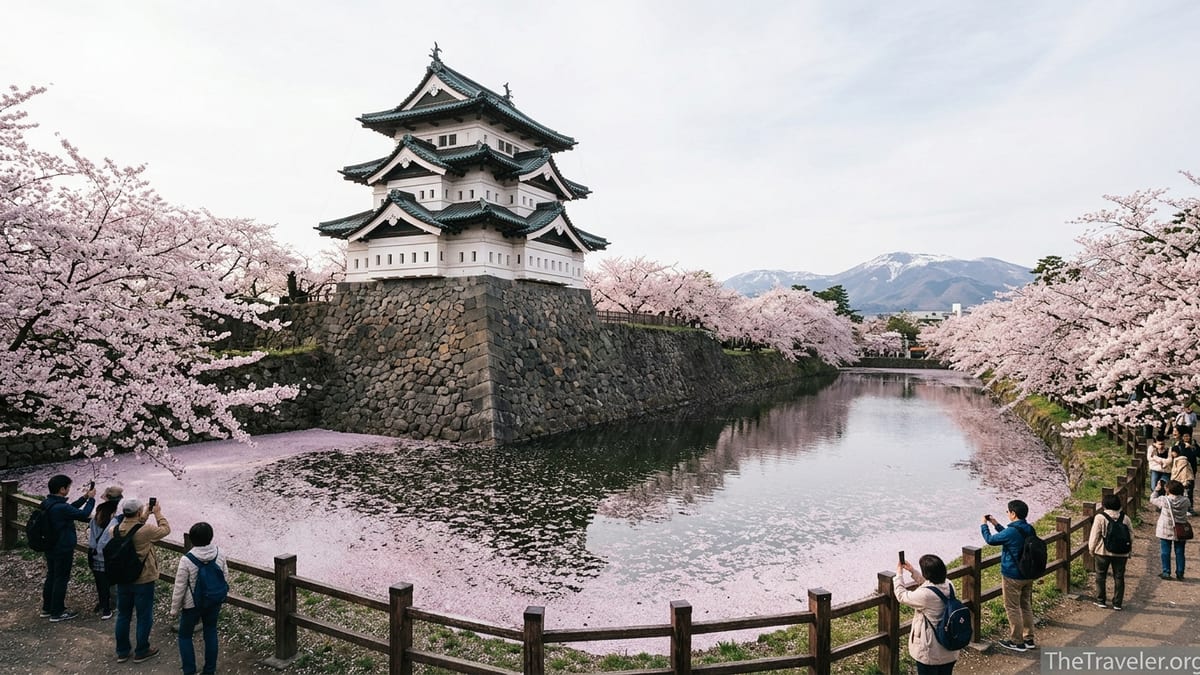
Hirosaki Park in Aomori Prefecture is one of Japan’s most famous cherry blossom destinations and a cornerstone of any late-sakura route. The park surrounds Hirosaki Castle and is packed with around 2,600 cherry trees, including long tunnels over the moats and lawns that transform into carpets of pink petals. The Hirosaki Cherry Blossom Festival typically runs from late April to early May, giving organizers enough flexibility to capture both the first bloom and the petal-fall “hanafubuki” that visitors love.
In many seasons, first bloom at Hirosaki Park appears around mid to late April, with full bloom often in the last third of April. In a recent example, forecast data placed first bloom at around April 20 and full bloom near April 26. For a traveler arriving in Tokyo in early April, this means you could enjoy the capital’s late-blooming varieties or other spring attractions, then ride the Tohoku Shinkansen north around April 20 to catch Hirosaki close to its peak. From Tokyo Station, the journey via Shinkansen to Shin-Aomori and a short local train onward takes roughly four hours, making it a realistic overnight shift in your itinerary.
Hirosaki’s appeal extends beyond the peak days. The castle’s western moat is famous for “sakura carpets,” where fallen petals accumulate on the water’s surface, often about a week after full bloom. Some travelers intentionally target this slightly later period, when the trees are past their absolute best but the moats are transformed into flowing pink rivers. If forecasts show that full bloom will hit earlier than usual, aiming for the “petal fall” phase can still deliver iconic photographs and a quieter atmosphere once domestic tour groups have moved on.
Because Hirosaki is a headline cherry blossom destination, hotel pressure is significant during the festival period. Mid-range business hotels near Hirosaki Station can sell out months in advance for late April weekends, and prices typically spike compared with shoulder season. Travelers who check rates in January often find rooms around the equivalent of 100 to 150 US dollars per night suddenly rise as tour buses and group bookings lock in. To manage this, consider booking cancellable rates in Hirosaki by December or January if your trip window is fixed, then adjust the exact nights once forecasts clarify. Alternatively, some visitors base themselves in Aomori City or even in nearby towns along the JR lines, commuting into Hirosaki for the day to avoid the tightest hotel crunch.
Kakunodate: Samurai Streets and Weeping Cherry Tunnels
Kakunodate in Akita Prefecture is a beautifully preserved former samurai town where austere black fences, traditional manor houses and gracefully drooping weeping cherry trees combine into one of northern Japan’s most atmospheric spring scenes. It is also a classic late-sakura destination. Historical patterns show that Kakunodate’s blossoms usually reach their best from late April through early May, often overlapping with Japan’s Golden Week holidays. Recent local data has recorded full bloom along the samurai residence street around April 17 to 20 and along the Hinokinai River around April 20 to 25.
The Kakunodate Cherry Blossom Festival is typically held every year from April 15 to May 5. By fixing the festival period rather than specific flower dates, the town accommodates natural variation in the season while ensuring that food stalls, temporary toilets and night illuminations are in place whenever the blossoms decide to cooperate. Visitors walking the samurai district during the festival can expect weeping cherries cascading over the fences, lanterns lighting up the trunks after dark, and a string of stalls near the river selling yakitori, local Akita sake and regional sweets.
Access from Tokyo is straightforward enough for independent travelers. The Akita Shinkansen connects Tokyo Station to Kakunodate Station in about three hours, with reserved seats often advisable on late April and Golden Week departures. From the station, the samurai district and the Hinokinai River are roughly a 20-minute walk or a short taxi ride. Some travelers choose to base themselves at Lake Tazawa or in nearby onsen towns, combining evening hot-spring soaks with daytime cherry blossom excursions to Kakunodate. A common pattern is two nights in the area: arrival and afternoon stroll through the samurai streets, a full day for riverbank picnics and manors, then onward by train to the next stop.
Hotel demand in Kakunodate surges during the April 15 to May 5 festival window, especially when full bloom appears to align with Golden Week. Small family-run inns may book out early with repeat domestic guests, while limited numbers of Western-style hotel rooms push prices up. A realistic scenario for a couple traveling in late April is finding that comfortable en suite rooms in and around Kakunodate cost notably more than in mid May, if they are available at all. To avoid being locked out, many travelers reserve accommodation six months ahead and accept that they may be arriving slightly before or after the absolute peak. If the trees bloom early, you can still enjoy lingering petals and spring greenery; if they bloom late, you may catch more buds than blossoms but benefit from quieter streets once the largest crowds have left.
Kitakami Tenshochi: River Walks and Festival Atmosphere
On the banks of the Kitakami River in Iwate Prefecture, Kitakami Tenshochi Park offers another strong late-sakura anchor for a northbound itinerary. The park is known for its long riverside rows of Somei Yoshino cherry trees, traditional carp streamer displays and boat rides under the blossoms. Historical averages place first bloom around mid April and full bloom in the second half of April, with some recent forecasts indicating first blossom around April 16 and full bloom near April 24. This makes Kitakami particularly appealing for travelers moving north from Sendai or Tokyo in mid to late April.
Kitakami’s cherry blossom festival generally runs from mid April to early May, with exact dates adjusted slightly year to year. During the festival, visitors can ride horse-drawn carriages beneath the trees, take river cruises when water levels allow, and join evening illuminated walks. Food stalls line the paths in peak periods, selling regional specialties such as Iwate beef skewers and local sweets. For budget-conscious visitors, Kitakami can feel less pricey than hyper-famous spots farther south, yet the atmosphere on a sunny weekend can rival them in energy.
Access to Kitakami is convenient via the Tohoku Shinkansen, which connects Tokyo and Sendai with Kitakami Station. From Tokyo, the ride takes around two and a half hours; from Sendai, about one hour. Tenshochi Park is reachable by local bus, taxi or a pleasant walk from the station, depending on your luggage and timing. A realistic itinerary might see you leaving Tokyo in the morning, checking into a business hotel near Kitakami Station by midday, then spending the afternoon and evening at the festival before heading on to Hirosaki or Kakunodate the following day.
In terms of accommodation, Kitakami offers a mix of business hotels and small inns. While rooms do tighten during peak festival weekends, availability is often a little better than in headline names like Hirosaki or Hakodate. Travelers booking two to three months ahead often find standard double rooms in central Kitakami at mid-range prices, and some choose to use the city as a practical base for exploring multiple late-sakura sites in southern Tohoku by local train. Even if blossom timing shifts by several days due to unusual spring temperatures, having a base within a short rail hop of several parks gives you options to chase whatever is currently at or near full bloom.
Hokkaido’s Sakura: Hakodate, Sapporo and Beyond
Hokkaido marks the final act in Japan’s cherry blossom season and is crucial for travelers who want to extend their sakura experience into early or even mid May. The island’s climate means blossoms here open significantly later than in Tokyo or Kyoto. Historically, popular spots such as Hakodate’s Goryokaku Park, Matsumae Park in southern Hokkaido and Sapporo’s Maruyama Park have tended to see first bloom around the end of April, with full bloom in late April or early May, though some years can be earlier or later by several days.
Goryokaku Park in Hakodate is a star attraction, combining a star-shaped Western-style fort with more than a thousand cherry trees. Visitors can stroll the moats at ground level or ride the nearby observation tower for panoramic views over a sea of pink. In some recent seasons, first bloom has been declared in the last week of April, with full bloom around the beginning of May. Matsumae Park, farther south on the same island, offers another deep late-sakura fix with its combination of castle, seafront location and hundreds of different cherry tree varieties, which help to lengthen the overall viewing window.
Sapporo, Hokkaido’s largest city, provides a practical urban base with extensive accommodation options and easy access to several blossom sites, including Maruyama Park and Moerenuma Park. Forecasts in recent years have often placed Sapporo’s first bloom around the final week of April, with full bloom in early May, though this can swing slightly depending on whether spring temperatures arrive early or lag. Because Hokkaido’s peak sometimes overlaps with Japan’s Golden Week holidays, domestic tourism can be intense. Hotels around Sapporo Station, Susukino and central Hakodate may see sharp price rises and high occupancy, particularly for family-sized rooms and higher-category properties.
For late-sakura planning, Hokkaido works best as the capstone to a journey that has already captured Tohoku at or near peak. A typical pattern might be to watch forecasts in March and early April, then commit to a Sapporo or Hakodate stay of three to five nights crossing the end of April and beginning of May. Even if one location misses peak by a few days, you can use rail passes or regional air connections to pivot between southern Hokkaido and Tohoku, chasing whichever park is currently blooming. Travelers who insist on a fixed, non-moveable date for a single location risk disappointment in an unusually warm or cold year, but those who treat Hokkaido as part of a flexible late-spring circuit usually find at least one memorable full-bloom day.
Building Flexible Northbound Routes
Because cherry blossom timing varies from year to year, it is more useful to think in terms of routes and windows than fixed dates. A classic late-sakura journey begins in Tokyo in early to mid April, moves through Tohoku as the month progresses, then finishes in Hokkaido around late April and early May. Within that framework, you adjust exact stays according to the season’s specific forecast. For example, if early April forecasts show average timing, you might plan Tokyo to Sendai, then on to Kitakami, Kakunodate, Hirosaki and finally Hakodate and Sapporo.
One practical route could look like this in broad strokes: arrive in Tokyo around April 8 to 10, spend several days adjusting to the time zone and enjoying late-blooming varieties or other sightseeing, then ride the Tohoku Shinkansen to Kitakami around April 18. After a day or two at Kitakami Tenshochi, continue to Kakunodate for weeping cherries and samurai houses, then travel onward to Hirosaki around April 22 to 24 for the castle park and moats. From there, take a limited express and, if convenient, an overnight in Aomori City before crossing by train or plane to Hakodate or Sapporo around late April, targeting Hokkaido’s early May peak.
If forecasts indicate an early season, you could shift the whole route forward by several days, reaching Tohoku sooner and Hokkaido by late April. Conversely, if the season looks late, you might extend your time in Tokyo, Nikko or the Japan Alps, then hit Kitakami and Kakunodate closer to the end of April, arriving in Hokkaido around the first week of May. Rail passes such as the Japan Rail Pass or regional Tohoku and Hokkaido passes can make these adjustments more affordable, allowing you to react to conditions rather than sticking to a rigid one-way ticket schedule.
The key is to lock in a skeleton itinerary that preserves flexibility at the edges. That usually means securing cancellable hotel reservations in key sakura hubs like Hirosaki and Sapporo three to six months before travel, while avoiding overcommitting to non-refundable stays in smaller towns. Many travelers hold two overlapping reservations in different cities for the same date, then cancel one once the forecasts become clearer a few weeks out. This approach carries some ethical responsibility: cancel as early as possible so other visitors can book, and avoid speculative hoarding of rooms you are unlikely to use.
Weather, Forecasts and How to Read Them
Weather is the main wildcard in cherry blossom planning. A colder than average March can delay the front by a week or more, while sudden warm spells can trigger rapid blooming followed by a short full-bloom window. In practical terms, this means that a date which delivered perfect full bloom last year might offer only buds or fallen petals this year. Late March and early April are the critical monitoring period: as temperatures settle, major Japanese weather companies refine their city-by-city projections for first bloom and full bloom across Tohoku and Hokkaido.
Forecasts usually provide two dates per location: the expected first blossom and the anticipated start of full bloom. First blossom marks the moment when a small percentage of flowers open on the sample trees, while full bloom is when about 80 percent or more of the flowers are open. For planning, you generally want to be in town between the projected full bloom date and about five days after, keeping in mind that wind and rain can shorten this window. For instance, if a forecast predicts full bloom in Hirosaki on April 26, aiming to be there between April 24 and April 29 gives you a buffer against minor shifts.
Because forecasts are revised over time, travelers should check them regularly in the six to eight weeks before departure. Many visitors track a few key reference cities rather than every single park. Tokyo gives a sense of how the season is starting, Sendai and Morioka hint at conditions in southern Tohoku, while Aomori and Sapporo act as bellwethers for Hirosaki and Hokkaido respectively. When you see that Tokyo has reached full bloom earlier than expected, it is often a sign that you should be ready to bring forward your Tohoku leg, whereas a sluggish season in Tokyo may translate into later peaks up north.
It is also important to manage expectations. Even in a year when you “miss” absolute full bloom by a few days, the experience can still be memorable. In many parks, buds, full blossoms and falling petals coexist within a surprisingly long stretch of time. Visitors to Kakunodate might find that the samurai district’s weeping cherries peak slightly before the riverbank Somei Yoshino, effectively stretching the viewing season. Similarly, at Hirosaki, early-blooming varieties near the castle keep and late-blooming trees along the moats can create a layered season in which different corners of the park are at their best on different days.
The Takeaway
Late-sakura travel in northern Japan is less about hitting a single “perfect” day and more about designing a route that follows the season as it ripples north. By focusing on hubs such as Hirosaki, Kakunodate, Kitakami and key Hokkaido cities like Hakodate and Sapporo, you give yourself multiple chances to encounter full bloom or magical petal-fall scenes even if the weather does not cooperate perfectly. The northbound cherry blossom front offers second and third chances that southern travelers rarely realize exist.
Success comes from flexibility and preparation in equal measure. Booking cancellable hotels in strategic locations, choosing rail passes that let you pivot, and watching updated forecasts from late winter onward will help you adapt in real time. Even when the season runs early or late, there is usually somewhere within a half-day’s train ride that is on the cusp of blooming or just entering full glory.
For those willing to embrace a bit of uncertainty, a late-sakura journey through Tohoku and Hokkaido can feel more spacious and intimate than the peak crowds of Tokyo or Kyoto. Historic castles framed by lingering snow on distant mountains, samurai streets draped in weeping blossoms, and star-shaped forts glowing pink at dusk provide a different mood to early spring farther south. Rather than lamenting missed petals in March, travelers can turn their eyes north and discover that Japan’s cherry blossom story still has many chapters left to unfold.
FAQ
Q1. When is the best time to plan a late-sakura trip to northern Japan?
For most years, arriving in Tokyo in early to mid April and reaching Tohoku between mid and late April, then Hokkaido around late April to early May, gives a good chance of encountering blossoms somewhere along your route.
Q2. How far in advance should I book hotels in Hirosaki, Kakunodate and Hokkaido?
For peak periods such as the Hirosaki Cherry Blossom Festival and Golden Week, it is wise to secure cancellable reservations three to six months in advance, especially for weekends and family rooms.
Q3. What happens if the cherry blossoms bloom earlier or later than expected?
If the season shifts, you can adjust your route by moving north faster in an early year or lingering longer in central Honshu in a late year, using rail passes and flexible hotel bookings to pivot.
Q4. Is it possible to visit Hirosaki, Kakunodate and Kitakami on the same trip?
Yes. With the Tohoku Shinkansen and local trains, many travelers combine all three over the course of four to six days, often starting in Kitakami, then continuing to Kakunodate and ending in Hirosaki before heading to Hokkaido.
Q5. Are cherry blossom festivals in northern Japan very crowded?
Popular spots such as Hirosaki Park, Kakunodate’s samurai district and Hakodate’s Goryokaku Park can be busy, especially on sunny weekends and during Golden Week, but they generally feel less compressed than peak days in Tokyo or Kyoto.
Q6. Do I need a rail pass for a late-sakura trip through Tohoku and Hokkaido?
A national or regional rail pass is not mandatory but often makes sense if you plan several long Shinkansen and limited express journeys as you follow the blossoms north.
Q7. Can I still enjoy northern Japan if I miss full bloom by a few days?
Yes. Many travelers find the petal-fall period, when moats and rivers fill with pink petals and paths soften underfoot, just as beautiful as the exact peak.
Q8. How should I dress for cherry blossom season in northern Japan?
Expect cool spring temperatures, especially in the evenings. Layered clothing, a light down jacket or fleece, and waterproof outerwear are practical choices for late April and early May.
Q9. Are English signs and information available at northern cherry blossom sites?
Major spots like Hirosaki Park, Kakunodate and Sapporo’s main parks usually provide at least basic English signage, and festival maps often include simple English or pictograms to guide visitors.
Q10. Is it necessary to rent a car for late-sakura travel in Tohoku and Hokkaido?
Public transport is sufficient for most cherry blossom itineraries, but renting a car can be helpful if you want to reach more remote viewpoints or combine sakura with rural hot-spring stays.