


My first Setouchi Triennale was the 2025 edition, when I spent six days island-hopping between Naoshima, Teshima, Inujima, Shodoshima, Megijima and Ogijima with an art passport on my phone and a growing collection of ferry tickets in my pocket. That trip, which cost me a little over 140,000 yen in total, taught me hard lessons about what the festival pass does and does not cover, how ferry bottlenecks shape your days, and how festival crowds transform the famously tranquil art islands of the Seto Inland Sea. With the Setouchi Triennale 2028 now confirmed, those 2025 experiences are the lens through which I plan my own return and help other travelers prepare.
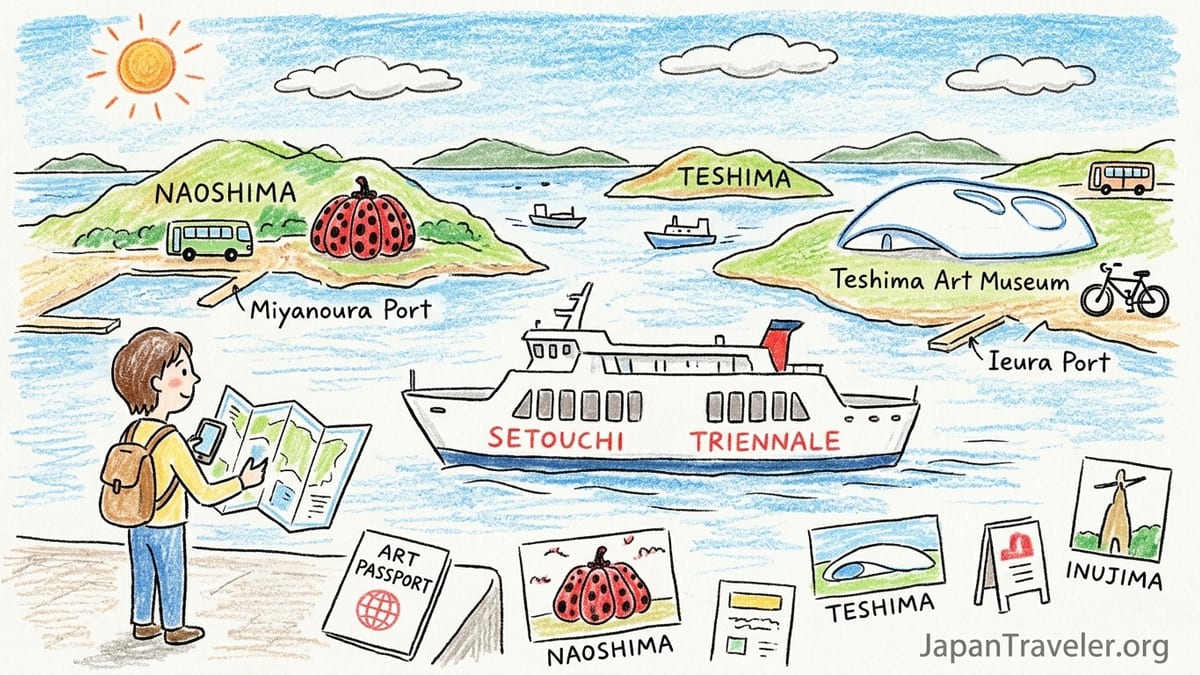
What I Actually Did at the 2025 Setouchi Triennale
My 2025 visit was built around a three-island focus: Naoshima, Teshima and Inujima, with shorter side trips to Shodoshima, Megijima and Ogijima. I based myself first in Takamatsu for three nights, then Okayama for two, using each as a hub for ferry connections. I bought a single-season digital Art Appreciation Passport for 4,500 yen on the official Setouchi Triennale app, timed for the spring session that ran from April into late May 2025. That pass became my main ticket for festival artworks and several participating museums, but it did not cover everything I wanted to see.
From Takamatsu, I ferried to Naoshima twice and to Teshima and Shodoshima once each. From Uno Port, reached via Okayama and the Uno Line, I took the boat to Inujima and later out to Megijima and Ogijima. Over six days I visited Naoshima’s Honmura and Benesse House area, Teshima’s Ieura and Karato zones, Inujima Seirensho and its Art House Project, and select outdoor installations and village projects on the smaller islands. I did not attempt every artwork, which would have been impossible given ferry schedules, but used the official map to cluster sites into walkable loops.
Accommodation was modest: a business hotel near Takamatsu Station for around 9,000 yen per night and a similarly priced place near Okayama Station later. Ferries and local transport added up quickly. Standard ferries between Takamatsu and Naoshima were around 700 to 800 yen one way for an adult, and similar for Teshima and Megijima, while the boat from Uno to Naoshima was about 680 yen. A high-speed boat to Teshima cost more than 1,000 yen. By the end of the week I had spent roughly 20,000 yen on ferries and local buses alone, 8,000 to 9,000 yen on museum tickets not covered by the pass, and about 5,000 yen per day on meals and snacks.
That mix of a festival pass, separate museum tickets, and pay-as-you-go ferries shaped how I moved. I prioritized islands where the pass covered many sites in one day and treated the most expensive separate-ticket museums as anchor visits, booking time slots where required. This firsthand 2025 experience is the foundation for my more cautious, no-guesswork approach to the 2028 edition.
Three Seasonal Sessions: How 2025 Worked and What 2028 Has Announced
The Setouchi Triennale has long used a three-session structure that spreads the festival across spring, summer and autumn, both to ease pressure on tiny islands and to showcase different seasonal landscapes. In 2025, the event was divided into these three periods between April 18 and November 9, with some artworks and islands participating only in certain sessions. That meant my April and May visit gave me Naoshima, Teshima and a number of smaller islands at full festival mode, but certain autumn-only projects on farther islands remained out of reach.
The seasonal system matters in practical ways. In 2025, some outdoor installations and community-based works opened only in summer and autumn, when local volunteers and student groups were available. A few boat routes, such as special festival-only shuttles, also ran on limited dates. Conversely, the spring period offered milder weather, fewer school-holiday crowds, and more manageable heat for cycling on Naoshima or Teshima. However, weekday visits in April still saw full boats on popular morning departures.
Looking ahead, 2028 is confirmed to follow the three-session model again, but with its own exact dates. Current announcements indicate that the 2028 Setouchi Triennale is planned from April 14 to November 12, divided into a spring session from April 14 to May 28, a summer session from late July to late August, and an autumn session from late September to mid-November, totaling about 117 festival days. Those dates are official plans, but visitors should still verify details on the festival site and with local tourism offices closer to departure, because fine-grained timetables and artwork lists are typically published gradually.
It is essential not to treat my 2025 trip pattern as a prediction for 2028. The core idea of three sessions will continue, and some islands such as Naoshima, Teshima, Shodoshima, Megijima, Ogijima and Inujima are already named as venues again, but the specific artworks, opening days for each island, and any extra ferry services will be unique to 2028. Planning should start with the announced 2028 session you intend to visit, then be refined once the festival releases its detailed calendars and pass information.
Festival Pass vs Separate Tickets: What I Actually Saved in 2025
In 2025, the Art Appreciation Passport was sold in several formats, including a single-season pass at 4,500 yen and multi-season options for travelers attending more than one session. I chose the single-season digital passport. During my spring trip I used the pass for about 15 distinct artworks or facilities: multiple village installations on Megijima and Ogijima, several Triennale projects on Naoshima and Teshima, and both the Inujima Seirensho Art Museum and the Inujima Art House Project, which participated in the festival framework.
Financially, the pass paid off, but only because I focused on festival-linked sites. Standard individual admissions during non-festival periods for places like the Inujima Seirensho Art Museum or some house projects are often in the 2,000 yen range for a combined ticket, while Triennale-specific installations typically charge several hundred yen each. By counting up posted door prices, I estimated I would have spent around 9,000 to 10,000 yen in admission fees for the sites I entered during that week. The 4,500 yen pass roughly cut that outlay in half.
However, the passport did not cover some of the Setouchi region’s most sought-after museums. The Chichu Art Museum on Naoshima, famous for its James Turrell and Walter De Maria installations, required a separate timed-entry ticket that I booked online in advance at around 2,100 yen. The Teshima Art Museum, dedicated to Rei Naito’s Matrix in a single, remarkable concrete shell, also charged its usual admission on top of the festival pass. Certain Naoshima Art House Project pieces with strict capacity controls, such as Kinza, maintained separate ticketing and advance reservation systems. These exceptions meant that, even with the passport, I spent another 6,000 to 7,000 yen on stand-alone museum tickets.
From a pure cost perspective, the passport makes the most sense if you plan to see a broad sample of Triennale works across multiple islands in a single session. Travelers who only want the headline permanent museums like Chichu, Benesse House Museum, Lee Ufan Museum and Teshima Art Museum, and who are indifferent to community-based installations or temporary festival works, might find that buying individual museum tickets during a non-festival year keeps total spending similar without the complexity of session-limited passes.
Island Experiences: Where I Went and How It Felt
Naoshima was my base reference point during the 2025 Triennale. I entered via Miyanoura Port from Takamatsu, where the red pumpkin by Yayoi Kusama greeted a crowd lining up for shuttle buses and rental bicycles. With the passport and separate museum bookings, I visited Benesse House Museum and several outdoor works near the shoreline, then rode the local bus to Honmura for the Art House Project. The atmosphere during the festival was lively and international, with queues forming even for small installations. A short walk between houses sometimes meant folding into slow-moving lines and knowing I could not see everything in one day.
On Teshima I disembarked at Ieura Port, picked up a rented bicycle and cycled the hills to Karato and back. The Teshima Art Museum, my primary goal, required a specific entry time purchased in advance, and the lineup at the entrance was carefully managed. Festival installations were scattered along the coastal road, some integrated into old houses, others in fields. The festival pass granted entry to several of these, but cafes and food trucks struggled with midday surges of visitors. At lunchtime I waited close to 40 minutes for a simple set meal and coffee, and by the time I returned my bicycle in late afternoon, the last boats back to Takamatsu were nearly full.
Inujima was different again. The boat from Uno to Inujima carried far fewer passengers than the Naoshima ferries, but nearly everyone on board headed straight from the small port to the Seirensho Art Museum and the adjacent Art House Project. The Seirensho complex, built into a former copper refinery, is part of the permanent Benesse Art Site, and its industrial ruins and quiet garden paths contrasted sharply with the bustle of Naoshima. Within the museum, visitor numbers were capped, creating a calm experience. My festival passport was scanned here and at the nearby houses, so the only extra cost was the ferry itself and a basic lunch at the island’s main cafe.
Shodoshima, Megijima and Ogijima offered smaller slices of the festival for me. I took a day trip from Takamatsu to Shodoshima’s Tonosho Port and focused on seaside installations reachable on foot and bus, leaving the island’s interior and more remote projects for another time. On Megijima and Ogijima, reached by short ferries from Takamatsu, I spent a half day wandering narrow alleys and hillside paths dotted with artworks, from colorful interventions in abandoned houses to small pavilions overlooking the sea. These two islands felt closer to a village-scale art walk than a museum itinerary, with more spontaneous encounters and fewer ticketed doorways.
Ferries, Local Transport and the Reality of Festival Crowds
Ferries are the real timetable of the Setouchi Triennale, and in 2025 they were where crowding felt most intense. Popular morning departures from Takamatsu to Naoshima or Teshima often filled up well before sailing time, especially on weekends and during national holidays. On one April Saturday, I arrived 35 minutes early for the Naoshima ferry and was already halfway down the boarding queue. Some travelers who arrived closer to departure had to wait for the next boat. Smaller passenger-only boats, particularly those linking Uno with Inujima and Teshima, had limited capacity and no advance reservations, so arriving early was the only insurance against missing a planned museum slot.
On board, ferries could feel crowded but generally remained orderly. There was usually enough space for hand luggage, but large suitcases created bottlenecks in narrow stairwells. This aligned with the advice I heard from local tourism staff and hotel front desks: send big bags ahead with a luggage delivery service if possible and approach the islands with small backpacks only. Shuttle buses on Naoshima sometimes left passengers behind at peak times, although additional services were often put on during the festival. On Teshima, rental bicycles sold out by mid-morning on my visit, leaving later arrivals reliant on infrequent buses or long walks.
Within museums and installations, crowding varied. The Teshima Art Museum controlled entries so carefully that once inside, the experience remained contemplative, though I waited more than 20 minutes outside to begin my time slot. In contrast, some smaller Triennale works in village houses allowed more flexible flows, and at midday the line could stretch around corners, leading to 30-minute waits for 5 to 10 minutes inside. Eating also required patience. On Naoshima’s Miyanoura waterfront cafes ran at full capacity, with lineups out the door at lunchtime. On Megijima and Ogijima, the handful of open eateries quickly filled, so I was grateful for convenience store snacks purchased in Takamatsu beforehand.
This combination of limited ferry capacity, concentrated meal options and time-controlled installations created a constant pressure to move quickly between sites. Several times I had to abandon potential artworks to ensure I caught a ferry back to the mainland. The lesson I carried into my thinking for 2028 is simple: choose fewer islands, aim for earlier boats, and reserve key museum slots first, letting everything else orbit around those anchors rather than chasing a long checklist.
Festival Atmosphere vs Non-Festival Visits
Setouchi’s art islands are not blank slates in non-festival years. Permanent institutions like Benesse House Museum, Chichu Art Museum and the Lee Ufan Museum on Naoshima, Teshima Art Museum, and Inujima Seirensho operate on their own calendars and ticketing systems even when the Triennale is not running. I have also visited Naoshima and Teshima outside festival periods, and the difference in atmosphere compared with my 2025 Triennale trip was striking.
On a non-festival visit to Naoshima before 2025, I stayed at a small guesthouse near Honmura and walked the Art House Project sites with only a handful of other visitors around. Ferries were still busy in the morning but rarely packed to the door. I could board shuttle buses with no problem and linger longer in each installation. Restaurants in Miyanoura filled at peak times but still had room for walk-ins. My total spending on that quieter trip, which focused on three major museums and a couple of house projects, ended up comparable to the 2025 festival day I spent on Naoshima, even though no Triennale pass was involved.
Teshima was similar. On a previous autumn visit unrelated to the festival, I booked the Teshima Art Museum and then wandered the island with far fewer time pressures. Some small cafes were closed midweek, but the trade-off was open coastal roads and peaceful hillside views. Without temporary Triennale works, my itinerary was simpler: one or two museums, a relaxed lunch, and a ferry back. Those non-festival trips convinced me that travelers whose primary interest lies in the permanent Benesse and related institutions might have a richer, more focused experience in an off-year, free from the festival’s crowd surges and the temptation to over-schedule.
By contrast, the 2025 Triennale wrapped the islands in an event atmosphere. Pop-up information booths at Takamatsu and Uno ports, branded signage and additional volunteers made logistics clearer, and the sense of shared discovery across multiple islands was real. In small villages on Megijima or Ogijima, community members welcomed visitors into former schools or homes repurposed as art spaces. Limited-time performances and participatory works added layers you simply cannot access outside a Triennale year. The trade-off was more queuing, more competition for ferry seats and meals, and a higher chance that you would leave an island feeling that you ran out of time.
Looking Ahead to 2028: Planning Framework, Not Predictions
The Setouchi Triennale 2028 program is still evolving, but confirmed information already gives travelers a framework. It will again center on Takamatsu and Uno as mainland hubs, with Naoshima, Teshima, Shodoshima, Megijima, Ogijima, Inujima and several other islands participating across three sessions from mid-April to mid-November 2028. An Art Appreciation Passport or equivalent festival pass is expected, though exact prices and coverage details have not yet been published. Permanent museums managed by Benesse and related foundations are likely to maintain their own separate admissions and reservation systems.
For accommodation, Takamatsu remains the most versatile base, with business hotels and mid-range properties clustered near the station and ferry terminal, and easy connections to Naoshima, Teshima, Shodoshima, Megijima and Ogijima. Uno and nearby Okayama provide another good base, especially if your focus is Naoshima and Inujima, with the Uno Line connecting Okayama Station to Uno Port in about an hour. Serious art travelers might consider splitting their stay between Takamatsu and Okayama, as I did in 2025, to reduce early-morning cross-bay commutes.
In terms of trip length, my 2025 experience convinced me that four to six full days in the region is the sweet spot if you want to sample three or four islands without rushing. For a spring 2028 plan, a reasonable framework would be two Naoshima days (one largely for permanent museums, one for festival works and village art), one Teshima day, one Inujima plus Okayama or Uno area day, and an optional fifth day for either Shodoshima or a Megijima and Ogijima combination. Summer and autumn visits may require extra buffer days to absorb schedule changes, heat, or typhoon-related disruptions.
For tickets and official updates, visitors should monitor the Setouchi Triennale’s official site, regional tourism portals such as those for Kagawa and Okayama Prefectures, and the Benesse Art Site Naoshima site for museum-specific announcements. In 2025, the official mobile app became a key platform for purchasing passports and receiving notices, although English navigation lagged behind Japanese updates. By 2028, this digital infrastructure may improve, but it is still important to cross-check any third-party booking sites with official sources to confirm pass validity, blackout dates and what exactly is included.
Costs, Value and What I Would Change for 2028
When I totaled my 2025 spending for the Setouchi Triennale, the numbers looked roughly like this: around 45,000 yen for five nights of mid-range accommodation, approximately 20,000 yen for ferries and local transport, 4,500 yen for the Art Appreciation Passport, about 7,000 yen in separate museum tickets, and around 30,000 to 35,000 yen on meals, snacks and incidental purchases over six days. Factoring in rail travel to and from the region, the all-in cost passed 140,000 yen. For that amount, I visited six islands, entered more than 20 artworks and museums, and experienced a cross-section of architecture, landscape art and community projects that would be impossible in a single city break.
What felt most worth the expense were the permanent museums that anchor the region. The Teshima Art Museum justified every yen and every minute spent on reservations and ferry planning. Chichu Art Museum and Benesse House Museum on Naoshima, and the Inujima Seirensho complex, delivered immersive experiences that lingered long after I left. On the festival side, small-scale projects in village houses on Megijima and Ogijima, where local residents casually chatted with visitors, offered unique insight into island life and made the festival feel rooted rather than imported.
What felt overpriced or frustrating was rarely the sticker price of tickets and more often the hidden cost of lost time. Standing in line for ferries or installations, or rushing up a hill to make a departure, took a toll. A couple of meals on Naoshima and Teshima were more expensive than their quality justified, clearly inflated by festival-driven demand. I wished I had carried more snacks and water to reduce reliance on crowded cafes. I also regretted trying to see too many islands in too few days. My single day split between Megijima and Ogijima left little time to digest the art or simply watch the sea.
For 2028, I will plan differently. I intend to focus on three core islands instead of six, probably Naoshima, Teshima and Inujima, and to dedicate one slow buffer day with no art goals at all, just walking in Takamatsu, Uno or Okayama. I will buy the festival pass only after I see clear information about its coverage relative to permanent museums and will reserve key museum slots first before building the rest of my schedule around ferry timetables. Most importantly, I will treat ferries as finite resources rather than flexible shuttles and will arrive at ports earlier, even if that means more quiet time with a book and a view of the Seto Inland Sea.
The Takeaway
My 2025 Setouchi Triennale trip was rewarding, but it was also demanding. The art passport reduced admission costs when I used it intensively across multiple islands, yet it did not replace separate tickets for marquee museums. Ferries and buses worked reliably but sometimes reached capacity long before departure, and the pressure of moving from artwork to artwork, island to island, meant that I occasionally lost sight of the quiet, contemplative moments that the Seto Inland Sea landscape invites.
For travelers eyeing the 2028 edition, the festival’s three seasonal sessions offer flexibility, but they also require careful reading of dates and island participation. Those who care most about the permanent Benesse and related museums might prefer a non-festival year, when crowds thin and itineraries are simpler. Those who crave the energy of a living art event, with temporary installations, community projects and a sense of shared discovery across boats and villages, will find the Triennale worth the extra effort and cost.
Above all, success at Setouchi is less about checking off every artwork and more about choosing a manageable set of islands, anchoring your days around a few must-see museums, and treating ferries, food and rest as integral parts of the experience rather than logistical afterthoughts. If you approach 2028 with that mindset, informed by the lessons many of us learned painfully in 2025, you will be better placed to enjoy both the art and the sea that continues to inspire it.
FAQ
Q1. Is a Setouchi Triennale festival pass necessary to enjoy the 2028 edition?
For visitors planning to see multiple Triennale artworks across several islands in one session, a festival pass is likely to save money and simplify entry. Travelers focused mainly on permanent museums like Chichu Art Museum, Benesse House Museum or Teshima Art Museum, which often require separate tickets anyway, might find that individual admissions in a non-festival year provide equal or better value.
Q2. How many days should I allocate for the Setouchi Triennale 2028?
Based on my 2025 experience, four to six full days in the region is ideal if you want to visit three or four islands without constant rushing. A shorter three-day visit can work if you focus tightly on Naoshima and Teshima, while longer trips allow time for Inujima, Shodoshima or smaller islands such as Megijima and Ogijima.
Q3. Which island should I prioritize if I only have time for one?
If you have to choose just one, Naoshima remains the most balanced introduction, combining major museums, outdoor artworks and village-scale projects. It has the widest range of accommodation and dining near the ports and integrates both permanent Benesse institutions and festival-specific installations during Triennale years.
Q4. How far in advance should I book museums like Chichu or Teshima Art Museum?
In 2025, timed tickets for Chichu Art Museum and Teshima Art Museum could sell out days or weeks ahead during busy periods. For 2028, it is wise to secure these reservations as soon as booking opens for your target dates, especially for weekends or public holidays, then plan ferries and other island visits around those confirmed slots.
Q5. Are ferries during the Triennale bookable in advance?
Most standard ferries between Takamatsu, Uno and the main islands operated on a first-come, first-served basis in 2025, with tickets purchased at the port on the day. Some special or high-speed services may offer advance sales, but in practice arriving 30 to 60 minutes early for popular morning departures is the most reliable way to secure a spot.
Q6. What is the best base city for visiting multiple art islands?
Takamatsu is usually the most convenient single base, with frequent ferries to Naoshima, Teshima, Shodoshima, Megijima and Ogijima and good rail links to other parts of Japan. For travelers focused on Naoshima and Inujima, staying in Okayama or Uno can shorten morning port transfers. Splitting a stay between Takamatsu and Okayama worked well for me in 2025.
Q7. Will restaurants and cafes be overwhelmed during the 2028 festival?
During the 2025 Triennale, popular cafes on Naoshima, Teshima and the smaller islands were often at or beyond capacity at midday, leading to 30-minute or longer waits. For 2028, you should expect busy peak hours again, carry snacks and water from mainland convenience stores, and consider eating early or late to avoid the biggest crowds.
Q8. Is cycling a good way to get around Naoshima and Teshima during the festival?
Cycling is an excellent way to explore both islands, but rental bicycles can sell out by mid-morning on peak festival days. In 2025 I found an electric bike invaluable on Teshima’s hills. For 2028, aim for early ferries if you plan to rent a bike and be prepared to switch to local buses or walking if rentals are unavailable.
Q9. How much should I budget per day at the Setouchi Triennale?
My 2025 costs averaged roughly 20,000 to 25,000 yen per day, including mid-range accommodation, ferries and buses, museum admissions, meals and incidental spending. Travelers on tighter budgets can reduce this with hostel stays, careful island selection and picnics, while those seeking higher-end hotels or fine dining should plan for significantly more.
Q10. Is it better to visit during the Triennale or in an off year?
It depends on your priorities. The Triennale offers a dense concentration of temporary artworks, performances and community projects across many islands, creating a unique atmosphere. Off-year visits are calmer, with fewer crowds and simpler logistics, ideal for travelers whose main interest is the permanent museums and the quiet landscapes of the Seto Inland Sea.