


I landed in Okinawa expecting an easy, “Japan’s Hawaii” kind of week: turquoise water, a couple of beach days, then a quick hop to another island or two. What I got instead was a lesson in distances, weather windows, and how different each Ryukyu island group feels once you’re actually traveling through the archipelago like a parent juggling luggage, snack breaks, and transfer clocks.
Our family arrived from Tokyo Haneda on a morning flight into Naha Airport (OKA). We based ourselves on Okinawa Main Island for 4 nights, then took a ferry from Tomari Port to the Kerama Islands for 2 nights, flew Naha to Miyako (Miyako Airport, MMY) for 3 nights, and finished with 4 nights in the Yaeyama Islands using New Ishigaki Airport (ISG) as our hub. In plain numbers: 13 nights, four different airport check-ins (Haneda, Naha, Miyako, Ishigaki), multiple ferries, and two rental car pickups that taught me exactly when a car is essential and when it’s just an expensive stroller substitute.
Before arriving, I pictured the Ryukyus as a single vibe: beachy, slow, warm, and resorty. After two weeks on the move, I’d describe it differently. Okinawa Main Island felt like a busy subtropical prefecture with real city life, traffic, and history right under the neon. The Keramas felt like a marine park first and a town second, ruled by boat timetables and sea conditions. Miyako felt engineered for beach driving: long straight coastal roads, sugarcane fields, and bridges that make island-hopping deceptively easy. Yaeyama felt the most “edge of Japan” to me: ferry terminals humming at sunrise, mangrove tours that left my kids muddy and happy, and a strong sense that local identity here isn’t a marketing slogan.
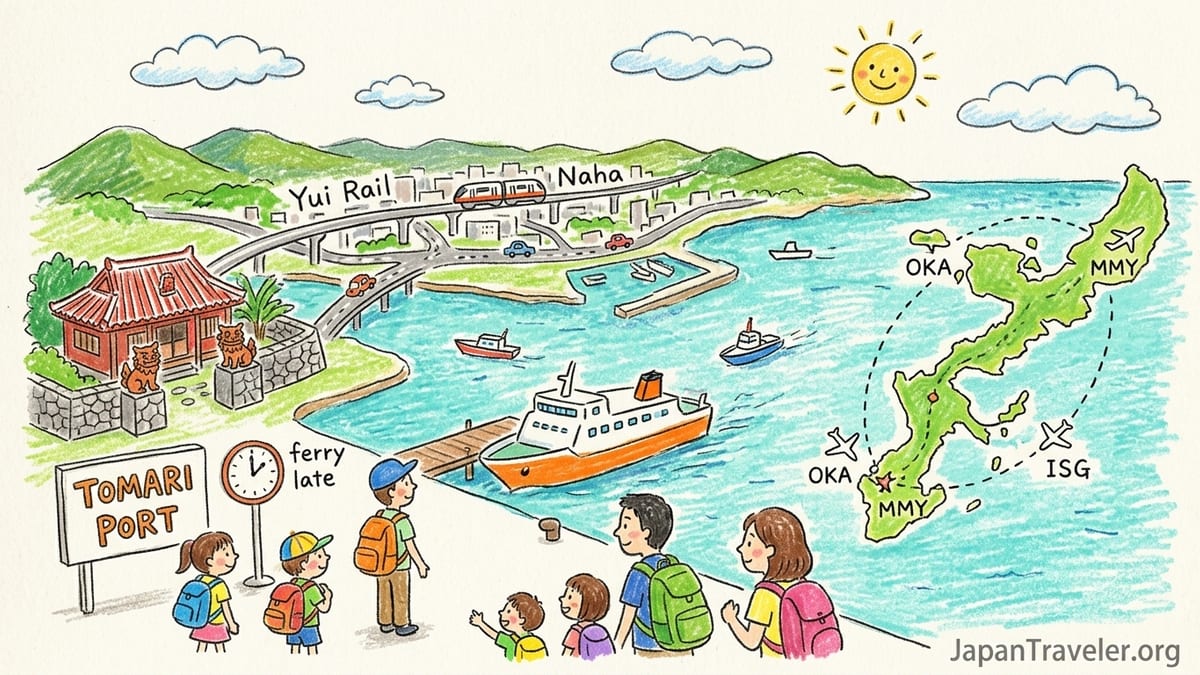
My Route, Airports, And The First Mistake I Made Planning The Ryukyus
I built our itinerary thinking it would be like hopping Greek islands: frequent connections, short transfers, easy same-day moves. The map looks compact, but the Ryukyus are a long chain and the travel days are real. We did Haneda to Naha (OKA) first, because Naha is the archipelago’s practical gateway with lots of airlines serving it. From there we planned a Kerama side trip by ferry, then flights onward to Miyako (MMY) and Ishigaki (ISG).
The first mistake: I tried to combine “too many Ryukyu flavors” in too few days. In practice, each move has hidden time sinks: packing sandy kids, returning rental cars, shuttle buses to off-airport rental depots, waiting at a ferry terminal, and the reality that boats can be delayed or canceled. I had originally sketched out a one-night Kerama visit as a “quick dip.” I’m grateful we changed it to two nights, because even when everything runs smoothly you lose chunks of daylight to departure schedules and check-in.
The second mistake: I underestimated transfer time between Naha Airport and Tomari Port (the ferry terminal area used for Kerama ferries). On paper it’s close. In real life, you still need to physically get to the Tomarin terminal building at Tomari Port, queue at the ticket office, and handle boarding formalities. If you’re coming off a flight, especially with kids or checked luggage, the stress compounds quickly.
Okinawa Main Island: City Energy, War Memory, And Beaches That Don’t Feel “Resort”
We spent our first 4 nights on Okinawa Main Island, splitting time between Naha and a drive north. What surprised me immediately was how “lived-in” Okinawa feels compared with the fantasy image many travelers carry. Naha has the practical pulse of a real working city: commuting traffic, compact streets, shopping arcades, and families out for dinner. If you come expecting only palm trees and pool bars, the urban texture can feel like a mismatch, but I grew to appreciate it as the anchor that makes the rest of the island chain make sense.
In Naha, we didn’t rent a car immediately. That was intentional, and it saved us money and hassle. The Yui Rail monorail is a clean, kid-friendly way to reach central Naha from the airport, and it kept our first day simple. Once we headed north, we rented a car from a major chain that shuttles customers to their depot near the airport. The “gotcha” is that rental car desks aren’t typically inside the terminal; you budget time for a shuttle ride and paperwork, then the drive out of the airport area.
Okinawa’s beaches on the main island taught me a basic Ryukyu truth: beautiful water doesn’t always mean the most relaxing swim. Some popular beaches are managed, with nets, posted flags, and clearly marked zones, while other spots can be reefy, shallow at low tide, or prone to currents. The sea color close to shore often shifted by the minute: pale mint over sand, then a sudden deeper blue where the reef edge drops off. It’s gorgeous, but it didn’t feel like a single endless resort beach the way I’d naïvely imagined.
Culturally, Okinawa Main Island is also where the “Ryukyu is not just mainland Japan with better weather” idea finally clicked for me. You feel it in place names, the local pride around traditional performing arts, and the fact that Ryukyuan history is visible in a way that isn’t just decorative. Even if you keep your sightseeing light because you’re traveling with kids, the atmosphere differs: it’s Japan, but it isn’t simply “Tokyo with palm trees.”
Kerama Islands By Ferry: Tomari Port Reality, Sea Conditions, And Pace Of Life
After Okinawa Main Island, we moved by ferry from Tomari Port in Naha to the Kerama Islands for 2 nights. This was the portion of the trip that most punished my planning optimism. Tomari is not an “arrive and float away” experience; it’s a working terminal. You go to the correct ticket counter, handle the boarding form process, and then wait in a way that feels closer to commuting than cruising. With kids, I recommend arriving early enough that nobody is melting down while you’re trying to read signage and keep track of passports, tickets, and snacks.
Kerama life felt immediately slower once we stepped off the boat. The towns are small, the roads are quiet, and the daily rhythm is tied to ferries, weather, and what’s open for dinner. This is where I made my third mistake: I booked a beautiful remote hotel because the photos looked like the dream. The reality was that there wasn’t a convenient restaurant cluster nearby, and after a long day of sun and salt we ended up eating convenience-store style food more than I’d planned. With children, proximity to a couple of dependable dinner options matters more than the view from the balcony.
On the water, the Keramas delivered the clearest blues of our entire trip, the kind of clarity that makes kids shout even if they’re glued to a tablet on the ride over. But that clarity comes with safety considerations. We leaned heavily on local beach rules, and we checked marine safety guidance before letting the kids snorkel even in seemingly calm coves. If you’re traveling in warmer months, it’s smart to build flexibility into your schedule because sea conditions can change quickly and boats can be canceled for safety.
The Keramas also taught me a lesson about timing: don’t schedule a major marine excursion immediately before a flight. I had initially considered snorkeling on the morning of our departure back to Naha, then connecting to an afternoon flight. Between fatigue, wet gear, and the risk of rough seas delaying boats, it was a recipe for stress. We moved our “big water day” earlier in the stay and kept departure day simple.
Miyako Islands: Humidity, Beach Geometry, And When A Rental Car Actually Helps
From Naha, we flew to Miyako (Miyako Airport, MMY) for 3 nights. The flight itself was straightforward, but the shift on arrival was immediate: Miyako felt like it runs on cars. The distances between beaches, viewpoints, and dinner spots are just long enough that taxis add up fast, and public transport isn’t the kind of all-day, every-neighborhood network many families are used to in big Japanese cities.
In Miyako, renting a car made sense for us, but I still managed to overdo it. I booked the car starting immediately upon arrival, then realized our first afternoon was better spent walking, eating, and getting over travel fatigue. If your first night is close to town or close to your hotel’s beach, you might consider delaying the rental by a day. On the flip side, once we started beach-hopping, having a car transformed our days: quick stops for sunscreen re-ups, dry clothes, and an emergency air-conditioned cool-down when the humidity felt like a warm blanket.
Miyako’s sea color looked different from Okinawa Main Island to my eyes: broader gradients of pale turquoise over sandbars, with fewer “busy” coastal buildings in some stretches and a more open feeling when you’re driving along the coast. Beaches here felt designed by nature for swimming: long, sandy entries and wide shallows that were family-friendly at the right tide. The coral story is still present, but the experience felt more like “beach geometry” than “reef maze,” at least from a kid’s-eye level.
One important practical detail: Miyako’s island-hopping can feel deceptively simple because several nearby islands are connected by bridges. That ease can trick you into packing too much into each day. We did it once, stacking a long bridge drive, a beach stop, a late lunch, and a sunset viewpoint. By dinner time everyone was cranky. The lesson for parents: Miyako rewards slower days. Pick one main beach and one backup beach, then stop trying to “collect” every scenic spot.
Yaeyama (Ishigaki And Nearby Islands): Ferry Terminal Mornings And The “Archipelago Feel”
We finished with 4 nights based in Ishigaki (New Ishigaki Airport, ISG), using ferries to visit smaller Yaeyama islands on day trips. If you want to understand the Ryukyus as an archipelago instead of a single island destination, Yaeyama is where it becomes tangible. Your day often starts at the port, scanning boards, buying tickets, and watching groups fan out to different boats. The ferry terminal becomes part of the travel experience, not just a place you pass through.
We did a day trip to Taketomi from Ishigaki, a short ride that felt almost like a commute for locals, but an adventure for our kids. Ferries on this route run frequently in peak periods and are operated by the region’s well-known companies. The rhythm is simple: arrive early, get the right line, keep your ticket handy, and accept that you’re sharing the boat with everyone from scuba divers to grandparents traveling with groceries.
On these smaller islands, the texture of life felt even more local than on Okinawa Main Island. Towns are compact, and the pace is slow in a way that’s not staged. It’s also where I felt language differences most clearly. Standard Japanese will take you far, but you’ll hear local pronunciations and place names that don’t sound like what you practiced from a Tokyo phrasebook. My kids noticed it first, asking why some signs looked “different” or why the music at events didn’t sound like what they’d heard on the mainland.
Yaeyama also forced me to get serious about weather and sea risk planning. If the sea is rough, ferries can be canceled or rerouted, and that can disrupt everything you’ve reserved on the other side. We treated ferry day trips like “weather-permitting” experiences and made sure we could still have a good day on Ishigaki itself if plans changed.
What The Ryukyus Taught Me About Food, Driving, Resorts, And Culture Beyond “Japan’s Hawaii”
Food was one of the easiest ways to feel the Ryukyus as distinct. Even when we kept meals simple to keep our kids happy, we repeatedly ran into Okinawan specialties and local styles that don’t feel like Tokyo or Kyoto dining. Some nights were family-friendly set meals; other nights were market snacks and something quick back at the hotel because we’d misjudged distance or restaurant hours.
Driving across the Ryukyus is its own topic. On Okinawa Main Island, driving felt like driving in a busy prefecture: multi-lane roads, shopping centers, and real congestion at peak times. In Miyako and Ishigaki, driving felt more like coastal countryside, but with its own stressors, including navigating to remote beaches, finding parking, and dealing with sudden downpours that turned a sunny plan into a windshield-wiper slog. It’s manageable, but you should mentally categorize driving days as “real travel days,” not “rest days.”
Resort development also varies dramatically by island group. Okinawa Main Island has large-scale resort areas and built-up tourist zones, but also neighborhoods that feel purely local. Miyako has a resort feel in certain coastal stretches, while also offering wide open scenes that look almost empty from the road. Ishigaki’s development felt mixed, with plenty of visitor services but also a working-island atmosphere that never fully disappears.
The biggest shift in my thinking was cultural. Calling the Ryukyus “Japan’s Hawaii” is tempting because it helps people picture warm seas and a vacation vibe, but it also flattens what makes these islands important and distinct. The Ryukyus have their own historical identity, and even on a family trip focused on beaches, that difference is visible: in music, local pride, architecture, and the sense that you’re in a borderland shaped by ocean routes and a complex past. Treating that difference with respect made the trip feel richer than a simple tropical escape.
The Takeaway
Traveling the Ryukyu Islands as an archipelago is less like taking one beach vacation and more like running a relay: each leg has its own rules, its own timing, and its own weather risks. The payoff is that you don’t just see “Okinawa.” You feel the chain’s variety: city energy and history on Okinawa Main Island, marine-park life in the Keramas, beach-driving freedom in Miyako, and ferry-linked island culture in Yaeyama.
If I could redo our trip, I’d keep the number of bases the same but make each base longer by trimming ambition inside each island group. I’d also plan every transfer day like a real event, not a footnote between beaches. That means earlier departures, backup plans for ferry cancellations, and not treating the ocean like a guaranteed theme park ride.
Most importantly, I’d stop trying to force one description onto the whole chain. The Ryukyus aren’t one place. They’re many places linked by water, weather, and a culture that feels meaningfully distinct from mainland Japan once you slow down enough to notice.
FAQ
Q1. How many days do you need to island-hop the Ryukyus beyond Okinawa Main Island?
For a parent-friendly pace, I’d aim for at least 10 to 14 nights if you want Okinawa Main Island plus two southern groups like Miyako and Yaeyama, with a ferry-access side trip like the Keramas.
Q2. Is Naha Airport the best starting point for a multi-island Ryukyu trip?
Yes for most travelers. Naha is the practical gateway with frequent domestic connections and the easiest access to ferries from Tomari Port for Kerama trips.
Q3. Do you need a rental car on Okinawa Main Island?
If you stay mostly in Naha, you can skip it at first. If you plan to explore beyond the city, especially northward, a rental car becomes very useful for families.
Q4. Do you need a rental car on Miyakojima?
In our experience, yes if you want to beach-hop efficiently. Distances add up, and having a car makes it easier to manage heat, sudden rain, and kid logistics.
Q5. What’s the biggest ferry mistake first-timers make in Okinawa?
Underestimating time at Tomari Port: ticket counters, boarding procedures, and the need to arrive early. Another common mistake is assuming boats run like trains even in rough seas.
Q6. Can you day-trip from Ishigaki to Taketomi easily?
Yes. It’s one of the simplest Yaeyama day trips, with short travel time and frequent service in many seasons, but you still want to arrive early during busy periods.
Q7. How do typhoons and rough seas affect Ryukyu travel plans?
They can disrupt ferries, flights, and marine tours, sometimes on short notice. Build buffer time, avoid stacking tight connections, and keep a flexible “Plan B” day on each base island.
Q8. Is snorkeling safe in the Ryukyus for families?
It can be, but treat safety guidance seriously: follow beach flags, use flotation, avoid solo swimming, and check local marine safety updates because currents and waves can change quickly.
Q9. What’s the single easiest way to reduce stress while island-hopping with kids?
Separate big water activities from departure days. Don’t schedule your major snorkeling or boat tour right before a flight or a ferry transfer.
Q10. How are the Ryukyus culturally different from mainland Japan?
The differences show up in history, local identity, music and performance traditions, language textures, and a sense of island culture shaped by ocean trade routes rather than mainland rail corridors.