


Sado Island, floating off the coast of Niigata in the Sea of Japan, is finally stepping into the spotlight. With its celebrated gold mine aiming for UNESCO World Heritage inscription, steady ferry links from Niigata and Naoetsu, and a mix of rugged coastlines and traditional villages, Sado is one of Japan’s most rewarding medium-size island escapes. This 2026 guide explains how to get there, where to stay, and how to link the island’s gold-mining heritage, coastal scenery and fishing towns into a satisfying itinerary.
Why Sado Island Belongs on Your 2026 Japan Itinerary
Sado Island is the largest island in the Sea of Japan and feels like a compact version of rural Japan, with rice fields, cedar forests, rocky peninsulas and fishing ports all stitched together by one main loop road. Historically it served as a place of exile, later becoming one of the country’s most important gold- and silver-producing regions. That mining history is now at the heart of Japan’s bid to have the Sado Island Gold Mines added to the UNESCO World Heritage List, which has drawn fresh attention to Aikawa and its preserved industrial landscape.
For travelers in 2026, Sado offers a rare combination. It is easy to reach on regular ferries from Niigata and Naoetsu, yet it still feels pleasantly remote compared with major tourist circuits. You can stay in coastal resort hotels facing the Sea of Japan, family-run ryokan in fishing towns or simple guesthouses in traditional neighborhoods. With a rental car you can drive from the gold mines and windswept northern cliffs to tub boats, hidden coves and historic port streets in just a couple of days, although a longer stay rewards slow exploration.
The island is organized around four broad areas: Ryotsu on the east side where ferries from Niigata arrive, Aikawa on the northwestern coast near the main gold mine sites, Sawata and the central Kuninaka plain in the middle, and Ogi on the southern peninsula with Shukunegi village and the famous tarai-bune tub boats. Most visitors will pass through several of these areas, so thinking about ferries and accommodation together is the key to a smooth itinerary.
Distances on Sado are short on paper but feel longer at island speed. Driving directly from Ryotsu to Aikawa takes roughly one hour without stops, to Sawata around 40 minutes, and to Ogi about 70 to 80 minutes depending on your route. The scenic coastal roads invite frequent pauses at viewpoints and small shrines, so it is wise to treat travel times as a minimum and build in generous margins for photography and food stops.
Reaching Sado in 2026: Ferries, Jetfoils and Cars
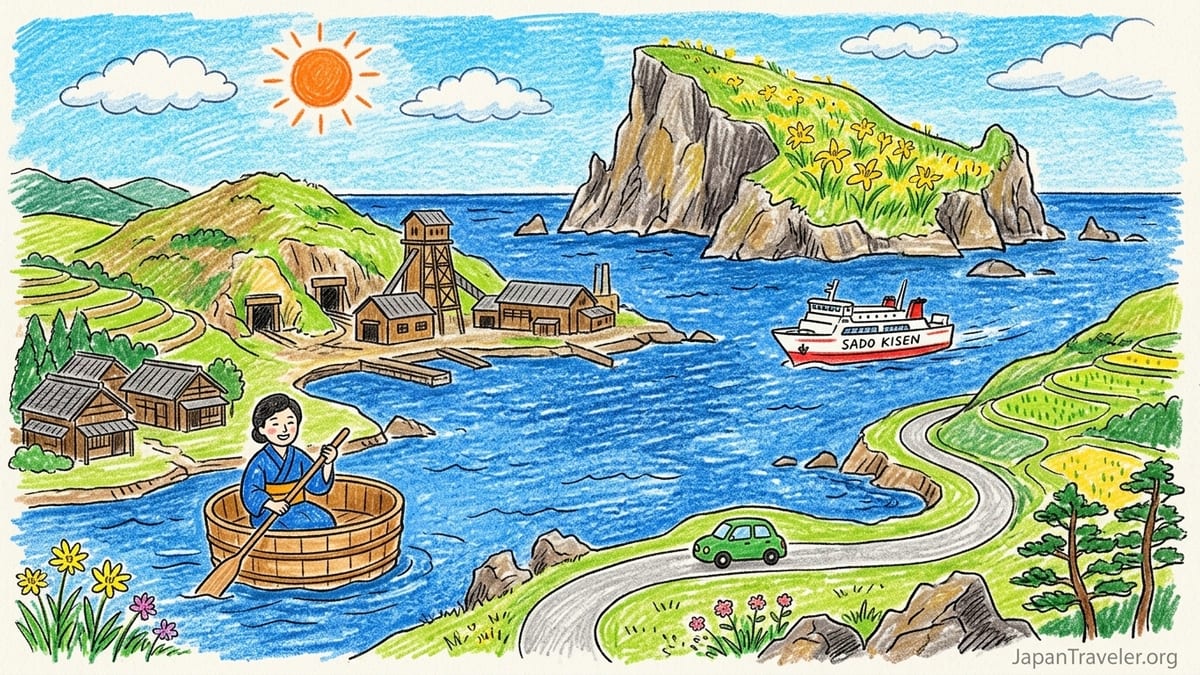
Sado is reached almost entirely by sea. The main operator Sado Kisen runs ferries between Niigata and Ryotsu on the island’s east coast year-round, and between Naoetsu in Joetsu and Ogi on the south coast for the extended warm season. According to current 2026 timetables, the Niigata–Ryotsu route offers a conventional car ferry that takes about 150 minutes and a faster jetfoil service that covers the crossing in around 67 minutes. The Naoetsu–Ogi route uses a high-speed car ferry that typically takes about 100 minutes and runs several round trips a day from roughly late March to late November.
On the Niigata–Ryotsu line, a one-way adult ticket for the standard second-class seating on the car ferry is around 2,970 yen, while reserved first class and suites cost more for extra comfort and space. The jetfoil is significantly faster but also more expensive, with typical one-way adult fares in the range of a little over 8,000 yen. These fares already include fuel surcharges that Sado Kisen revises several times per year, so exact prices may shift slightly by season. If you are not bringing a vehicle, most travelers find the standard car ferry good value, especially on clear days when you can sit on deck and watch the coastline recede.
Bringing a car from the mainland is convenient but rarely the most economical choice for short visits. Vehicle transport fees on the Niigata–Ryotsu car ferry are charged by length and add a sizable surcharge on top of the passenger fare, often comparable to or more than the daily cost of renting a compact car on Sado. For a typical small car, the one-way vehicle fee can reach well into five figures in yen. Costs for larger vans or SUVs are higher again. Unless you are already driving your own car around the region for a longer trip, it is usually cheaper and simpler to travel as a foot passenger and pick up a rental car at Ryotsu or Ogi port.
Advance reservations are strongly recommended in busy periods. For the Niigata–Ryotsu route, foot-passenger tickets can sometimes be purchased on the day, but popular departures during Golden Week, summer school holidays and long weekends can fill up. Car decks on the ferries have limited capacity and vehicle spaces often sell out earlier than passenger seats. On the Naoetsu–Ogi line, which has fewer daily sailings and a shorter operating season, both passengers and vehicles should ideally be booked in advance, especially if you are aligning the crossing with specific hotel check-in dates.
Getting Around: Why You Need More Than Buses
Once on Sado, transportation is the single biggest factor that shapes what you can see. Sado has a network of route buses that primarily link ports, town centers and some key sights, but they are infrequent, often only every one to two hours on main routes and sometimes just a handful of departures per day on minor lines. The latest English-language “All You Need Timetable” for 2026 makes this clear: buses reach places like Aikawa, the gold mine area and Ogi, but travel often involves careful connections and early final departures back toward your base.
Trying to visit both the northern and southern coasts by bus in one or two days usually results in a rushed experience or long waits at bus stops. As a concrete example, you might reach Aikawa from Ryotsu by mid-morning, have time for the main gold mine attraction, then find that the afternoon bus to Ogi leaves too early to see much else. Evening buses can be sparse, which affects dinner options away from your accommodation. Travelers who have tried to rely solely on buses often report that they spent too much time checking tables and not enough time exploring.
For most visitors a rental car is the most practical way to enjoy Sado’s beaches, viewpoints and rural corners. Several national chains and local agencies have desks at Ryotsu port, and there are rental options around Sawata, Aikawa and Ogi. Compact cars are usually the best fit on Sado’s narrow roads, with daily rates for a small automatic typically starting around 7,000 to 9,000 yen before fuel and optional insurance, depending on season and booking channel. It is wise to reserve well ahead for peak periods, as some regular visitors have found fleets sold out or reduced in recent years.
Driving on Sado is straightforward for anyone comfortable with the left-hand traffic used throughout Japan. Most main roads are one lane each way, and traffic outside Ryotsu is light. Distances between key sights are modest in kilometers but can be slow because of curves and village speed limits. As a guideline, allow at least 45 to 60 minutes to drive from Ryotsu to Aikawa, about the same from Aikawa down to Ogi if you follow the coastal road with its photo stops, and around 30 minutes between Sawata and either Aikawa or Ryotsu. Taxis exist but are limited and can be expensive for long cross-island journeys, so they work better for short transfers or as a backup rather than a daily mode.
Aikawa and the Sado Gold Mine: Industrial Heritage and North Coast Drama
Aikawa on Sado’s northwestern coast is the historic heart of the island’s gold and silver mining industry. The surrounding hills are dotted with former mine shafts, processing sites and worker settlements that date back to the early Edo period. The central attraction today is the Sado Gold Mine complex, which includes underground galleries, restored equipment and open-air remains set into the forest. Several zones are open on self-guided walking courses with multilingual explanations, and some parts of the complex highlight the labor history and technology that underpin Japan’s World Heritage nomination.
What makes the Aikawa area special is the way industrial ruins blend with wild coastline. Just west of the main town, cliffs tumble into the Sea of Japan, with viewpoints over jagged rocks and unusually clear water on calm days. Coastal hotels such as large resort-style properties and long-established ryokan sit on headlands facing the sunset, offering rooms that look directly over the open sea. While some of these buildings are older concrete structures from the high-growth years, their locations are hard to beat for photography and sea air. Staying here works well for travelers who want to focus on mining heritage by day and quiet evenings with on-site dinners.
Beyond the mine itself, the wider Aikawa district preserves elements of the company town era. You can walk streets lined with wooden houses, visit small local museums and find shrines connected with miners’ beliefs in protection and fortune. The area also gives easy access to Senkaku Bay, a scenic stretch of coastline characterized by steep cliffs dropping into narrow inlets of deep-blue water. There are short walking paths, viewing platforms and seasonal pleasure boat rides here, and the bay is one of Sado’s classic postcard scenes.
From Aikawa, the loop road that follows the Osado mountain range offers dramatic driving. Heading northeast leads through small settlements and up toward inland trailheads, including routes into the Donden Highlands where alpine flowers bloom in late spring and early summer. Heading south along the coast, you skirt coves and rock arches toward Sawata and the central plains. In travel time terms, Aikawa is about one hour’s drive from Ryotsu and roughly 40 minutes from Senkaku Bay, making it a strong base for photographers and history-focused travelers who want to concentrate on the island’s northern half.
Ogi, Shukunegi and the South: Tub Boats and Maritime History
On Sado’s southern tip, Ogi presents a different side of the island, shaped by maritime trade rather than mines. The port receives seasonal ferries from Naoetsu and has a small town center with a handful of inns and shops. The surrounding coves contain the tarai-bune tub boats that have become a symbol of Sado. These shallow wooden tubs, once used mainly by local women for collecting shellfish and seaweed close to shore, can now be ridden at several spots near Ogi. A short paid ride lets visitors sit inside the round tub while a boatwoman in traditional attire steers with a single paddle, an experience that feels far removed from modern ferries and highways.
A few kilometers from Ogi port lies Shukunegi, one of Sado’s most atmospheric historic settlements. Designated as an Important Preservation District for Groups of Traditional Buildings, Shukunegi is a tightly packed maze of narrow lanes and wooden houses, many built by ship carpenters who made a living from coastal trade in the Edo period. The houses here are known for their thick wooden facades, latticed windows and clever use of small plots, with some former merchant residences now open to visitors for a small entry fee. Walking quietly through Shukunegi in the late afternoon, as the light softens and laundry dries in side alleys, gives a strong sense of daily life in an old port town.
Ogi works well as a base for travelers interested in traditional crafts, quiet harbors and slower-paced evenings. The town has small ryokan and guesthouses that serve seafood caught nearby, with menus often featuring squid, rockfish and seasonal shellfish. From Ogi it is a short drive to coastal viewpoints such as Yajima-Kyojima, a pair of rocky islets connected to the mainland by a footbridge, and to small beaches used mainly by locals in summer. Driving from Ogi to Shukunegi takes about 10 minutes, to Sawata around 45 minutes and to Aikawa about 80 minutes along the western coastal road, so you can explore widely during the day but should be prepared for some evening driving if you plan dinners away from your accommodation.
For families and travelers who enjoy hands-on experiences, the south offers more than just scenery. In addition to tub boats, some small centers and local operators arrange workshops related to traditional crafts, such as bamboo work or fan-making, although availability changes year by year. Ogi is also associated with the world-famous taiko drumming ensemble Kodo, which is headquartered on Sado. Their international touring schedule varies, but when they rehearse or perform locally, the deep drumbeats add another layer to Ogi’s atmosphere.
Scenic Drives, Senkaku Bay, Onogame and Temples
One of Sado’s greatest pleasures is following the coastal roads that ring the island, where rice paddies and cedar groves give way to sea cliffs and fishing piers. North of Aikawa lies Senkaku Bay, a series of narrow inlets where sheer rock walls plunge into water that shifts from turquoise to indigo. A small visitor facility near the main viewpoint usually charges a modest admission fee, which grants access to platforms extending out over the cliff edge and, in warmer months, short sightseeing boat trips that enter the bay. Photographers will find strong light contrasts here in the middle of the day, while late afternoon softens the cliffs’ colors.
Further north again, toward the island’s tip, Onogame stands out as one of Sado’s signature natural landmarks. It is a large grass-covered headland that rises almost directly from the sea, with a steep walking path climbing toward the summit. In late May and early June, huge numbers of yellow day lilies bloom on the slopes, creating a carpet of color that draws visitors from around the region. Outside the lily season, Onogame is still worth the drive for big-sky views and a sense of openness rare in more built-up parts of Japan. The drive from Aikawa to Onogame takes around 40 to 50 minutes, but you should allow longer if you plan to stop at small fishing harbors or shrines along the way.
The interior of Sado is dominated by twin mountain ranges, Osado in the north and Kosado in the south, separated by the cultivated Kuninaka plain. A network of roads and walking paths leads up to temples and viewpoints here. On the eastern side near Ryotsu and Mano, you can visit ancient temples with long staircases of stone steps, mossy lanterns and old cedar trees. Some of these sites are associated with figures exiled to Sado in the past, such as Buddhist monk Nichiren, whose time on the island left a mark on local religious traditions. While individual temple admission fees are usually small, the sense of history and quiet is significant, especially if you come early in the morning.
Scattered around the coast are beaches that come alive in summer. Near Sawata on the west coast, sandy stretches face the sunset and are popular with families and groups of friends in July and August. Facilities can be modest, often limited to seasonal showers, basic toilets and temporary snack stands, but the lack of large-scale development is part of the charm. Smaller coves near Ogi and along the Kosado side toward Akadomari offer rock pools and clear shallows that reward snorkelers on calm days. If you are driving, it is easy to combine an afternoon at the beach with sunset at a nearby viewpoint or headland.
Where to Stay: Ryotsu, Aikawa, Ogi and Central Sado Compared
Choosing the right base on Sado shapes not just what you see, but how relaxed your days feel. Ryotsu, Aikawa, Ogi and the central Sawata and Kuninaka area each suit different types of travelers. Ryotsu, close to the main ferry and jetfoil terminal from Niigata, is the most convenient arrival point. Around Lake Kamo and the port you will find onsen hotels such as long-established lakefront properties, modern business-style hotels and smaller ryokan within a short taxi ride of the terminal. These work well if you are arriving late or leaving early, or if you want to minimize transfers with children and luggage.
Aikawa on the northwestern coast favors travelers who prioritize gold mine heritage and dramatic sea views. Coastal resort hotels in this area, including large properties classified in local hotel association lists, typically have spacious rooms, communal baths and set dinner menus focused on sashimi and seasonal local fish. They are excellent bases for couples and photographers, who can reach the Sado Gold Mine in roughly 10 to 15 minutes by car and Senkaku Bay in around 30 to 40 minutes. Smaller ryokan and guesthouses in and above the town suit independent travelers who like to wander old streets in the evening and try local eateries.
Ogi and nearby Shukunegi appeal to cultural travelers and families seeking traditional experiences. Accommodation here tends to be smaller scale, often family-run inns and guesthouses with just a handful of rooms. Properties near Ogi port ease early departures on the Naoetsu ferry, while those closer to Shukunegi or in quiet side streets offer deeper immersion in local life. Some inns advertise the chance to eat seafood landed at the harbor that same morning, or to bathe in simple onsen fed from local hot springs. For visitors interested in Kodo’s taiko drumming, staying in the south also puts you closer to Earth Celebration events when they take place in and around Ogi.
In the middle of the island, Sawata and the broader Kuninaka area provide the best road connections. These central districts sit at the crossroads of highways leading to Ryotsu in the east, Aikawa in the north and Ogi in the south, which makes them efficient bases for road-trippers who want to cover the whole island. Here you will find a mix of modest business hotels, minshuku (family-style bed and breakfast) and a growing number of farm-stay style accommodations where guests can sleep near rice fields and orchards. Sawata town itself has one of the island’s better concentrations of restaurants, izakaya and small bars, so dinner choices are wider than in some resort clusters where you eat mostly in-house.
Seasonal Highlights, Kodo and Weather-related Disruptions
Like much of northern Japan, Sado’s seasons bring distinct travel personalities. Spring from April to June is one of the most pleasant times to visit, with cherry blossoms in early April followed by fresh green in the mountains and the day lily carpets at Onogame in late May and early June. Daytime highs often sit in the mid-teens to low twenties Celsius, inviting coastal walks and mine visits without oppressive heat. Sea temperatures are still cool for swimming, but ferry crossings are often smooth.
Summer, especially late July and August, is festival time and beach season. Temperatures climb into the high twenties or low thirties, humidity rises and the west-coast beaches near Sawata and smaller coves near Ogi see more visitors. The island’s most famous cultural event is Earth Celebration, centered around the taiko drumming group Kodo, which is usually held in or near Ogi over several days in August. Exact dates change each year, and 2026 dates should be confirmed on official Kodo and Sado tourism channels once announced, but whenever the festival runs it draws both domestic and international visitors for open-air concerts, workshops and community events.
Autumn from September into early November brings cooler air, clearer skies and striking foliage on the Osado and Kosado ranges. The rice harvest lends a golden hue to the Kuninaka plain, and coastal drives feel sharper in the lower humidity. This is an excellent time for photographers and hikers, as long as you keep an eye on occasional autumn storms. By late November, the Naoetsu–Ogi ferry usually pauses for winter, concentrating traffic on the Niigata–Ryotsu route.
Winter on Sado is quieter, with occasional snow in the interior and frequent gray days along the coast. Strong winds and rough seas can cause delays or cancellations on the ferries, especially for faster vessels. Sado Kisen publishes notices about altered timetables during ship maintenance periods and bad weather, and in January and February in recent years there have been reduced sailings. If you plan a winter visit, it is sensible to allow an extra buffer day in case departures are canceled or moved. The reward is a far more local feel, with ryokan dining rooms filled mostly with Niigata residents and mainland visitors coming for seafood and hot baths.
Suggested 1-, 2- and 3-Day Itineraries
How long you should spend on Sado depends on how widely you want to roam. With only one full day, it is best to focus on a single side of the island. Arriving early at Ryotsu on the jetfoil, you could pick up a rental car and head straight to Aikawa for the Sado Gold Mine, lunch in town and a drive along the coast to Senkaku Bay, finishing with sunset near your Aikawa hotel before returning to Ryotsu the next morning. This concentrates on mining heritage and northern coastal scenery.
With two days and one night, you can sample both history and traditional port life. A good plan is to arrive at Ryotsu, rent a car and drive north to Aikawa for the gold mine in the morning, then continue north to Onogame and back down to Senkaku Bay for late-afternoon light. Overnight in Aikawa or Sawata, then on day two drive south along the west coast to Ogi, stopping at beaches and small fishing harbors. Spend midday in Shukunegi and take a tarai-bune ride in the afternoon, before either driving back to Ryotsu for a late ferry or staying a second night near Ogi and leaving via the Naoetsu ferry if it is in season.
A three-day, two-night itinerary gives enough time for a more relaxed loop. One example is to arrive in Ryotsu and stay the first night there, using the afternoon to explore nearby temples and viewpoints. On day two, drive to Aikawa, explore the gold mine and Senkaku Bay, and continue north to Onogame if the weather is good, then spend the night at a coastal Aikawa hotel. On day three, drive south through Sawata, detouring inland to small shrines or viewpoints, then continue to Ogi and Shukunegi for the afternoon, staying a final night in Ogi before catching the Naoetsu ferry. Travelers who prefer fewer hotel changes can instead base themselves in Sawata for all nights and make day trips north and south from this central hub.
For visitors who want to experience both the southern villages and the northern coast without feeling rushed, staying at least three nights is ideal. This allows a full day for Aikawa and the mining heritage, a full day around Ogi and Shukunegi with time for workshops or coastal walks, and a flexible day in the middle for beaches, temples or weather-dependent activities like the Onogame hike. Longer stays also build in a buffer for ferry disruptions or rainy days when indoor attractions such as museums and historical houses are more comfortable than cliff-top viewpoints.
Costs and a Sample Two-Night Budget
Travel costs on Sado vary by season and accommodation style, but it is possible to outline a realistic two-night budget for a mid-range trip in 2026. Consider a traveler arriving from Niigata, renting a compact car on Sado, staying in comfortable lodging and eating a mix of hotel dinners and local meals. As of recent fare tables, a round-trip Niigata–Ryotsu car ferry ticket in second class for one adult is roughly 6,000 yen to 7,500 yen once seasonal fuel surcharges are included, while the equivalent round-trip on the jetfoil is more than double that. For budgeting, setting aside around 7,000 to 9,000 yen for round-trip passenger ferry fares per person is reasonable if you plan ahead and avoid the most expensive seating categories.
Rental car costs for two full days with pickup and drop-off at Ryotsu port typically fall somewhere around 16,000 to 20,000 yen for a compact automatic, including basic insurance but excluding fuel. Fuel consumption is modest given the island’s limited distances; even with extensive driving, two days might use roughly a single tank, adding perhaps 3,000 to 5,000 yen depending on fuel prices. Accommodation offers the widest spread. A mid-range onsen ryokan in Aikawa or Ryotsu with dinner and breakfast might cost between 15,000 and 25,000 yen per person per night in a standard room, while simpler minshuku or business hotels without meals in Sawata or central Sado might come in closer to 6,000 to 10,000 yen per person per night.
Food beyond what is included in your room can add another 3,000 to 5,000 yen per person per day if you mix local lunches of seafood bowls or soba with casual izakaya dinners and snacks from convenience stores. Entry fees to major attractions are comparatively modest. The main Sado Gold Mine complex charges only a few thousand yen or less for adult admission depending on the course you choose, while Shukunegi’s historic houses, Senkaku Bay viewpoints and smaller museums generally ask for several hundred yen each. Tub boat rides around Ogi typically fall in the 1,000 to 2,000 yen per adult range.
Putting these pieces together, a plausible total budget for one adult for a two-night, two-and-a-half-day visit in 2026 that includes round-trip ferry from Niigata, two hotel nights (one mid-range ryokan with meals, one simpler stay), two days of rental car, fuel, meals and key admissions might land in the neighborhood of 70,000 to 100,000 yen. Traveling as a couple can reduce some per-person costs, especially on car rental and fuel, while families can benefit from child discounts on ferries and shared rooms. At the higher end, staying in top-category rooms with elaborate kaiseki dinners and using the jetfoil both ways can push budgets significantly higher, while experienced budget travelers willing to forgo car rental and stay in the simplest accommodations can bring costs down, though with restricted access to remote sights.
The Takeaway
Sado Island in 2026 offers a rare balance of accessibility and authenticity. Regular ferries from Niigata and Naoetsu make it straightforward to add to a Honshu itinerary, yet once you are on the island, terraced rice fields, mining relics and compact fishing towns quickly replace city skylines. Aikawa and the Sado Gold Mine tell the story of centuries of resource extraction that Japan now hopes to see recognized on the world stage, while Ogi and Shukunegi preserve wooden streets and seafaring traditions anchored by the iconic tarai-bune tub boats.
To make the most of Sado, plan around both geography and transport. Decide whether you value ferry convenience near Ryotsu, mining heritage and sunset views in Aikawa, traditional experiences and festivals around Ogi, or central road connections and restaurants in Sawata and the Kuninaka plain. Book ferries and rentals early for busy periods, give yourself enough nights to experience both the north and south, and leave room in your schedule for unscripted stops at temples, coves and roadside shrines. With that approach, Sado becomes more than a day-trip detour and instead turns into a highlight of a wider Japan journey.
FAQ
Q1. How many days do I really need on Sado Island?
Most visitors find that two full days and two nights is the minimum to see both the Aikawa gold mine area and Ogi with Shukunegi without rushing, while three to four nights allow time for scenic drives, beaches and weather flexibility.
Q2. Is it better to arrive via Niigata–Ryotsu or Naoetsu–Ogi?
Niigata–Ryotsu has more sailings year-round and offers a choice of car ferry or jetfoil, so it suits most first-time visitors. Naoetsu–Ogi is ideal if your focus is the southern villages or if you are touring central Japan by car and traveling during the route’s spring-to-autumn operating season.
Q3. Do I need to reserve Sado ferries in advance?
For foot passengers outside peak holidays, you can sometimes buy tickets on the day, but advance reservations are wise on popular departures. If you are bringing a car or traveling during Golden Week, summer or festival periods, booking ahead is strongly recommended.
Q4. Should I bring a rental car from the mainland or rent on the island?
For short visits it is usually cheaper and more flexible to travel as a foot passenger and rent a car at Ryotsu or Ogi, because transporting a vehicle on the ferry adds a substantial fee on top of passenger fares.
Q5. Can I see the main sights using only buses?
You can reach major towns and some attractions by bus, but infrequent services and early last departures make it difficult to link the northern and southern coasts in a short stay. A rental car or at least some use of taxis greatly expands what you can comfortably see.
Q6. What is special about the Sado Gold Mine and Aikawa area?
The Sado Gold Mine represents centuries of mining history and is central to Japan’s push for UNESCO World Heritage recognition. Around it, Aikawa combines industrial ruins, old streets and rugged sea cliffs, making it the best base for travelers interested in heritage and dramatic west-coast scenery.
Q7. Where should I stay if I want traditional village scenery and tub boat rides?
Stay around Ogi or near Shukunegi in the island’s south. You will be close to tarai-bune tub boat operators, Shukunegi’s preserved wooden streets and small harbors, and within easy reach of viewpoints like Yajima-Kyojima.
Q8. When does Earth Celebration usually take place?
Earth Celebration, led by the taiko group Kodo, is typically held over several days in August in and around Ogi, but exact dates change annually. For 2026, check official Kodo and Sado tourism announcements before finalizing travel plans.
Q9. What kind of food is Sado best known for?
Sado is renowned for its seafood, including squid, rockfish and local shellfish, along with rice grown on the island’s plains and sake from Niigata Prefecture. Many ryokan dinners highlight sashimi platters and grilled seasonal fish.
Q10. Is Sado Island suitable for families with children?
Yes. Families can enjoy tub boat rides, gentle beaches near Sawata and Ogi, short walks at Senkaku Bay, and interactive areas of the Sado Gold Mine. Staying near ferry ports or in central Sawata keeps driving times manageable with younger travelers.