


The Shimanami Kaido is one of Japan’s most rewarding cycling routes: around 70 kilometers of dedicated paths, bridges and island roads linking Imabari in Shikoku with Onomichi in Hiroshima. Yet for first-time visitors, turning this dreamy ride into a concrete plan can be confusing. Should you ride in one day or two, start in Imabari or Onomichi, rent a standard bike or an e-bike, and what on earth do you do with your suitcase? This guide treats the Shimanami Kaido as a commercial decision, walking you through real-world options, costs and trade-offs so you can choose the version of the route that fits your time, budget and fitness.
Understanding the Shimanami Kaido Route
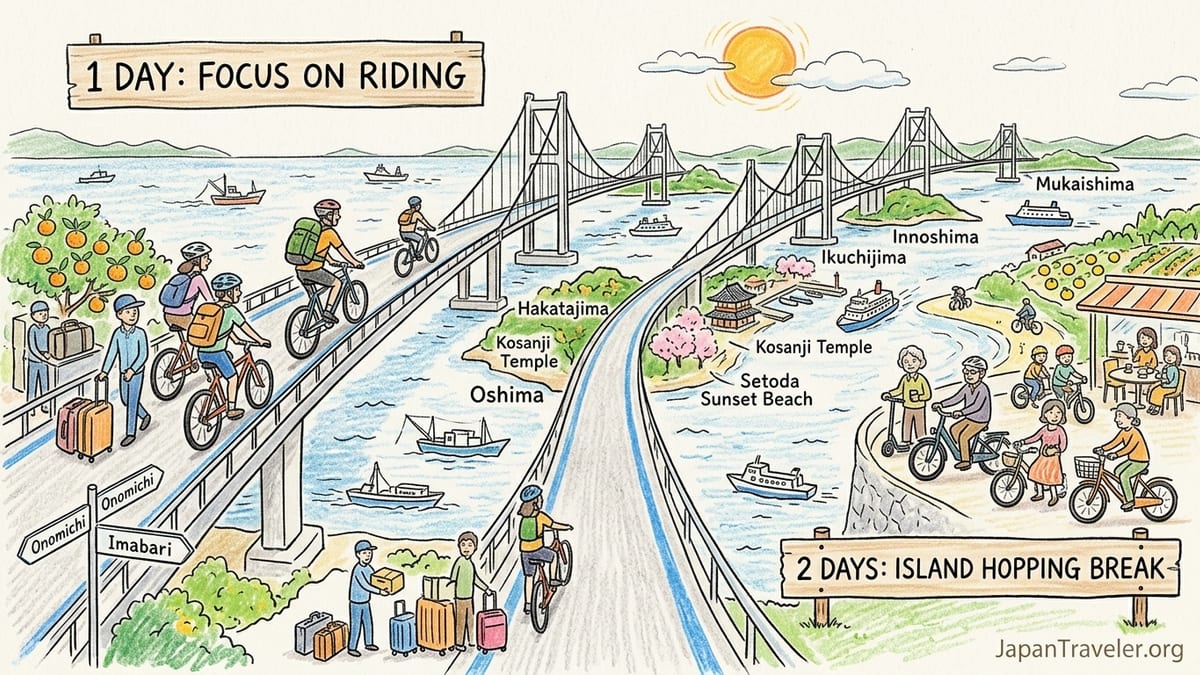
The Shimanami Kaido cycling road runs between Imabari on Shikoku and Onomichi on Honshu, crossing six main islands via a chain of spectacular bridges. The core route is roughly 70 kilometers from city to city, following a blue line painted on the pavement that guides you over Oshima, Hakatajima, Omishima, Ikuchijima, Innoshima and Mukaishima. Most cyclists follow this official line without major detours, which keeps distance and elevation manageable for reasonably active travelers.
On paper, 70 kilometers might sound like a serious undertaking, but the actual riding is friendlier than many people expect. The gradients on bridge approaches are generally gentle, often around 3 to 5 percent, and the route provides separate cycling lanes or wide sidewalks that feel safe even for less confident riders. The main challenge is not steep hills but the simple fact of spending 5 to 8 hours in the saddle, depending on your pace and number of photo and café stops along the way.
For context, organized events that close parts of the Shimanami expressway to traffic schedule experienced riders to complete an Imabari to Onomichi course within regular daytime hours, showing that fit cyclists can cover the distance comfortably in a day. Casual travelers often take longer because they stop for views from Kurushima Kaikyo Bridge near Imabari, beaches around Setoda on Ikuchijima and shrines or temples such as Kosanji on Ikuchijima. How much time you want for these side visits is one of the key factors in deciding between a one-day and two-day ride.
The route can be ridden in either direction with no major difference in elevation gain. Instead, your choice of start and end point should be driven by logistics such as where you are coming from, where you are headed next, and how you plan to rent and return your bike. In practice, that often means choosing between starting in Imabari, where several large rental hubs cater to cyclists heading north, and starting in Onomichi, where bike shops cluster around the waterfront near the station.
One-Day vs Two-Day: Which Schedule Suits You?
Doing the Shimanami Kaido in a single day is entirely realistic for healthy adults who are comfortable being active for several hours. If you walk 10,000 to 15,000 steps most days or occasionally ride a bike at home, you can expect to cover 70 kilometers over 7 to 9 hours at a relaxed touring pace. Many travelers report starting around 8 or 9 in the morning, having an early lunch around Setoda or Omishima, and rolling into their destination by late afternoon before returning rental bikes around 17:00 to 18:00.
That one-day schedule works best in spring and autumn when daylight is long and temperatures are mild. For example, a traveler staying in Hiroshima might take an early train to Onomichi, rent a city bike by 9:00, and aim to reach Imabari by 17:00 to catch an evening bus or train onward to Matsuyama. This style of trip prioritizes the satisfaction of completing the route over lingering at beaches or museums. It is ideal for time-pressed visitors or regular cyclists who want a full, but not extreme, day of exercise.
In contrast, a two-day ride turns the Shimanami Kaido into a more relaxed island-hopping mini-break. Splitting the distance into two roughly 35-kilometer segments means you can stop for long lunches, take detours to coastal viewpoints, or spend an hour at Setoda Sunset Beach without watching the clock. Families with children, older travelers or anyone uncertain about their stamina often appreciate waking up on an island, having breakfast overlooking the sea, and finishing the second half with fresh legs rather than pushing through fatigue late in the day.
One practical way to think about the choice is to consider your wider itinerary. If you already have days of heavy sightseeing and train travel scheduled before and after, cramming the route into one intense day might feel punishing. In that case, paying for an extra night on an island such as Omishima or Ikuchijima buys you rest, flexibility around weather, and the chance to experience the Seto Inland Sea at dusk and dawn, which many cyclists later describe as the highlight of their trip.
Imabari to Onomichi vs the Reverse Direction
There is no objectively “right” direction to cycle the Shimanami Kaido, but the experience differs in subtle ways. Starting in Imabari and riding north to Onomichi is popular with travelers arriving from Matsuyama or other parts of Shikoku. Imabari’s main rental hubs, including Sunrise Itoyama near the Kurushima Kaikyo Bridge and the station-area cycle terminal, are set up for outbound one-way rentals. Leaving Imabari lets you cross the famously long Kurushima Kaikyo suspension bridge during the cool morning hours, when visibility is often crisp and the sea below can look like a sheet of glass.
Ending in Onomichi has its own advantages. Onomichi’s compact old town climbs steeply from the waterfront into a hillside maze of narrow lanes, temples and viewpoints. Rolling into town in the late afternoon, returning your bike, then checking into a small hotel near the station allows you to celebrate the end of your ride with local specialties such as Onomichi ramen or grilled seafood. The next morning, you can take the ropeway up Mount Senkoji for a final look back across the islands you just cycled through.
Riding in the opposite direction, from Onomichi to Imabari, suits travelers whose broader route runs from Hiroshima or Osaka toward Shikoku and Kyushu. In this case, you might spend a night in Hiroshima, take a morning train to Onomichi, rent a bike near the waterfront, and head south across Mukaishima as ferries shuttle locals and schoolchildren alongside you. Arriving in Imabari sets you up to continue by train to Matsuyama for hot springs at Dogo Onsen or further down Shikoku.
Wind is another factor to consider, although it is unpredictable from day to day. Some cyclists report experiencing headwinds when traveling north, others when traveling south. Since there is no consistent prevailing wind that clearly favors one direction, it is safer to base your decision on practical connection times, where hotel choices appeal to you more, and which side of the route you want to explore after you return your bike.
Standard Bikes vs E-Bikes: Cost, Comfort and Who Needs What
The official Shimanami rental system currently charges around 3,000 yen per day for a regular bicycle and around 8,000 yen for a one-day e-bike rental, with slight variations depending on the model and outlet. Third-party shops in Onomichi and Imabari offer their own fleets too, with typical prices for standard cross bikes in a similar range and e-bike rentals often between 6,000 and 8,000 yen per day. For a solo rider, that means the jump from a conventional bike to an e-bike might add 3,000 to 5,000 yen to your daily costs, roughly the price of a casual lunch and coffee stops along the route.
Whether that extra expense is worth it depends primarily on your fitness, your confidence on a bike, and how you want the day to feel. If you routinely cycle distances of 30 kilometers or more at home or do other cardio exercise several times a week, a well-maintained standard bike is likely sufficient. Many travelers in their 20s to 50s with average fitness complete the full route in a day on standard rental hybrids without serious issues, enjoying the gentle bridge climbs and cruising the flat promenades on Oshima and Ikuchijima.
E-bikes come into their own for riders who are less active, are anxious about hills, or are recovering from minor injuries. The electric assistance smooths out climbs to the bridges, helps you maintain a steady pace against headwinds, and reduces the chances of running out of energy late in the day. For example, a multigenerational family might choose standard bikes for teenagers and a parent who cycles regularly, while an older grandparent rents an e-bike so they can keep up without strain. Over two days, that comfort factor becomes even more valuable because you can take detours without worrying about how much battery you have left if you mostly stay on eco or normal assist modes.
One important commercial detail is that the public rental system allows one-way returns for standard bikes at its ten rental terminals, but e-bikes are often restricted to round trips unless you use specific private outfits or accept a higher one-way fee. This matters if you plan to start in Onomichi and finish in Imabari without backtracking. Before committing to an e-bike, check whether your chosen shop permits one-way returns on the day and whether you must return the e-bike to the same branch. In practice, travelers who insist on one-way flexibility often choose a standard bike or work with specialist rental operations that offer e-bike drop-offs at designated mid-route facilities.
Luggage Forwarding, Storage and Bike-Friendly Accommodation
One of the biggest practical questions for Shimanami Kaido riders is what to do with suitcases and larger backpacks. Fortunately, luggage forwarding is a normal part of Japanese travel culture. Same-day luggage transfer services operate between Imabari and Onomichi, often linked to local bike shops and tourism offices. For example, you might drop off a suitcase at a cycle terminal near Imabari Station before 9:00 and have it delivered to a partner facility near Onomichi Station or to a pre-booked hotel by late afternoon, for a fee that is typically comparable to standard takkyubin parcel services rather than a luxury surcharge.
Travelers who plan to stay overnight on an island can chain services together. On day one, you could send a large suitcase from Hiroshima to an inn on Omishima using a nationwide courier, then on day two forward it again from Omishima to Matsuyama or back to the Tokyo area. Some local services also operate locker-based systems where you leave bags in secure storage near Onomichi Station or Imabari, and staff transport them along the route while you ride. These arrangements usually need to be booked in advance, especially during peak seasons like Golden Week or the autumn long weekends.
Bike-friendly accommodation options are plentiful along the route, particularly on Omishima and Ikuchijima. These range from dedicated cycling hostels with bike racks in the lobby and repair tools on hand, to small minshuku guesthouses and beachfront campsites that welcome riders. Many properties advertise indoor bike storage or allow you to bring your bike into your room. For example, a couple riding from Imabari might aim to overnight on Omishima, staying at a guesthouse near Miyaura Port that offers dinner with local seafood and breakfast from around 7:00 so you can get back on the road early.
In the cities at each end, chain hotels near the stations in Imabari and Onomichi frequently host cyclists passing through. When booking, it is worth checking whether your hotel has coin-operated laundry, which allows you to wash cycling clothes overnight, and whether they can assist with arranging luggage forwarding if you prefer not to handle the paperwork yourself. Calling or emailing in simple English ahead of time is generally enough to confirm policies on bike storage and luggage handling.
Guided Tours vs Independent Cycling
Cycling the Shimanami Kaido independently appeals to many travelers because the route is clearly signposted and the logistics are manageable. You choose your rental shop, pick your start time, and can stop wherever you like for photos, coffee or a swim. The blue line on the road, bilingual maps and frequent rest areas make navigation straightforward, and convenience stores and vending machines are plentiful, so you do not need to carry large amounts of food or water.
However, guided options are increasingly available and can be a sound commercial choice for certain travelers. Professional guides based in Imabari or Onomichi sell one-day and two-day packages that bundle bike rental, route planning, support vehicles and sometimes accommodation. For a first-time visitor who is nervous about language barriers or mechanical issues, paying more for a guided tour buys peace of mind. If your chain drops or you puncture a tire, a support van can step in, rather than leaving you to troubleshoot by the roadside.
Guided tours can also be valuable if you want deeper context about the islands. A local guide might lead you off the main blue route to small shrines, citrus farms or viewpoints that independent riders would likely miss. For example, they might suggest a detour to a family-run café on Innoshima known for its mikan-flavored soft serve, or time your arrival at Setoda Sunset Beach so that you can swim while the guide watches the bikes and keeps track of the ferry schedule for your next leg.
The main trade-off is flexibility and cost. A private or small-group guided tour typically costs significantly more than a DIY rental plus hotel booking, especially if it includes a support vehicle. Schedules are less adaptable to spontaneous changes, and you may share the experience with strangers whose pace or interests differ from yours. For confident cyclists used to navigating abroad, independent cycling will usually feel more natural and better value. For those who prioritize comfort, minimal planning and extra safety nets, especially families with children or older relatives, the premium for a guided option can be justified.
Who Can Realistically Complete the Route, and When to Stay Overnight
Realistically, most healthy adults with moderate fitness can complete the standard 70-kilometer Shimanami Kaido route in a single day, especially on a standard hybrid or city bike with multiple gears. People who regularly walk, hike or cycle at home will find the physical demands similar to a long day of sightseeing in a large city, spread across more continuous low-intensity exercise. Many trip reports describe riders in their 30s to 60s with no special training completing the route in 7 to 8 hours including breaks.
That said, there are clear cases where an overnight stay on an island makes more sense. Families with children under about 12 often find two shorter days more enjoyable, because younger riders tire earlier and are more easily distracted by beaches and viewpoints. Similarly, travelers with knee or back issues, those not accustomed to cycling, or anyone nervous about traffic and bridges will likely appreciate the psychological comfort of knowing they only need to pedal 30 to 40 kilometers before reaching their lodging.
Season and weather should also influence your decision. In July and August, heat and humidity can turn a one-day attempt into a slog, even for fit riders. In these months, splitting the route and starting early each morning helps you avoid the worst of the midday sun. In winter, limited daylight and occasional strong winds can make an island overnight a safer choice, giving you a buffer if your pace is slower than expected or if you decide to warm up in a café while a shower passes.
Finally, consider what you want emotionally from the ride. If your priority is ticking off a famous cycling route in the most efficient way, a one-day push with minimal detours will deliver that achievement. If you envision lingering in small fishing ports, watching the sun set behind suspension bridges, and soaking in an onsen before sleep, then planning at least one island night aligns better with that mood. In commercial terms, the extra cost of another night’s accommodation can be seen as buying time and atmosphere, rather than distance covered.
Planning a Sample Itinerary: Concrete Scenarios
To illustrate how these decisions fit together, consider a fit couple visiting in October who are comfortable cycling but short on days. They stay in Hiroshima, take an early train to Onomichi, leave a large suitcase in coin lockers near the station, and rent two standard cross bikes from a waterfront shop at around 3,000 yen each. They set off by 9:00, stop briefly at Setoda for lunch and photos, and reach Imabari by 17:00, tired but satisfied. After returning the bikes, they check into a business hotel near Imabari Station and take a regional train to Matsuyama the next morning.
Now imagine a family of four traveling in April with two children aged 10 and 13 and a grandparent in their late 60s. They start in Imabari, using a luggage service to send suitcases from their Hiroshima hotel directly to a small inn on Omishima. The parents and teenagers ride standard bikes, while the grandparent uses an e-bike to smooth the climbs. They leave around 10:00, stop for lunch overlooking the Kurushima Kaikyo Bridge, and arrive at their Omishima guesthouse mid-afternoon, in time for a walk to a nearby shrine. The next day they ride the remaining half to Onomichi, returning the bikes by late afternoon and checking into a small hotel near the station.
A third scenario involves a solo traveler in early summer who rarely cycles at home and is anxious about navigation and mechanical issues. They book a one-day guided tour from Onomichi that includes an e-bike, helmet, English-speaking guide and support van. The price is higher than renting independently, but the guide helps them pace the day, avoid busy road sections and discover quieter coastal stretches. Luggage is stored at the tour operator’s office, and at the end of the ride the support van returns both rider and bike to Onomichi, removing the need to plan public transport from Imabari.
These examples show how the same 70 kilometers can be configured into very different experiences. By thinking in terms of time, fitness, budget and desired comfort level, you can choose the combination of direction, bike type, luggage handling and overnight stops that best matches your own travel style and constraints.
The Takeaway
The Shimanami Kaido is less an extreme athletic challenge and more a modular travel product that can be scaled to suit a wide range of visitors. With a core distance of around 70 kilometers, gentle gradients and abundant rental and luggage services, it is within reach of most healthy adults, and can be tailored from a single intense day to a leisurely island-hopping break. The biggest decisions you face are commercial and logistical: how many days to allocate, in which direction to ride, whether to invest in an e-bike, and how to handle your bags and bookings.
If you are reasonably fit, visiting in spring or autumn and comfortable managing your own logistics, a one-day ride on a standard rental bike from Imabari to Onomichi or vice versa is a rewarding, good-value option. If you are traveling with children, older relatives, or in the height of summer or depth of winter, stretching the route over two days with an island overnight, luggage forwarding and possibly an e-bike for less confident riders will likely deliver a more relaxed and memorable experience. Either way, careful planning and realistic expectations turn the Shimanami Kaido from a vague aspiration into a highlight of your time in Japan.
FAQ
Q1. How long does it take to cycle the Shimanami Kaido in one day?
Most reasonably fit adults complete the roughly 70 kilometer route in 7 to 9 hours, including rest stops and a simple lunch, when starting in the morning.
Q2. Is the Shimanami Kaido suitable for beginners who rarely cycle?
Yes, if you are generally healthy and choose an easy pace, but beginners often prefer using an e-bike or splitting the ride over two days with an island overnight.
Q3. Which direction is better, Imabari to Onomichi or the reverse?
There is no major difference in difficulty; choose based on your wider itinerary, train connections, where you want to stay afterward, and rental bike availability.
Q4. Do I really need an e-bike for this route?
If you are moderately active, a standard multi-gear bike is usually enough. E-bikes are most helpful for less fit riders, older travelers or hot and windy days.
Q5. Can I send my luggage from one end of the route to the other?
Yes, luggage forwarding and same-day transfer services operate between Imabari and Onomichi, and many hotels and bike rental terminals can help arrange them.
Q6. Is it safe to cycle the Shimanami Kaido with children?
The dedicated cycling paths and clear blue line markers make it relatively safe, but younger children may struggle with the distance, so a two-day plan is recommended.
Q7. Do I need to book bike rentals in advance?
Advance reservations are strongly advised in busy periods such as weekends, Golden Week and autumn holidays, especially for e-bikes and higher-end road or cross bikes.
Q8. What is the best season to ride the Shimanami Kaido?
Spring and autumn are ideal, with comfortable temperatures and long daylight hours. Summer can be very hot and humid, and winter brings shorter days and occasional winds.
Q9. Can I ride only part of the route and turn back?
Yes, many cyclists start from either Imabari or Onomichi, ride to a mid-route island such as Omishima or Ikuchijima, then return the same way or use local buses and ferries.
Q10. Are guided tours worth the extra cost?
Guided tours cost more but provide route support, local insights and help with logistics. They are especially useful for nervous beginners, families and older travelers.