


In Tohoku, autumn does not arrive all at once. It pours over high volcanic ridges in late September, sinks into beech forests by October, then finally flames through deep gorges and river valleys into November. For travelers, that staggered progression is a gift: by following elevation and latitude rather than chasing a single “peak” week, you can build a trip that strings together some of Japan’s most dramatic landscapes, including Oirase Stream, Lake Towada, Naruko Gorge, Mount Kurikoma and the Hachimantai highlands.
How Autumn Moves Through Tohoku’s Mountains and Valleys
Tohoku covers a huge swathe of northern Honshu, from the Pacific coast across to the Sea of Japan, and from low rice plains up into 1,600 meter volcanoes. That elevation range is what shapes the foliage season. High ridges such as Mount Kurikoma and the Hachimantai plateau typically start to change from around mid to late September at their summits, while valleys like Naruko Gorge and the lower stretches of Oirase Stream usually peak from mid to late October or even early November, depending on the year. Official tourism information for the region generally describes late September through November as the broad koyo window, and that aligns with what local forecasts and recent traveler reports show on the ground.
The pattern is simple in theory. Cold arrives first above 1,500 meters, so the highest ridgelines colour up, then the band of peak colour moves downslope over two to four weeks. On Mount Kurikoma, for example, the summit often turns fiery in the second half of September, while the middle slopes and trailheads see their best colour into early or mid October. Near sea level it can still feel like late summer at that point. By the time valleys such as Naruko’s steep V-shaped gorge or Oirase’s river corridor peak in late October, the mountaintops above are already bare or dusted with early snow.
In practice, climate variability means there is no fixed “guaranteed” week. Some years, warm autumn weather pushes the schedule a week or more later; others, an early cold snap can accelerate things. Japanese weather companies publish annual koyo forecasts, and Tohoku prefectural tourism offices share photo updates on social media as colours develop. For a concrete example, recent forecasts for Oirase have given a typical peak around 15 October to the first week of November, while Mount Kurikoma’s main season was described as running from mid September near the summit to mid October lower down. Treat those as guide rails and plan flexibly rather than banking everything on one particular weekend.
Because the region is large and public transport on mountain roads can be sparse, another practical way to think about timing is by “elevation bands.” Aim for 1,500 meters and above in late September and very early October, mid-mountain plateaus around 1,000 to 1,400 meters from early to mid October, and gorges and lakes under 600 to 800 meters from mid October into early November, especially in the north around Aomori and Akita. With that logic you can design a route that naturally follows the season from one landscape to the next.
Oirase Stream and Lake Towada: Mossy Gorge and Caldera Lake
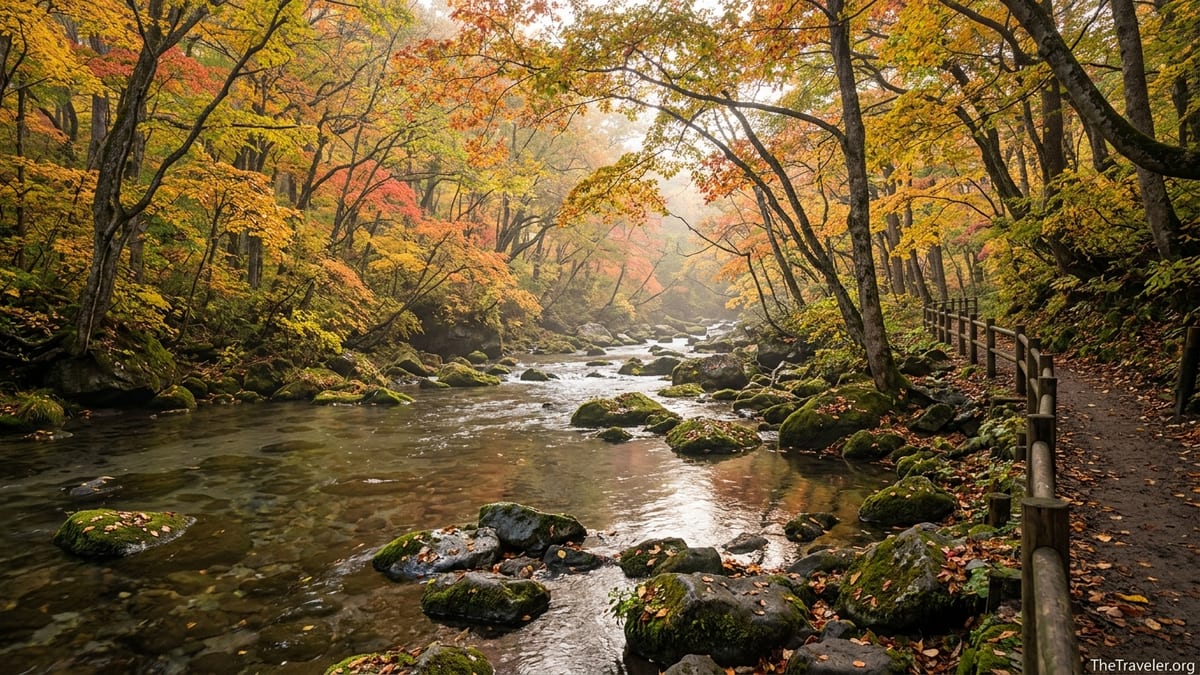
Oirase Stream in Aomori Prefecture is one of Japan’s iconic autumn walks: a clear river running roughly 14 kilometers from Lake Towada through a forested gorge, scatter‑shot with waterfalls and wrapped in beech and maple trees that flare yellow, orange and red. Recent travel guidance places typical peak colour from around mid October to early November, with the most photogenic sections between Ishigedo and Nenokuchi on the lake shore. The stream is almost flat, which makes it accessible to many travelers, but during top weekends it can feel busy, and private cars are at times restricted in favour of shuttle buses.
Lake Towada itself sits at roughly 400 meters in a volcanic caldera, ringed by forested ridges. The colours around the lakefront at Yasumiya and along the coastal road usually follow slightly behind the highest surrounding slopes. A practical pattern for many visitors is to base for one or two nights at a lakeside ryokan in Towadako Onsen village or along the southern shore. A basic lakeside room with dinner and breakfast in October often runs in the range of 18,000 to 25,000 yen per person at midrange properties, though simple business‑style hotels in Towada city may be cheaper if you are willing to drive in the morning.
Public transport is possible but requires paying attention to schedules. Highway buses or JR buses connect Aomori city and Hachinohe to Lake Towada, and there are seasonal bus lines running along Oirase Stream with stops at trailheads and viewpoints. Buses are not especially frequent, so a common strategy is to ride to an upstream point in the morning, walk a chosen section for two to four hours, and then catch an afternoon bus back toward your accommodation. Seat reservations can be required on some intercity bus segments, especially from Hachinohe toward the lake, so it is wise to reserve once you know your dates.
A rental car removes many of these constraints. From Hachinohe or Aomori stations, compact rentals in autumn often cost around 7,000 to 10,000 yen per day including basic insurance. That gives you the flexibility to start at sunrise, stop at small roadside viewpoints along National Route 102, or continue onward to the Hachimantai highlands. Be prepared, however, for narrow shoulders and a mix of tour buses and private cars on peak weekends. Parking lots at popular Oirase waterfalls like Choshi Otaki can fill by mid morning, which is another reason an overnight stay and an early start pay off.
Naruko Gorge and Mount Kurikoma: Classic Gorge Views and God’s Carpet
Further south in Miyagi and Iwate, Naruko Gorge and Mount Kurikoma form a natural pairing for travelers coming up from Tokyo. Naruko is one of Tohoku’s signature koyo sites, where a river has carved a deep, steep gorge fringed by mixed forest. The famous viewpoint from the Ofukazawa bridge looks out over a curving railway line threading through orange and red cliffs. Typical best viewing at Naruko is in the second half of October, though some years the peak slides into the final week of the month or early November. Because the gorge walls are relatively low in elevation compared to high mountains, colours develop a little later than on nearby peaks.
The onsen town of Naruko Onsen makes a practical base, sitting just one stop from Naruko Gorge on the JR Rikuu East Line and connected by local buses and taxis. Traditional ryokan line the narrow valley, some with outdoor baths that look directly onto wooded hillsides. In mid to late October, weekend rates for midrange ryokan commonly fall in the 15,000 to 22,000 yen per person range with two meals, while simple guesthouses and business hotels nearby may start under 10,000 yen. Staying in Naruko allows you to walk sections of the gorge trail at first light, when crowds are thinner and the low sun catches mist rising from the river.
Mount Kurikoma rises not far to the north, straddling Miyagi, Iwate and Akita. At around 1,626 meters it is high enough that autumn arrives relatively early, and local tourism offices describe a season that starts near the summit in mid September and spreads down to the foot of the mountain until about mid October. The mountain is famous for its so‑called “carpet of god,” a sweeping patchwork of red rowan, orange maple and yellow birch covering the broad upper slopes. Multiple trailheads make it accessible to different hikers, with popular routes such as the Iwakagami‑daira central trail offering a half‑day hike on a well‑maintained path.
Reaching Kurikoma by public transport requires more planning than Naruko. The most straightforward option for independent travelers is to take the Tohoku Shinkansen from Tokyo to Ichinoseki or Kurikoma‑Kogen, then use seasonal buses or prebooked taxis to reach trailheads. In reality, schedules are limited and subject to change, and many domestic visitors opt to rent a car at Ichinoseki Station for a day trip, combining a morning hike with an afternoon soak at an onsen such as Sukawa or the hot springs at the mountain’s base. Road access to upper trailheads can be controlled on peak foliage weekends, with parking lots filling very early, so if you intend to hike during the most popular period, consider staying overnight near a trailhead or in a nearby town to allow a before‑dawn start.
Hachimantai Highlands: Plateau Roads, Marshes and Onsen
Southwest of Lake Towada, the Hachimantai area straddles Iwate and Akita Prefectures, forming a broad volcanic plateau within Towada‑Hachimantai National Park. Unlike the single summit of Kurikoma, Hachimantai is more of a high undulating tableland, crossed by scenic roads such as the Hachimantai Aspite Line. In autumn these roads cut through rolling ridges covered in hardwood forest, giving long views over bands of yellow and red that stretch toward distant peaks. Local tourism material highlights the entire plateau as one of northern Tohoku’s classic koyo drives, usually best in early to mid October on the highest sections, with colours lingering later around the lower onsen villages.
The plateau tops out at around 1,600 meters, so the very highest marshes and ponds begin changing in late September. Travel pamphlets distributed by regional tourism offices describe how the colour then moves down along the Aspite Line and Jukai Line over the following weeks. For example, a typical year might see the upper Hachimantai pass in near‑peak colour around the first week of October, while forest along the lower sections and around hot spring towns such as Hachimantai Onsenkyo and Tamagawa Onsen reach their best a week or two later. Because these roads are closed in winter due to heavy snow, autumn is also the last practical period of the year for easy high‑plateau access.
In terms of logistics, Hachimantai is easiest with a car. From Morioka Station, a major Tohoku Shinkansen stop, you can reach the highlands by rental car in roughly 90 minutes, driving past rural towns before climbing onto the plateau. This makes Morioka a useful base for those who prefer an urban hotel with evening dining options. In contrast, staying overnight in one of the highland onsen areas offers a very different rhythm. At Tamagawa Onsen, for instance, guests wake to sulphur steam drifting across riverside fumaroles, and can be on nearby trails within minutes of leaving the bathhouse. Accommodation here ranges from simple tatami rooms in long‑established spa complexes to modern inns with elaborate kaiseki dinners built around local river fish and mountain vegetables.
Public buses do run from Morioka or nearby cities into the Hachimantai area, but services taper off outside the core season and may operate only a few times per day. For travelers relying on buses, it can be practical to pick one or two key destinations rather than trying to stitch together a multi‑stop plateau traverse. An example approach would be to ride the morning bus to the Hachimantai summit area, walk a short loop around marshes and viewpoint decks, then return on the afternoon bus to a base in Morioka, adjusting your day if fog or rain roll in.
Building an Itinerary from Tokyo: Sample Route Combinations
For many international visitors, Tohoku is reached via Tokyo using the Tohoku Shinkansen. High‑speed services such as Hayabusa and Komachi cover the distance from Tokyo to key hubs like Sendai, Morioka and Shin‑Aomori in roughly two to three and a half hours. That speed makes it realistic to assemble multi‑stop autumn itineraries that combine several of the landscapes described above, even within a week. The key is to align your route with the likely progression of the foliage, moving from higher to lower elevations or from south to north depending on your calendar.
One practical one‑week example for early to mid October would start in Tokyo, take the Shinkansen to Morioka, and rent a car for two or three days to explore Hachimantai and nearby onsen. From there, you could ride the Shinkansen or a limited express north to Aomori or Hachinohe, then continue by bus or rental car to Lake Towada and Oirase Stream, staying two nights at the lake. Finally, you could travel south to Sendai by Shinkansen and continue to Naruko Onsen for a last night or two, catching the early stages of colour in Naruko Gorge before returning to Tokyo. This route essentially traces a rough arc across the northern half of Tohoku, focusing on the plateau and lake band.
For a trip in the second half of October, when high summits may already be bare, a different pattern works better. In that period, many travelers build a loop that emphasises gorges and mid‑elevation valleys. You might take the Shinkansen from Tokyo to Sendai, then a local train to Naruko Onsen for two nights, timing your visit to the gorge’s peak. From there, you could head north via Shin‑Aomori to Oirase and Lake Towada, where colours typically remain strong into late October or early November. If you still want a taste of highland scenery, a side trip into the lower parts of Hachimantai or nearby highlands from Morioka can fill a spare day, even if the very highest ridges are past their best.
Travelers who want to sample Mount Kurikoma specifically often do so as a focused side trip from Sendai or Ichinoseki in late September or early October. A plausible pattern is to ride a morning Shinkansen from Tokyo to Ichinoseki, collect a rental car, then drive toward trailheads on the Iwate or Miyagi side, timing your hike for midday when mountain temperatures are a little warmer. After descending, you can soak in a local hot spring and either stay overnight nearby or return to Ichinoseki or Sendai for more lodging options. Because public transport is limited and parking lots can be saturated in the most colourful days, flexibility and an early start are crucial for Kurikoma in particular.
Transport Realities, Hiking Conditions and Why Overnights Matter
Beyond broad timing, what shapes a successful Tohoku foliage trip is an honest view of transport and conditions. Mountain weather is changeable in October and November, with chilly mornings, mild afternoons and sudden fog or showers. On high ridges such as Hachimantai and Kurikoma, temperatures at dawn can drop close to freezing even when nearby cities remain mild. Trails may be wet and slippery under fallen leaves, and exposed boardwalk sections around marshes can feel slick. Proper footwear, layered clothing and lightweight rain gear are not optional in this environment, even for short walks from car parks to viewpoints.
Public transport is workable on the main lines but thins dramatically the moment you leave Shinkansen and limited express routes. Trains into Naruko Onsen, for example, run several times per day, yet the small local bus that continues to trailheads and viewpoints operates with a much sparser schedule. At Lake Towada and Oirase, highway and local buses form a seasonal network, but gaps of one or two hours between services are common. This does not mean you must rent a car, but it does mean that a casual, “we will just see what is running” approach can leave you waiting by the roadside instead of on the trail.
Overnight stays near the mountains are what make early starts and quieter visits possible. At Oirase and Lake Towada, lodging at Towadako Onsen or one of the hotels along the gorge gives you a huge advantage: you can walk out just after sunrise, when mist hangs low over the river and buses have yet to disgorge day‑trippers. At Naruko Onsen, sleeping ten minutes from the gorge allows a dawn wander across the famous bridge, when only photographers and a few locals are around. In both places, returning to hot spring baths as the day cools is a rewarding way to end long walks.
Overnights also matter for safety if you plan to hike Mount Kurikoma or parts of the Hachimantai plateau that lie far from major towns. Weather at 1,500 meters can shift quickly in October, and having a booked room in an onsen village such as Sukawa or Hachimantai Onsenkyo means you are not compelled to drive long distances in darkness or fog after a full day outdoors. Dinner and breakfast packages at these inns add predictability; you know you will have a hot meal regardless of whether mountain traffic or an extra viewpoint stop delays your descent.
The Takeaway
Autumn in Tohoku is less about ticking off a list of parks and more about moving with the season itself, from the reddening crowns of high volcanoes to the deep gold of beech‑lined gorges. By understanding how foliage descends from mountains like Kurikoma and the Hachimantai plateau down into valleys such as Naruko Gorge and Oirase Stream, you can plan an itinerary that feels almost like following a slow‑motion wave of colour.
Success comes from a handful of practical choices: travel by Shinkansen from Tokyo to key hubs such as Sendai, Morioka and Aomori; decide honestly whether you want the flexibility of a rental car for mountain roads; and book at least a few nights in onsen towns or lakeside villages close to the landscapes you most want to see. Within that framework, you can adjust your route as forecasts develop, perhaps swapping an extra day at Lake Towada if Oirase is looking especially strong, or pivoting toward Naruko if high summits have already shed their leaves.
Most of all, keep your expectations broad. The official window from late September through November reflects the reality that peak timing differs considerably across this large region. If you treat your trip not as a chase for a single perfect day, but as an exploration of different elevations and moods, you are far more likely to come home with a run of memorable moments: dawn mist on Oirase, a midday hike through Kurikoma’s “carpet of god,” the glow of Naruko’s cliffs at sunset and the quiet of a highland onsen under crisp autumn stars.
FAQ
Q1. When is the best time to see autumn leaves in Tohoku overall?
The broad foliage season in Tohoku usually runs from late September through November, starting on high mountains and finishing in lower gorges and valleys.
Q2. How early do colours appear on Mount Kurikoma and Hachimantai?
On high summits such as Kurikoma and the Hachimantai plateau, colours often begin in mid to late September, with mid October usually too late for peak at the very top.
Q3. When does Oirase Stream and Lake Towada usually peak?
Oirase Stream and the shores of Lake Towada typically show their best colour from around mid October into early November, varying slightly with each year’s weather.
Q4. What about Naruko Gorge’s peak timing?
Naruko Gorge in Miyagi Prefecture usually peaks in the second half of October, with some years stretching into early November, so timing a visit to that window works well.
Q5. Do I need a rental car to visit these places?
You can reach Naruko, Oirase and some Hachimantai spots by train and bus, but a rental car makes timing much easier, especially for Kurikoma and plateau areas.
Q6. Where should I stay overnight to access trails early?
Good early‑morning bases include lakeside inns at Lake Towada, onsen ryokan in Naruko Onsen, and hot spring areas near Hachimantai or at the foot of Mount Kurikoma.
Q7. How difficult are the hikes in these areas?
Oirase is mostly flat and suitable for casual walkers, while Mount Kurikoma and parts of Hachimantai involve steeper mountain trails that require proper footwear and basic fitness.
Q8. What weather should I expect in October and November?
Expect chilly mornings, mild afternoons and changeable conditions, with temperatures near freezing on high ridges and cool but comfortable weather in gorges and valleys.
Q9. Can I do a foliage trip from Tokyo using only trains and buses?
Yes. Many travelers ride the Tohoku Shinkansen to hubs like Sendai, Morioka or Aomori, then use local trains and seasonal buses to reach Naruko, Oirase and some highlands.
Q10. How far in advance should I book accommodation during foliage season?
For popular weekends from early October to early November, book onsen ryokan and lakeside hotels at least several weeks ahead, longer if you want specific properties.