


Driving in Tohoku rewards you with quiet mountain passes, tiny hot-spring hamlets and rugged coastline that are hard or impossible to reach by rail. Used well, a rental car turns Japan’s northern region into a flexible, deeply local journey rather than a long slog of highway kilometres. This guide explains how to combine Shinkansen hops with targeted self-drive segments, and outlines the key scenic routes, seasonal issues and practical details to know before you pick up the keys.
Why Drive in Tohoku Instead of Taking the Train Everywhere
Tohoku’s rail network is excellent between major cities. The Tohoku Shinkansen links Tokyo with Fukushima, Sendai, Morioka and Shin-Aomori at up to around 320 km/h, which makes long intercity jumps fast and comfortable. In contrast, many of the most atmospheric areas sit beyond the reach of efficient public transport: small onsen villages, remote coastlines and mountain roads where buses may run only a handful of times per day. A car unlocks these last-mile destinations far more easily than relying on local trains and infrequent buses.
Think of Tohoku as a series of compact driving “zones” stitched together by high-speed rail. For example, you might ride the Shinkansen from Tokyo to Morioka in about two and a half hours, then rent a car right at Morioka Station to explore Hachimantai’s mountain roads, Lake Towada and Oirase Gorge over three or four days, returning the car at Aomori and taking the train back south. This approach avoids a punishing round-trip drive of more than 1,000 kilometres on expressways while still giving you the freedom to stop at trailheads, viewpoint lay-bys and tiny ryokan that line the backroads.
Driving also changes how you experience the region day to day. Instead of planning around the last bus up to Nyuto Onsen or the limited local trains through rural Akita, you can linger at a farm shop, time your arrival at a coastal viewpoint for sunset or reroute if the weather closes in on a mountain pass. In sparsely populated prefectures like Iwate and Akita, where stations may be several kilometres from the sights themselves, a car can easily save hours of walking and waiting each day.
Costs are another consideration. Between tolls, fuel and rental fees, driving is not always cheaper than taking trains, especially for solo travellers. But for two or three people sharing a compact car, short focused rental periods can be cost competitive with multiple local rail tickets and taxis. The key is to avoid keeping a car while simply transiting between big cities on expressways when the Shinkansen will be faster, smoother and often no more expensive.
Official Tohoku Driving Routes and How to Use Them
The regional tourism board promotes seven themed Tohoku driving routes that knit together many of the classic self-drive areas. These include the Sanriku Coast, the Towada and Oirase area, a samurai heritage route centred on Aizu and northern castles, and a Japan Sea coast itinerary linking Akita and Yamagata. The routes are designed as flexible model courses rather than strict GPS tracks, and can be shortened, extended or combined depending on how much time you have and which Shinkansen stations you use for access.
For a first trip, many travellers combine parts of the Sanriku Coast and Towada/Oirase routes into a loop between Morioka, Hachimantai, Lake Towada and Hachinohe, using Morioka and Hachinohe Shinkansen stations as their start and end points. Another popular combination follows the samurai heritage and Japan Sea coast themes: pick up a car in Aizuwakamatsu or Koriyama, drive via Aizu’s castle town and rural onsen, then continue through Yamagata’s inland valleys to the Dewa Sanzan pilgrimage mountains and onwards to the coastal city of Sakata or Akita.
These official routes are especially useful for understanding driving times and seasonal highlights. For instance, the Towada/Oirase model route suggests allocating a full day to the scenic drive along the lake and the Oirase stream road, with time for short walks to waterfalls and lookouts. The Japan Sea coast route highlights how you can stitch together small fishing ports, bluff-top viewpoints and onsen towns such as Yunohama and Kamo Onsen between Niigata, Tsuruoka and Akita, which would be tedious to reach by a patchwork of buses.
Rather than trying to “complete” an entire model route, treat them as planning scaffolding. Decide which segments appeal most, then overlay them on a rail map. If you see that the route doubles back along the Tohoku Expressway between two cities already linked by Shinkansen, consider dropping the car for that leg and re-renting at the next hub. This simple adjustment can turn a tiring two-week full-loop drive into a relaxed combination of three or four distinct regional road trips.
Mountain Routes: Hachimantai, Lake Towada, Oirase and Onsen Country
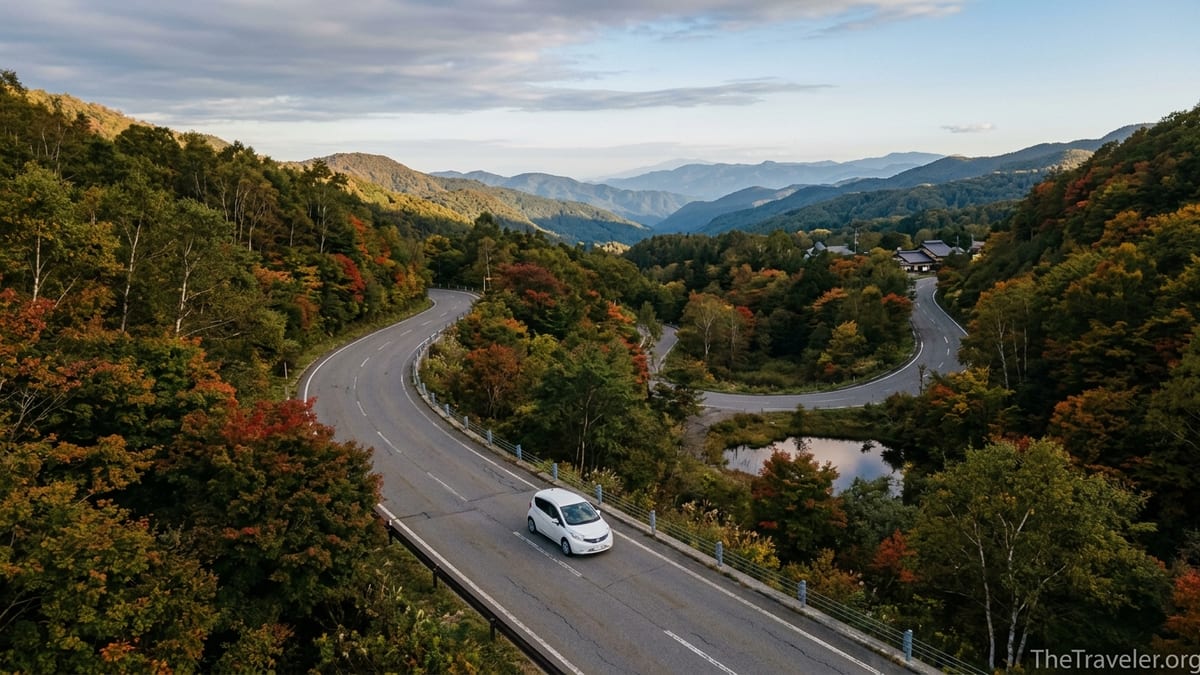
Hachimantai’s Aspite Line is one of Tohoku’s classic mountain drives: a 27 kilometre road that climbs the volcanic plateau between Iwate and Akita. In spring it is famous for snow walls rising several metres high along the roadside; in autumn the forested slopes turn vivid red and gold. The Aspite Line normally closes from around early November until mid April, reopening as a snow corridor drive when walls of snow line the route, before transitioning to a summer and autumn mountain road. Because closure dates vary slightly each year, you should always check local city or tourism websites just before travel.
Morioka is the natural base for this area. Major rental companies and JR-affiliated counters operate at Morioka Station, and you can be on rural roads within 20 to 30 minutes of picking up your car. A realistic two to three day circuit would see you drive the Aspite Line, stay in onsen areas such as Hachimantai Onsenkyo or the baths around Appi Kogen, then continue west into Akita for Nyuto Onsen. From Nyuto you can either loop back to Morioka via the expressway, or turn north toward Lake Towada for another mountain and lake segment.
Lake Towada and the Oirase Mountain Stream are perfectly suited to independent drivers. The lakeshore road, largely following national routes that encircle the crater lake, offers viewpoints, trailheads and boat piers that are much easier to reach by car than by relying on sparse buses. The Oirase stream road between Nenokuchi and Yakeyama loosely parallels the famous walking trail. Many travellers park at one trailhead, walk a section of the gorge and then use buses or a taxi to return to their car, something that is far simpler when you are not obliged to return to a distant train station the same day.
North of Towada, the roads fan out to small hot-spring villages and farm communities that see few foreign visitors. With a car, you can overnight at a rural onsen ryokan in the hills above Towada city, then detour through apple orchards and small roadside markets before rejoining the main roads to Hachinohe or Aomori. These are precisely the areas where driving gives you a meaningful advantage over rail: you can link attractions that would otherwise require time-consuming transfers, and stop impulsively for short hikes, viewpoints and local family-run inns with no station nearby.
Coasts, Castles and Countryside: Sanriku, Dewa Sanzan, Rural Akita and Aizu
The Sanriku Coast stretches along Iwate and northern Miyagi, a deeply indented shoreline of cliffs, coves and fishing towns. A combination of coastal expressways and older national routes like Route 45 now connects cities such as Hachinohe, Kuji, Miyako, Kamaishi and Kesennuma. Trains still run on parts of the coast, including sections of the Sanriku Railway, but service is limited and stations are often inland from the most photogenic spots. With a car, you can link places like Jodogahama Beach, Kitayamazaki’s cliffs and small tsunami museums in a single day that would be almost impossible using public transport alone.
Further west, Dewa Sanzan’s sacred mountains in Yamagata are another area where driving shines. The climbs to the shrines of Haguro, Gassan and Yudono involve narrow mountain roads, with bus services changing or stopping entirely outside peak pilgrimage season. By renting a car in Tsuruoka or Sakata, you can time your visits to avoid midday crowds, carry extra gear for hikes and stay at shukubo temple lodgings or country inns that may be far from any station. In late autumn and winter some mountain roads close or require winter equipment, so careful date checking and flexible planning are essential.
Rural Akita is best approached as a collection of valleys and lakes rather than a single loop. A classic route starts in Akita city, heads inland to Kakunodate’s samurai district, detours to the rural onsen of Nyuto and Tazawako, then continues north through farmland toward Oga Peninsula or Lake Towada. Without a car, linking these places would require shuffling between JR stations and local buses with varying frequencies. With one, you can combine Kakunodate’s historic streets, a lakeside hike at Tazawako and an evening soak in a rustic hot-spring ryokan in a single relaxed day.
Aizu in western Fukushima, often branded as the “samurai city” of Aizuwakamatsu, is the heart of the samurai heritage driving theme. Trains reach Aizuwakamatsu efficiently from Koriyama, but many of the most atmospheric spots, such as Lake Inawashiro’s quieter shores, rural sake breweries and tiny onsen clusters in the mountains, are easier by car. A smart pattern is to ride the Shinkansen to Koriyama, rent a car at the station and spend three days exploring Aizu, the Bandai Highlands and Urabandai’s lakes before looping back to Koriyama and returning the car.
Where to Rent Cars, One-way Drop-offs and Combining with Shinkansen
To make the most of self-drive segments without unnecessary highway mileage, start your rental at or near a major Shinkansen stop. In Tohoku, that usually means Morioka, Shin-Aomori, Aomori, Hachinohe, Akita, Sendai, Yamagata or Koriyama. JR-affiliated rental counters and national brands such as Toyota Rent a Car, Nissan Rent a Car and Times typically have offices just outside or inside station buildings, allowing you to step off the train and be on the road within roughly 30 to 45 minutes.
One-way rentals are widely available within the region and are central to efficient itineraries. For example, you can pick up a car at Morioka Station, drive via Hachimantai and Lake Towada, and drop it at Aomori or Hachinohe, avoiding a backtrack to Iwate. Similarly, some travellers start in Aizuwakamatsu or Koriyama and end in Yamagata or Sendai after crossing the mountains, then return to Tokyo by Shinkansen. Rental companies usually charge a one-way fee that increases with distance; for a short intra-prefecture move this might be modest, while a longer cross-region drop can be noticeably higher. When comparing prices online, ensure you have selected the correct pickup and drop-off offices so these fees are included in the quote.
If your focus is on rural driving and not on city traffic, consider renting at smaller intermediate stations rather than large urban centres. Ichinoseki, for instance, is a convenient place to pick up a car for exploring rural Iwate and southern Miyagi, while avoiding the congestion of Sendai city. Likewise, Hirosaki can serve as a quieter base for driving into the Hakkoda Mountains or central Aomori prefecture. The trade-off is that smaller offices may have less English support and a smaller vehicle fleet, so booking early is wise during peak seasons such as Golden Week, summer holidays and the October foliage period.
When building your trip, sketch the rail legs first using the Shinkansen as a high-speed spine, then bolt compact driving sections onto it. For instance, plan Tokyo to Sendai by Shinkansen, rent a car for three days on the Sanriku Coast, drop it back in Sendai, then continue by rail to Akita, where you rent again for a three-day inland loop. This keeps your total driving distance manageable, reduces the risk of fatigue and ensures that most of your time behind the wheel is spent on scenic or interesting roads rather than hours of expressway between large cities.
ETC Tolls, Parking and Fuel: Everyday Driving Costs
Japan’s expressways are toll roads, and Tohoku is no exception. Most rental cars in the region are equipped with an ETC reader, an electronic toll collection device that lets you pass through dedicated ETC lanes at toll gates without stopping. The tolls are then calculated automatically and either charged to a rental-specific ETC card or recorded for settlement when you return the vehicle. Driving the entire Tohoku Expressway from near Tokyo up to Aomori in a standard car would cost the equivalent of many thousands of yen in tolls, which illustrates why using Shinkansen instead for long hauls often makes sense.
For shorter driving sections, tolls are more manageable. A typical 100 kilometre hop on an expressway in Tohoku might cost on the order of a few thousand yen for a standard car, depending on the exact route and any discounts. Some local toll roads, such as smaller bypasses in Aomori, still do not accept ETC and require payment in cash or by card at a toll booth. Rental staff can show you the onboard ETC device at pickup and, if an ETC card is used, explain how charges will be settled. If you prefer, you can also request a car without an ETC card and pay cash at general lanes, though this means stopping at each toll gate and handling tickets.
Parking is generally easier and cheaper in Tohoku than in Tokyo or Kyoto. Many rural sights, trailheads and onsen towns provide free or inexpensive parking lots. In mid-sized cities such as Morioka, Aomori or Akita, expect to pay a reasonable hourly rate or a capped day rate at coin-operated lots, with clear digital displays and payment machines that accept coins and sometimes IC cards or credit cards. Because car ownership is common in rural Japan, accommodation almost always includes on-site or nearby parking; when in doubt, confirm with your ryokan or hotel while booking.
Fuel costs fluctuate, but petrol prices in Tohoku are typically similar to or slightly higher than the national average. You will find both full-service and self-service stations along major roads and near towns. Staff at full-service stations will usually handle the refuelling for you, while self-service pumps have clear pictograms and English prompts in many locations. Most rental contracts require you to return the car with a full tank, so plan a final fuel stop near your drop-off office; there is often a cluster of stations within a few kilometres of larger stations such as Sendai, Morioka and Aomori specifically for this purpose.
Seasonality, Winter Tires, Snow Driving and Mountain Closures
Season has a major impact on self-driving in Tohoku, especially in mountain areas such as Hachimantai, the Hakkoda range, Zao and Dewa Sanzan. Winter brings heavy snow to much of the region. Many high passes, including the Hachimantai Aspite Line and some roads toward Gassan, close from early November to mid or late April, reopening first as narrow corridors with high snow walls before fully clearing. Even in April and sometimes early May, roadside snowbanks can linger at higher elevations, and night-time temperatures may still drop below freezing.
Rental agencies in Tohoku routinely fit cars with winter tyres during the cold season, generally from late autumn into early spring. When booking between roughly late November and late March, confirm that your car will have studless snow tyres included in the rate; in Tohoku this is often standard rather than an expensive add-on. Chains are less common for visitors and are typically only necessary on particularly steep or remote roads, which cautious travellers should avoid in severe conditions.
If you are not experienced with snow driving, it is wise to structure winter trips so that your driving remains mostly on major roads and in lower valleys. Local drivers are used to snow, but conditions can change rapidly, with sudden whiteouts, icy patches and narrowed roadways where snowbanks encroach on the lane. In such circumstances, dropping a planned mountain detour and sticking to a lower-altitude route, or even returning the car early and using rail for the remainder, can be the safer choice. Planning shorter daily distances and building in buffer days improves your ability to adapt.
Spring and autumn are prime seasons for mountain roads, but they are also when closures and temporary restrictions are most common due to thawing, rockfall or early snowfall. Before heading into the hills, check fresh road information on local tourism or prefectural road websites, or ask at your accommodation or a nearby michi-no-eki roadside station. In summer, the main risk is dense fog on high passes and heavy rain during storm systems. Good practice is to start earlier in the day, when weather is generally more stable, and to allow extra time for slow driving in fog or rain rather than pushing to meet a tight city-to-city schedule.
The Takeaway
A thoughtful Tohoku road trip does not try to conquer the entire region in a single loop. Instead, it uses the Shinkansen for what it does best, then relies on short, intense bursts of self-drive freedom in the places where rail and buses fall short. Areas like Hachimantai, Lake Towada and Oirase, the Sanriku Coast, Dewa Sanzan, rural Akita, Aizu and remote onsen valleys reward the driver who is willing to leave the mainline and explore quieter byways.
By focusing on a handful of these regions, renting cars at practical Shinkansen gateways, understanding how ETC tolls, parking and fuel work, and respecting Tohoku’s demanding winter conditions, you can build an itinerary that feels adventurous rather than exhausting. The official themed driving routes give you a ready-made framework, but the real joy lies in the unscripted moments between their headline stops: a roadside farm stand, a small family-run ryokan in the hills, an empty viewpoint where the only sound is wind in the cedars. With the right preparation, the roads of Tohoku become less a logistics problem and more a central part of the experience.
FAQ
Q1. Do I really need a car to enjoy Tohoku, or can I rely on trains and buses?
Trains and buses work well for city-to-city travel and a few famous spots, but a car makes a big difference for mountain roads, rural onsen areas and the Sanriku Coast where public transport is infrequent and sights are scattered.
Q2. Where is the best place to start a Tohoku road trip if I am coming from Tokyo?
Most travellers ride the Shinkansen from Tokyo to a hub such as Sendai, Morioka, Shin-Aomori, Akita or Koriyama, then pick up a rental car right at the station to begin a regional loop rather than driving all the way from Tokyo.
Q3. How expensive are expressway tolls in Tohoku for a typical trip?
Toll costs vary by distance and route, but a short expressway leg of around 100 kilometres will usually cost the equivalent of a few thousand yen. Driving the entire length of the Tohoku Expressway from near Tokyo to Aomori in one go would be many times that, which is why combining Shinkansen with regional rentals is often more efficient.
Q4. Is it easy to rent a car with an ETC device and card?
Yes. Most rental cars in Tohoku have an ETC reader installed, and many agencies offer ETC cards that record your tolls for payment when you return the vehicle. At pickup, staff will show you how to use the device and explain how charges are settled.
Q5. What about parking in cities like Sendai or Aomori?
Parking in mid-sized Tohoku cities is generally straightforward, with coin-operated lots near stations and central districts. Rates are usually moderate compared with major metropolitan areas, and many hotels either include parking or offer discounted access to nearby lots.
Q6. Do rental cars in Tohoku automatically come with winter tyres?
During the snowy season, typically from late autumn to early spring, rental agencies in Tohoku usually fit cars with studless winter tyres as standard. It is still important to confirm this when booking if you plan to drive between roughly November and March.
Q7. How risky is it to drive on mountain roads in winter?
Conditions can be challenging, with snow, ice and reduced visibility. If you lack snow driving experience, it is safer to limit winter driving to lower-altitude roads, avoid night driving in the mountains, and be prepared to adjust your route or switch back to trains if weather worsens.
Q8. Can I do one-way rentals, such as picking up a car in Morioka and dropping it in Aomori?
Yes, one-way rentals within Tohoku are common. You might, for example, rent in Morioka for a Hachimantai and Towada loop and drop the car in Aomori or Hachinohe. A one-way fee usually applies and increases with distance, so factor it into your budget.
Q9. How many days should I allow for a self-drive loop around Hachimantai, Towada and Oirase?
Allow at least three full days to drive from a hub like Morioka through Hachimantai’s mountain roads, stay at an onsen, then continue to Lake Towada and explore the Oirase stream area without rushing.
Q10. Is it realistic to drive the whole Tohoku region in a single two-week rental?
It is technically possible but usually tiring and inefficient, with many hours spent on expressways. Most travellers find it more enjoyable to divide the region into two or three smaller driving areas and connect them by Shinkansen rather than keeping one car for the entire two weeks.