

Tohoku in winter is not a mild, postcard chill but a deep-freeze season of shoulder-high snowbanks, steaming outdoor hot springs and mountain roads buried under powder. For travelers who actually want winter, not just cool weather, it is one of Japan’s richest regions, combining atmospheric towns like Ginzan Onsen, iconic natural spectacles such as Zao’s “snow monsters,” remote hot spring villages, frozen gorges and serious ski terrain. This guide focuses on experiences that either require snow or are dramatically better with it, and explains how to build routes around photography, onsen, skiing or winter culture while staying realistic about temperatures, transport and daylight.
Understanding Tohoku Winter: Weather, Daylight and What It Means for Your Trip
Tohoku’s winter usually runs from late December into early March, with the most reliable deep snow from early January to late February. Inland basins and mountain areas in Yamagata, Akita and Aomori see extended periods where daytime highs hover around freezing and nights drop to minus 5 to minus 10 degrees Celsius, occasionally lower in cold snaps. Coastal cities such as Sendai may be a few degrees milder, but even there wet snow and icy sidewalks are common. Travelers used to temperate winters are often surprised by how quickly uncovered hands or wet socks become a problem once windchill is factored in.
Short daylight hours also reshape your sightseeing rhythm. Around midwinter, sunrise in much of Tohoku is close to 6:45–7:00 a.m. and sunset can be as early as 4:15–4:30 p.m. That leaves a compact window for photography on mountain passes, lakes and gorges before visibility drops. A traveler based in Yamagata City who wants to photograph Zao’s snow monsters, then transfer to Ginzan Onsen the same day, will find the practical shooting hours shrink once time for buses, ropeways and check-in is added.
Snow quality varies across the region. Areas facing the Sea of Japan, such as Akita and parts of Aomori, tend to get huge volumes of comparatively heavy, moist snow, which piles into impressive walls along roads and around onsen villages. Higher, inland ski resorts like Appi Kogen in Iwate often enjoy lighter, drier powder more suitable for skiing and snowboarding. When planning, assume that even if a city center looks manageable, side roads to onsen clusters or trailheads can be significantly colder and snowier than the nearest station.
Winter also affects your pace. Walking 500 meters from Ginzan Onsen’s bus stop to a riverside ryokan might be trivial in October but can take twice as long when you are dragging a suitcase through fresh snow at night. Leaving deliberate margin between transfers is not over-cautious in Tohoku; it is often the difference between an enjoyable evening bath and a stressful dash after a delayed train or bus.
Practical Winter Prep: Clothing, Footwear, Luggage and When Not to Drive
Warm clothing is essential, but how you layer matters as much as what you bring. A typical packing list for a week in January might include a moisture-wicking base layer, a light fleece or wool mid-layer, and a windproof, insulated outer jacket. In places like Zao Onsen or Nyuto Onsen, where temperatures frequently dip below freezing, travelers often appreciate a long down coat that covers the hips for extra warmth while waiting for buses or exploring on foot. Compact chemical hand warmers sold at convenience stores throughout Japan are useful in train station queues or during night photography sessions at snow festivals.
Footwear is where many visitors underestimate conditions. Smooth-soled sneakers become treacherous on compacted snow and ice. A better choice is a waterproof winter boot or hiking shoe with a defined tread and room for thick socks. In Ginzan Onsen, the main street is kept walkable but still slick, and you may find yourself shuffling cautiously between bridges for photos after dark. Simple slip-on traction cleats, which can be purchased online or at outdoor shops in Tokyo and Sendai, make an immediate difference when you are walking to a remote outdoor bath or climbing the stone steps around Lake Towada’s shrines.
Luggage strategy becomes critical once you add snowbanks and village lanes. Rolling a large hard suitcase along the snowy approach to a ryokan in Nyuto Onsen is tiring and noisy, especially in the evening quiet. Many visitors instead use Japan’s luggage forwarding services from Tokyo or Sendai to ship big bags to a city hotel, then travel around Tohoku with a 30–40 liter backpack or small duffel. This is particularly practical if you plan to combine a ski stay at a resort such as Zao Onsen Ski Resort or Appi Kogen with one or two remote onsen villages in the same trip.
Winter driving in Tohoku is only advisable for those already comfortable with snow and ice. Car rental desks in cities like Sendai and Morioka do offer vehicles fitted with winter tires, but that does not eliminate risks on narrow mountain roads prone to whiteout conditions and heavy drifts. Access roads to Nyuto Onsen, Oirase Gorge and some rural ski areas can experience closures or chain controls in midwinter. If you have never driven in deep winter, it is safer to rely on the rail network and connecting buses, particularly when visiting less urbanized prefectures such as Akita and Aomori where storms can move in quickly.
Snow Onsen Icons: Ginzan Onsen, Nyuto Onsen and Classic Winter Soaks
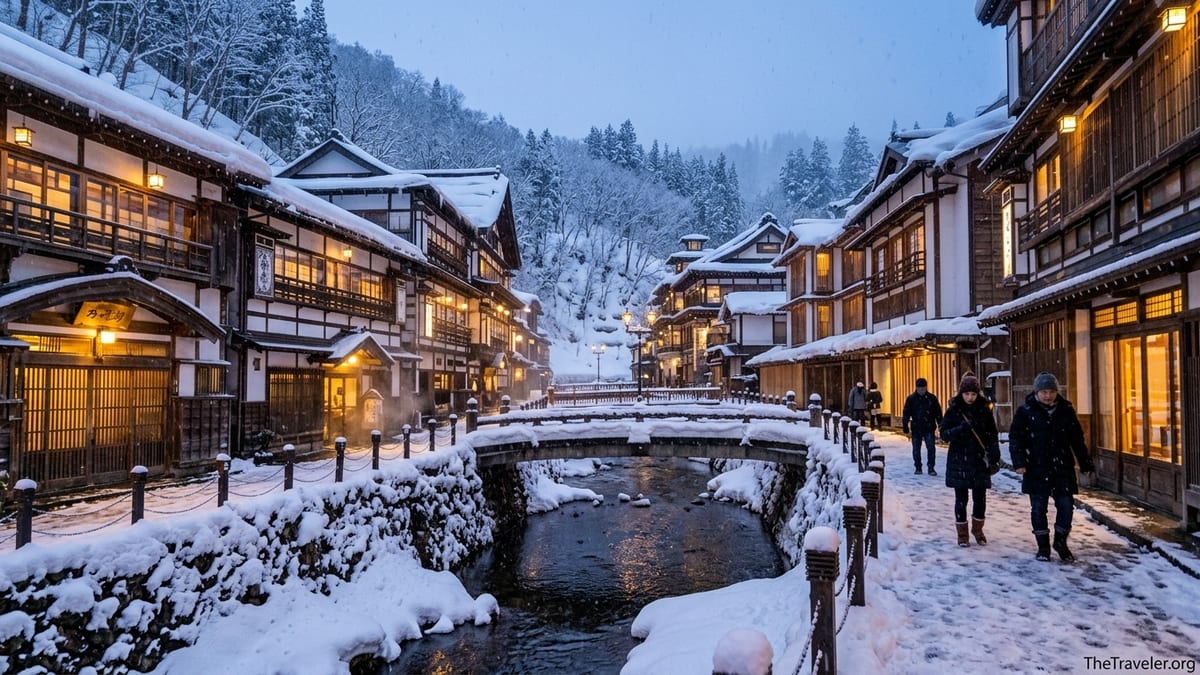
Ginzan Onsen in Yamagata Prefecture has become one of Japan’s most photographed winter hot spring towns for good reason. The compact valley is lined with multi-story wooden ryokan built in early 20th-century styles, their facades glowing with warm lanterns after dark while snow piles on the balconies and bridges. In January or February, guests often arrive on an afternoon bus from Oishida Station, step down into knee-deep powder and walk past the Ginzan River, which forms a central corridor through the town. Many ryokan provide umbrellas and in-house yukata robes, but in midwinter most visitors add their own down jackets on top for the short, chilly stroll to dinner.
Night photography is one of Ginzan Onsen’s principal draws. Street lighting along the river is relatively subdued, creating a nostalgic atmosphere, yet snow reflects enough ambient light to shoot without harsh flashes. Photographers typically carry a weather-sealed camera or keep gear under a scarf while hopping between vantage points on the bridges. Early evening, between 5 and 7 p.m., tends to be the sweet spot when lanterns are lit but day-trip crowds have thinned, giving overnight guests more space to enjoy the scene.
Further north in Akita Prefecture, Nyuto Onsen offers a different kind of winter experience: a cluster of rustic, largely self-contained ryokan scattered in forested foothills near Lake Tazawa. Here, the focus is on soaking in milky, mineral-rich water while snow stacks around wooden fences and half-buries changing huts. Properties such as Tsurunoyu Onsen are famous for open-air baths surrounded by high snow walls in January and February. Access typically involves travel by Akita Shinkansen to Tazawako Station and then a local bus or ryokan shuttle into the mountains, and visitors should check that their chosen inn’s shuttle is operating in winter, as not all nearby bus routes run year-round.
For travelers who want onsen immersion without long transfers, several ski resort towns provide excellent compromises. Zao Onsen combines sulfurous hot springs with direct access to ski lifts and the Zao Ropeway, while Aomori’s Hakkoda area has traditional lodges where guests soak after a day of backcountry skiing. In each case, booking two or three nights at the same ryokan or hotel allows you to enjoy snowy outdoor baths at different times of day, from morning steambaths while snowflakes drift down to late-night soaks under clear, starry skies.
Snow Monsters, Frozen Gorges and Ski Terrain: Where Winter Really Shines
Zao’s “snow monsters,” or juhyo, are among Tohoku’s most distinctive winter sights. These surreal shapes form when strong, moist winds coat the region’s evergreen trees in successive layers of rime ice and powder, eventually turning them into towering white figures spread across the slopes of Mount Zao. The Zao Ropeway and related lifts operate winter sightseeing courses that allow visitors who do not ski to ascend in gondolas and walk short, groomed routes among the snow creatures, particularly after sunset when special lighting events are held on selected evenings in January and February.
Skiers and snowboarders at Zao Onsen Ski Resort get an entirely different perspective. Long runs weave between the snow monsters near the top, where visibility can swing from bluebird clarity to near-whiteout depending on the weather. While there are beginner-friendly pistes lower down, the upper areas often feel best suited to intermediates comfortable with uneven terrain and limited contrast. Non-skiers should plan for extremely cold and windy conditions at the summit, with windchill making it feel much colder than the posted temperature, and dress more warmly than they would for walking through a city like Sendai on the same day.
On the Aomori and Akita border, Oirase Gorge and Lake Towada transform into a winter landscape of frozen waterfalls, crystalline icicles and silent snow-laden trees. Rather than walking the entire gorge, which can be challenging in deep snow, many winter visitors join guided tours that use buses to leapfrog between viewpoints where the river’s cascades freeze into photogenic curtains of ice. Hotels along the gorge, including well-known properties operated by national resort brands, host guests who want to combine short, guided snowshoe walks with indoor comforts and hot spring baths.
For serious skiers and riders, other Tohoku resorts supplement Zao. Appi Kogen in Iwate offers a modern, fairly compact ski area with groomed runs suitable for intermediates and often excellent powder. Geto Kogen in neighboring Iwate is known among enthusiasts for heavy snowfall and tree-skiing zones that appeal to confident riders. These resorts are typically accessed by Shinkansen to Morioka or local stations followed by resort buses, which are timed to train arrivals in winter and remove the need for visitors to tackle local roads after storms.
Winter Culture and Festivals: From Kamakura to Snow Lanterns
Tohoku’s winter is not only about landscapes but also about how local communities adapt to and celebrate the season. One of the most atmospheric events is the Hirosaki Castle Snow Lantern Festival in Aomori Prefecture, usually held over several days in February. During the festival, the grounds around the castle fill with hand-carved snow lanterns and small kamakura, or igloo-like snow huts, illuminated from within. Visitors stroll the park in the early evening, often wearing rented boots and padded coats, sipping hot amazake or regional apple drinks while fireworks reflect off the snow when weather allows.
Elsewhere, Yokote in Akita Prefecture hosts its own snow festival centered on kamakura. In residential neighborhoods and along riverbanks, families and volunteers shape large snow domes, then spend the evening inviting passersby inside to share warm drinks and roasted rice cakes. Entering a kamakura feels surprisingly cozy; the packed snow insulates against wind, and candlelight bounces off the white walls. English-language signage is limited, but visitors can learn basic etiquette from tourism information counters before heading out: remove shoes where indicated, greet the hosts and accept simple offerings as a sign of respect.
Smaller winter events dot the region. In Yamagata and Iwate, local onsen towns host torchlit night walks through snow corridors, while fishing communities along the Sea of Japan coast organize seafood markets where grilled squid, crab and hot soup help participants stay warm. For culture-focused travelers, a realistic itinerary might be to base in Hirosaki for the snow lanterns, add a night at a nearby onsen like Owani Onsen, then continue by train toward Akita for kamakura in Yokote and finally finish in a mountain hot spring area such as Nyuto Onsen.
These festivals do, however, depend heavily on weather and preparation. Deep snow is both the raw material and the backdrop, and warm spells can make structures slushy underfoot. Local organizers are used to managing these fluctuations, often rebuilding or reinforcing snow lanterns during the festival period, but attendees should wear waterproof boots and bring a small towel in case they step into a puddle or meltwater channel along the paths.
Riding the Winter Rails: Reliable Trains and Scenic Journeys
For most visitors, the backbone of a winter trip in Tohoku is the rail system rather than rental cars. The Tohoku Shinkansen connects Tokyo with major hubs like Sendai, Morioka and Shin-Aomori, maintaining high punctuality even in heavy snow thanks to snow-clearing equipment and dedicated crews. Branch lines such as the Yamagata Shinkansen to Yamagata and Oishida, or the Akita Shinkansen to Tazawako and Akita City, bring travelers closer to mountain hot springs and ski resorts. While occasional delays do occur during major storms, trains are generally more dependable than buses or private cars on the same routes.
Some lines double as winter sightseeing experiences. The Gono Line along the Sea of Japan coast, reachable from Akita and Aomori, offers sweeping views of snow-covered beaches and rugged waves, particularly when viewed from special tourist carriages that may include wider windows and local snack service. Inland, trains running toward Yamagata snake through rural valleys where apple orchards, rice fields and rivers disappear under blankets of snow, with small stations appearing like isolated outposts in a white landscape. Simply riding these lines for a segment of a day, then returning to a regional hub, can be as memorable as a more formal excursion.
Rail passes can make such travel more economical for visitors planning multiple long-distance journeys within a week or two. While specific products and conditions change over time, travelers often choose nationwide rail passes when combining Tohoku with other regions, or Tohoku-area passes when focusing purely on the northeast. In practical terms, a traveler flying into Tokyo might use a pass to take a Shinkansen to Sendai, transfer to a Yamagata-bound train for Zao Onsen, then travel onward to Oishida for Ginzan Onsen and finally continue toward Akita and Aomori before looping back.
Buses and local trains connect railheads to outlying winter destinations, but their frequency tends to drop off in the snow season, and some services do not operate to certain trailheads or remote onsen in winter. Before finalizing plans, check recent timetables for routes such as the bus from Tazawako Station to Nyuto Onsen or services along Oirase Gorge and Lake Towada. Building in backup options, such as an extra night in a nearby city or a willingness to switch a day trip to a closer onsen, keeps your trip flexible if a storm causes temporary suspensions.
Designing Routes for Different Winter Travelers
Travelers focused primarily on snow photography might design a route that strings together multiple visual highlights with generous time buffers. One example is to start in Yamagata City for access to Zao’s snow monsters, staying two nights to allow for one clear evening at the top of the ropeway. From there, continue to Ginzan Onsen for at least one night on a half-board plan, arriving early enough to photograph the town in late-afternoon daylight and again after dark. Then travel north to Aomori, using the city as a base for a guided winter excursion to Oirase Gorge and Lake Towada where frozen waterfalls and snowy riverbanks provide daytime shooting opportunities.
Onsen enthusiasts might instead prioritize slower stays in fewer places. An effective plan could begin with two nights in Nyuto Onsen, allowing time to sample multiple baths and perhaps purchase a local bathing pass that covers several inns in the cluster. Afterward, move to a city such as Morioka or Hirosaki for one night to break up transit, then spend two nights in Ginzan Onsen or another historic hot spring town. This approach limits the number of icy transfers while maximizing hours actually spent soaking in outdoor baths as snow falls around wooden eaves and pine trees.
Skiers and snowboarders can craft a loop focused on varied terrain. For instance, a rider might allocate three or four nights to Appi Kogen for groomed pistes and convenient lift infrastructure, then transfer to Zao Onsen for two or three nights where they can combine daytime laps between snow monsters with evening onsen sessions. Confident powder seekers could add a side trip to a resort like Geto Kogen, known for substantial snowfall, using winter shuttle buses to avoid driving mountain roads after storms.
Those drawn to winter culture and festivals can time their visits to February events. One route might include Hirosaki for the Snow Lantern Festival, followed by a hop to Akita or Yokote for kamakura, then a final stretch in Yamagata or Iwate to explore local markets, sake breweries and small snow festivals near onsen towns. Because exact festival dates change year to year and can shift around weekends, it is wise to check published schedules before fixing accommodation, particularly in smaller cities where rooms near the venue book out quickly.
The Takeaway
Tohoku rewards travelers who embrace winter rather than trying to work around it. Deep snow, frigid temperatures and early sunsets create both logistical challenges and extraordinary atmospheres that simply do not exist at other times of year. Whether you are weaving through Zao’s snow monsters, watching steam rise from an outdoor bath in Nyuto Onsen, or photographing lantern-lit streets in Ginzan Onsen, the key is to slow down your pace and plan around the realities of snowbound transport.
By aligning your route with your primary interest, whether that is photography, onsen, skiing or local festivals, you can avoid overextending yourself on icy transfers and instead spend more time in the very landscapes you came to see. Pack for warmth, favor trains over cars in heavy snow, leave wiggle room for storms, and treat winter conditions as part of the experience rather than an obstacle. Approached that way, a Tohoku winter trip becomes less about ticking off destinations and more about savoring moments of contrast: cold air on your face, hot water on your skin, silence in snow-covered forests and the glow of human life gathered close against the season.
FAQ
Q1. When is the best time to visit Tohoku for reliable snow?
The most reliable period for deep snow in Tohoku is generally from early January through late February, when inland and mountain areas have consistent accumulation and winter-only activities such as Zao’s snow monsters and many snow festivals are in full swing.
Q2. How cold does it actually feel in places like Ginzan Onsen and Nyuto Onsen?
Daytime temperatures often hover around freezing and nights can drop below minus 5 degrees Celsius, but windchill and dampness make it feel colder, especially when you are standing on bridges, waiting for buses or walking between baths in snowy onsen towns.
Q3. Do I need special boots for a Tohoku winter trip?
Yes, proper footwear makes a big difference. Waterproof winter boots or hiking shoes with good tread and space for thick socks are strongly recommended, and many visitors also bring slip-on traction cleats for extra grip on icy streets and paths around onsen and gorge viewpoints.
Q4. Is it safe for first-time winter drivers to rent a car in Tohoku?
It is possible but not advisable for most visitors. Mountain roads to places like Nyuto Onsen, Oirase Gorge and some ski resorts can be narrow, icy and affected by whiteouts or closures, so travelers without significant snow-driving experience are usually better off using trains and buses.
Q5. How reliable are trains in Tohoku during heavy snow?
Shinkansen and major regional lines are generally very reliable, with dedicated snow-clearing systems and crews. While severe storms can cause delays or occasional suspensions, trains still tend to be more dependable than buses or private cars on the same routes in midwinter.
Q6. Can I visit Oirase Gorge and Lake Towada on my own in winter?
You can, but winter conditions and reduced public transport make guided tours or hotel-organized excursions more practical. These often combine bus transfers with short walks to frozen waterfalls and scenic points, reducing the need to navigate snowy trails alone.
Q7. How many nights should I spend in a place like Ginzan Onsen?
One night is the minimum to experience the town after day-trippers leave and to enjoy dinner and breakfast at a ryokan, but two nights are ideal if you want unhurried photography in different lighting and more time to soak in the baths.
Q8. Are Tohoku ski resorts suitable for beginners?
Yes, many resorts such as Zao Onsen and Appi Kogen have gentle beginner slopes, rental shops and ski schools. However, beginners should stay on lower, better-sheltered pistes in poor visibility and avoid upper slopes near tree zones or snow monsters during storms.
Q9. What should I wear for outdoor winter festivals and snow lantern events?
Dress in layers with a warm, windproof coat, insulated waterproof boots, gloves, a hat and possibly a scarf or face covering. Standing or walking slowly in snow at night feels much colder than walking quickly through a city during the day.
Q10. Is it easy to combine multiple Tohoku winter highlights in one trip?
It is very feasible if you keep your route focused and allow enough nights. For example, a 7 to 10 day trip can realistically link Zao’s snow monsters, Ginzan Onsen, a ski resort stay, and either Nyuto Onsen or a Lake Towada and Oirase Gorge excursion using Shinkansen and regional buses.