


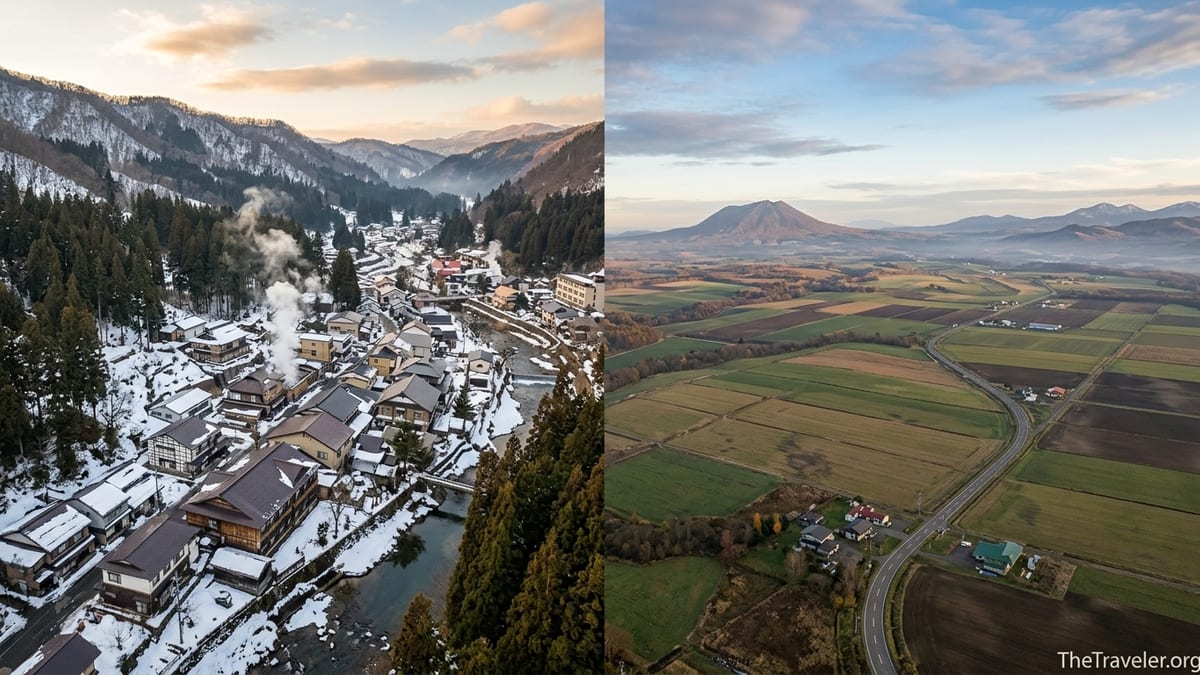
If you only have time for one northern Japan region, the choice between Tohoku and Hokkaido shapes your entire trip. Both offer heavy snow, steaming hot springs, soulful regional food and wide landscapes that feel far from Tokyo. Yet they are built for very different styles of travel. This guide looks at how they compare in practice, from rail passes and rental cars to ski resorts, onsen towns, food, festivals and seasonal highlights, then closes with clear recommendations by season and traveler type.
Access and Trip Structure: Tohoku as a Spur, Hokkaido as a Journey
For most international visitors, the decision quietly starts at Tokyo Station. Tohoku plugs directly into the capital via the Tohoku and Akita Shinkansen lines, with trains running frequently from early morning to late evening. You can leave Tokyo after breakfast and reach Sendai in around 90 minutes or Morioka in roughly 2.5 hours, staying entirely on high-speed rail. That makes Tohoku easy to bolt onto a broader Honshu itinerary that might also include Kyoto, Kanazawa or Hakone.
Hokkaido, by contrast, tends to work best as its own trip. Technically you can reach southern Hokkaido by the Hokkaido Shinkansen to Shin-Hakodate-Hokuto, but travelers usually continue by limited express train or bus to Sapporo or the main ski areas, which adds several more hours. In practice, most visitors fly from Tokyo’s Haneda or Narita to New Chitose Airport near Sapporo, often using domestic fares bundled into international tickets. That flight pattern encourages dedicating a week or more to circling the island rather than trying to squeeze Hokkaido into a few spare days.
The difference shows up in how people plan. A common Tohoku route might be five days using a JR East rail pass: Tokyo to Sendai, a side trip to Matsushima Bay and the temple complex at Yamadera, then north to Hirosaki or Hachinohe, ending back in Tokyo. Hokkaido itineraries are more likely to be stand-alone: for example, ten days split between Sapporo, the Niseko ski area, Otaru’s canal-side warehouses and the wildlife-rich Shiretoko Peninsula in the far east.
If you dislike flying, Tohoku clearly wins for convenience. If you are willing to add a domestic flight and want one large, slow arc through big landscapes, Hokkaido starts to pull ahead.
Getting Around: Rail vs Rental Car in Northern Japan
Within the region, Tohoku is still fundamentally rail-first. Shinkansen lines run north–south on the Pacific side, connecting major hubs like Fukushima, Koriyama, Sendai, Morioka and Shin-Aomori. From these, local JR lines and private railways reach smaller cities and notable sights, such as the Oirase Gorge near Lake Towada or the castle town of Hirosaki. For many routes, you can rely almost entirely on trains, with bus connections only for the last stretch into national parks or remote onsen villages.
Hokkaido’s rail network, by contrast, is thinner and was not designed around today’s tourism flows. Trains reach key cities such as Sapporo, Otaru, Asahikawa, Hakodate and Obihiro, and connect to some ski areas. But for places like eastern Hokkaido’s Akan-Mashu National Park or the wild Shiretoko Peninsula, public transport becomes infrequent and slow. Many visitors end up renting a car from Sapporo or New Chitose Airport, especially in summer and early autumn when driving conditions are most forgiving.
Costs reflect this structure. A regional rail pass for Tohoku can make sense even for a six- or seven-day trip if you plan to cover a lot of ground by Shinkansen. In Hokkaido, travelers often compare a limited-use rail pass plus a few days of car rental against relying on buses and occasional domestic flights. One common real-world pattern is to arrive in Sapporo by air, spend city days on foot and subway, then rent a compact car for a three- or four-day loop through Biei’s flower fields, Furano’s farm stays and the onsen around Asahidake.
For travelers nervous about winter driving on snow and ice, Tohoku again feels easier. You can reach heavy-snow destinations like Yamagata’s Zao Onsen or Aomori’s Hakkoda mountains almost entirely by train and ropeway, with only short, well-cleared bus rides. Hokkaido’s main highways are well maintained but distances are long, weather is more extreme in places like central and eastern Hokkaido, and local advice often suggests renting a car only if you have prior winter-driving experience.
Winter Scenery and Skiing: Powder Capital vs Snow Monsters
Both Tohoku and Hokkaido are serious snow country, but the physical experience differs. Hokkaido is globally famous for its dry, light powder, particularly in the Niseko, Rusutsu and Furano areas. The Niseko region alone hosts several interlinked resorts that receive generous snowfall each winter, with terrain that appeals to both strong skiers and beginners. Furano and Rusutsu draw those who want quieter slopes and deep snow conditions but slightly less of Niseko’s international party scene.
Tohoku’s winter personality is less about powder statistics and more about atmosphere. One emblematic sight is the "snow monsters" at Zao Onsen on the Yamagata–Miyagi border, where strong winds and freezing fog coat fir trees into ghostly white figures each mid-winter. Visitors ride a series of ropeways from the hot-spring town up to a plateau of frozen forms and can ski or snowboard past them before returning to soak in acidic hot spring baths in the valley below. Similar frost-coated tree formations appear on other Tohoku peaks such as Hakkoda, reinforcing the region’s reputation as Japan’s classic "snow country."
For pure ski infrastructure and resort choice, Hokkaido still has the edge. It offers a cluster of major ski destinations within a few hours of Sapporo, supported by dedicated winter shuttle buses from New Chitose Airport. Resorts cater heavily to international guests, so you will find English-language ski schools, rental shops with modern gear and a wide range of accommodation styles from self-catering apartments to high-end hotels.
Skiers who prefer a more local scene may gravitate to Tohoku. Places like Zao Onsen in Yamagata or Appi Kogen in Iwate are sizeable resorts with modern lifts and long runs, but they remain dominated by domestic visitors. Prices for lift passes and on-mountain meals can be noticeably lower than in Hokkaido’s most famous resorts, and you are more likely to share gondolas with Tokyo families or local high-school ski teams than with large overseas tour groups.
Onsen, Food and Cities: Subtle Flavors vs Bold Comfort
If soaking and eating are priorities, both regions deliver, but the mood is different. Tohoku is rich in classic hot spring towns that feel tucked into the mountains, such as Naruko Onsen in Miyagi, Nyuto Onsen in Akita and the wooden bathhouses of Ginzan Onsen in Yamagata. These are places where you might arrive at a small station, transfer to a winding bus ride, and emerge at a cluster of ryokan with steamy streets and traditional multi-course dinners.
Hokkaido’s onsen experiences often tie into big landscapes and resort travel. Noboribetsu, one of the island’s most famous hot spring areas, sits above a steaming volcanic valley with boardwalks and observation points. Many travelers visit as a side trip from Sapporo or as a rest day amid a ski-focused itinerary. Smaller onsen communities are scattered around the island’s national parks, including around Lake Akan and the Daisetsuzan range, where open-air baths look out over forests and river valleys.
On the plate, Tohoku leans toward sturdy comfort foods and regional specialties rooted in harsh winters. Travelers remember Aomori apples, Akita’s kiritanpo hot pot made with pounded rice, and beef from areas like Yonezawa or Maesawa, sometimes paired with local sake from small breweries. In coastal cities like Hachinohe or Kesennuma, morning seafood markets offer scallops, squid, seasonal tuna and local grilled mackerel, usually at prices that compare favorably to Tokyo.
Hokkaido’s food scene is broader known internationally, particularly for seafood and dairy. Sapporo is famous for miso ramen crowned with butter and sweet corn, while cities like Hakodate and Kushiro pride themselves on pre-dawn fish markets where visitors can build their own breakfast rice bowls from trays of uni, crab and salmon roe. The island’s cool climate supports artisanal cheese, ice cream and baked goods, so travelers often weave cafés and farm shops into summer road trips through Biei and Furano’s farmland.
Nature, National Parks and Cultural Heritage
For many visitors, Tohoku offers the deeper sense of historic Japan. This is where you find the temple complex of Hiraizumi in Iwate, with its gold hall and mossy Pure Land gardens, and the atmospheric samurai district in Kakunodate, Akita. Wooden temples at Yamadera cling to cliffs above the valley near Yamagata City, and the old castle grounds in Hirosaki turn crimson with autumn leaves. These sites are typically reached by train plus a short bus or walk, fitting neatly into a public-transport itinerary.
Hokkaido tells a different story, one of more recent Japanese settlement layered over older Indigenous culture. Outside the cities, you quickly hit wide-open spaces: marshlands full of cranes in Kushiro, volcanic lakes in Akan-Mashu National Park, and rugged coasts where foxes and deer appear near the roadside. The Shiretoko Peninsula, for example, is known for its dense brown bear population and remote hiking routes, with boat tours in ice season offering the chance to see sea eagles and drift ice along the Sea of Okhotsk.
From a national park perspective, Hokkaido is the more dramatic of the two, with multiple large protected areas that feel truly wild by Japanese standards. Daisetsuzan National Park in central Hokkaido, sometimes nicknamed "the roof of Hokkaido," offers volcanic plateaus, alpine flowers and long-distance hiking in summer, with ropeways giving day-trippers access to panoramic views. Tohoku’s national parks, such as Towada-Hachimantai or Bandai-Asahi, are smaller in scale but easier to dip into for a day from nearby cities via bus or local train.
Travelers who want to balance temples, old townscapes and landscapes in equal measure often find Tohoku more satisfying, particularly if they have already seen Kyoto and Nara but want to go deeper into Japan’s historical layers without crowds. Those who care most about feeling far from cities, watching wildlife and walking in big sky country tend to remember Hokkaido more vividly.
Ainu Culture, Festivals and Cherry Blossoms
One of the clearest cultural differences is the presence of Ainu heritage in Hokkaido. The Ainu are an Indigenous people of northern Japan, with their own language, spiritual practices and decorative motifs. Travelers can learn about this culture at dedicated museums and cultural facilities around the island, where craft demonstrations, music performances and interpretive exhibits explore both history and contemporary Ainu life. This gives Hokkaido a layer of cultural context that is distinct from the rest of Japan.
Tohoku, meanwhile, is famous for its powerful summer festivals that combine drumming, lanterns and floats. In August, the Aomori Nebuta Festival fills the streets with enormous illuminated floats, while Akita’s Kanto Festival sees performers balancing towering poles of paper lanterns on their hands and hips. Sendai’s Tanabata Festival decorates downtown arcades with huge paper streamers. These events are large enough that accommodation books out months in advance, but they remain more locally focused than many of Japan’s better-known city festivals.
Cherry blossoms are another major factor for spring travelers. Tohoku blooms later than Tokyo and Kyoto, so it is popular with repeat visitors who want a slower, less-crowded hanami season. Hirosaki Park in Aomori, built around a former castle, is one of Japan’s classic cherry blossom destinations, with petals filling moats and framing old stone walls. In contrast, much of Hokkaido sees its blossoms even later, with urban spots like Sapporo’s Maruyama Park and scenic locations like Matsumae’s castle grounds offering hanami into late April or early May.
For travelers planning a spring trip that starts in Tokyo, Tohoku’s timing aligns nicely. You might enjoy peak blossoms in the capital in late March or early April, then ride the Shinkansen north to catch the wave of pink as it climbs through Sendai to Hirosaki. Hokkaido’s later season works better for those whose holidays do not begin until mid or late April and who are happy to fly directly to Sapporo without weaving Tokyo and Kyoto into the same itinerary.
Overall Travel Difficulty and Who Each Region Suits
For many first-time visitors to Japan, Tohoku feels like a natural next step after the Tokyo–Kyoto core. English signage is solid on Shinkansen routes and in major stations, and staff at big-city hotels in places like Sendai or Morioka are accustomed to helping overseas guests. Once you branch into rural areas, English may be limited, but the structure of rail travel, clear timetables and simple transfers tends to keep the learning curve manageable.
Hokkaido is not inherently difficult, but it does assume a bit more independence, especially away from Sapporo and the main ski resorts. If you are comfortable renting a car, navigating with GPS and adjusting plans for weather, the island rewards you with flexibility and the ability to stay in farm inns, lakeside pensions and small coastal towns that buses might visit only a few times a day. Without a car, you will rely more on careful timetable reading, airport buses and pre-booked shuttles.
Budget is another soft dividing line. In both regions, you can keep costs down by choosing business hotels near stations and eating in local izakaya or noodle shops. However, Hokkaido’s most famous winter destinations, such as Niseko, have seen prices rise with international demand, including in accommodation, ski schools and restaurant bookings during peak weeks. Tohoku’s ski and onsen areas, while not cheap, often feel more aligned with domestic price expectations, especially outside of major holiday periods.
Sensitivity to crowds may also guide your choice. Tohoku’s distances from Tokyo psychologically filter out some visitors, so even popular spots can feel calmer than their equivalents in central Japan. Hokkaido’s key hubs, particularly Sapporo Snow Festival in winter and the busiest powder weeks, can feel more overtly touristy, though the island is large enough that you can still find quiet if you head to less famous corners.
Seasonal and Traveler-Type Recommendations
Instead of chasing one universal "winner," it makes more sense to match region to season and travel style. In winter, Hokkaido is hard to beat for skiers and snowboarders who prioritize deep, dry powder and a tight cluster of major resorts. Plan a trip centered on New Chitose Airport, splitting time between Sapporo and one or two ski areas connected by shuttle buses, and add a night or two at an onsen like Noboribetsu for recovery. Tohoku in winter is ideal for travelers who care more about mixed experiences: ride a Shinkansen from Tokyo, watch the snow monsters at Zao or the heavy snow around Hakkoda, and finish days with long soaks in atmospheric hot spring towns.
In spring, especially from late March through April, Tohoku usually wins if your trip starts in Tokyo. You can follow the northward march of cherry blossoms from the capital up to Sendai and Hirosaki, adding in cultural stops at Yamadera, Hiraizumi or Kakunodate. Hokkaido suits those arriving later, when Sapporo and Hakodate’s blossoms open as much of Honshu has already turned green.
Summer and early autumn highlight Hokkaido’s strengths. Temperatures are cooler than Tokyo, humidity is lower and long days invite road trips past flower fields in Furano and Biei, hikes in Daisetsuzan and wildlife watching in eastern Hokkaido. This is prime time for travelers comfortable with renting a car and who want wide landscapes, farm stays and lakeside cabins. Tohoku in summer is at its best if you aim for the great festivals in August or retreat into the mountains and coasts to escape the heat, combining hiking in areas like Towada-Hachimantai with evenings in rural onsen.
For cultural deep-divers, Tohoku remains the stronger choice in almost any season. Its layered history, rural temple complexes, local festivals and old hot spring towns create a sense of continuity with older Japan that complements rather than repeats Kyoto. For nature-first travelers who imagine an entire week of big skies, wildlife and long drives between small towns and onsen, Hokkaido offers a kind of spaciousness that is hard to find elsewhere in the country, provided you are willing to invest the time and logistics to reach it.
The Takeaway
When viewed through the lens of real-world travel rather than abstract comparison, Tohoku and Hokkaido are not rivals so much as different answers to the same question: how far north do you want to go, and how independently do you want to move once you get there. Tohoku slots neatly into a Shinkansen-based Japan itinerary starting and ending in Tokyo, rewarding those who enjoy slower cities, historic temples and onsen-heavy days, especially in winter and spring.
Hokkaido, on the other hand, makes most sense as a dedicated island journey built around a domestic flight, a longer stay and either a focus on powder snow or a rental-car loop through national parks and rural towns. It suits travelers who are happy to trade some convenience for wider horizons and who are comfortable with the idea that distances and weather can dictate the pace of the trip.
Neither region is inherently "better." If you want to add a few northern days to a classic Tokyo–Kyoto route and stay on rail, choose Tohoku. If you are ready to give northern Japan an entire vacation of its own, especially for serious skiing or wide-open summer landscapes, choose Hokkaido. In the end, you will likely leave whichever you pick with a new reason to return and explore the other.
FAQ
Q1. Is Tohoku or Hokkaido better for a first-time visitor to Japan?
For a first trip built around Tokyo and Kyoto, Tohoku is usually easier to add because the Shinkansen connects directly from Tokyo, allowing a few northern days without changing your overall structure. Hokkaido is better if you can dedicate most of your time to the island and are comfortable adding a domestic flight.
Q2. Which region is easier to explore without renting a car?
Tohoku is generally easier without a car, since Shinkansen lines connect major cities and many sights are reachable by train plus short bus rides. In Hokkaido, public transport works well between big cities and ski resorts, but more remote lakes, national parks and coastal areas are significantly more convenient with a rental car.
Q3. Where should I go for the best skiing: Tohoku or Hokkaido?
Hokkaido offers the widest choice of major ski resorts and is famous for light powder, especially around Niseko, Rusutsu and Furano. Tohoku has excellent, often less crowded resorts such as Zao Onsen and Appi Kogen, which appeal to those who want strong skiing combined with traditional onsen towns.
Q4. Which region is better for hot springs and traditional ryokan stays?
Both regions have memorable hot springs, but Tohoku tends to feel more traditional overall, with classic ryokan clusters such as Nyuto Onsen, Ginzan Onsen and Naruko Onsen. Hokkaido’s onsen are often linked to bigger landscapes and resort-style facilities, for example in Noboribetsu or around national parks.
Q5. How do winter travel conditions compare between Tohoku and Hokkaido?
Both regions see heavy snow, but Tohoku’s main winter destinations are usually straightforward by rail, which reduces the need to drive in icy conditions. Hokkaido’s highways are well maintained, yet distances can be longer and rural roads more exposed, making winter rental cars more suitable for drivers used to snow and ice.
Q6. Where will I find more cultural and historical sites?
Tohoku has more traditional temples, castles and old townscapes, such as Hiraizumi’s temple complex, Kakunodate’s samurai district and Hirosaki’s castle park. Hokkaido’s cultural focus is different, centering on Ainu heritage and the story of more recent Japanese settlement rather than on older feudal-era sites.
Q7. Which region is better for cherry blossom viewing?
Tohoku is often the better choice if you are starting in Tokyo, as its blossoms open later, letting you follow the season north from the capital to places like Sendai and Hirosaki. Hokkaido’s cherry blossoms bloom even later, so it suits travelers whose trips begin from mid to late April and can focus around Sapporo or Hakodate.
Q8. Is Hokkaido more expensive than Tohoku?
Every trip is different, but some of Hokkaido’s most famous winter spots, especially Niseko, can be noticeably more expensive for accommodation and ski services due to strong international demand. Tohoku’s cities and onsen areas often feel closer to domestic price levels, particularly outside of peak festival or holiday periods.
Q9. Which region is better suited to families with children?
Families who prefer simple logistics and rail travel often find Tohoku easier, with compact city centers and straightforward day trips from hubs like Sendai. Hokkaido works very well for families who are comfortable with rental cars and want a mix of ski resorts, wildlife experiences and spacious farm stays in summer or early autumn.
Q10. If I love nature and hiking, should I choose Tohoku or Hokkaido?
Both regions offer excellent hiking, but Hokkaido tends to feel wilder and more expansive, especially in national parks like Daisetsuzan or Shiretoko. Tohoku’s trails and mountain areas, such as those around Towada-Hachimantai or Bandai, are easier to fit into a rail-based itinerary and pair well with cultural sightseeing.